Featured Standard & Custom Industrial Modules
Precision-calibrated TFT-LCD displays optimized for embedded human-machine interfaces, medical monitoring, and automotive control units.






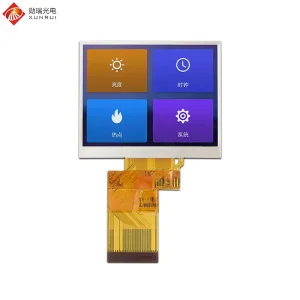

Global Landscape of 3.2-Inch TFT LCD Architectures
Analyzing the strategic transition from monochrome dot-matrix indicators to active-matrix thin-film transistor arrays in compact automation hardware.
The global demand for compact visual interfaces has shifted decisively toward 3.2-inch active matrix thin-film transistor (TFT) liquid crystal display (LCD) panels. While previously dominated by low-information-density segment displays or passive-matrix monochrome modules, modern embedded systems necessitate rich graphical user interfaces (GUIs), responsive touch integration, and crystal-clear rendering from extreme viewing angles. Headquartered in Shenzhen, China, Shenzhen Xunrui Optoelectronic Technology Co., Ltd. (XUNRUI) has emerged as an authoritative display manufacturing factory engineered to supply this mission-critical hardware globally.
A standard 3.2-inch TFT LCD panel bridges the dimensional gap between ultra-compact wear-level screens (below 2.0 inches) and full-size handheld displays (3.5 to 5.0 inches). Operating predominantly at resolutions of 240×320 (QVGA) or 320×480 (HVGA), this physical scale provides an ideal pixel pitch that maximizes legibility without exceeding the internal RAM thresholds of budget-conscious MCUs. By utilizing advanced In-Plane Switching (IPS) liquid crystal alignment alongside legacy Twisted Nematic (TN) modes, Chinese optoelectronic foundries deliver sub-millisecond response rates, high static contrast ratios, and extreme operating longevity tailored specifically to Tier-1 industrial buyers.
Sub-Pixel Aperture & Transmission
By leveraging enhanced mask designs and indium gallium zinc oxide (IGZO) or refined amorphous silicon (a-Si) transistor backplanes, our 3.2" cells achieve high aperture ratios, reducing required backlight power by up to 28% compared to industry baselines.
Sunlight Readability (Up to 1000 nits)
Our in-house LED rail packaging integrates high-efficiency Nichia or Osram solid-state diodes with dual-die reflectors. Coupled with high-efficiency optical diffusers, standard luminances can be boosted from 250 nits up to sunlight-viewable 1,000+ nits.
Industrial Ruggedization
Liquid crystals optimized for wide-temperature operation eliminate isotropic transitions and black-spots even at +85°C sustained exposure, ensuring cold-crank operation down to -30°C without sluggish frame transitions or latency spikes.
Technical Architecture: Electrical & Optical Matrix
Standard parameters for China-manufactured 3.2-inch TFT LCD modules available for OEM procurement and customization.
| Design Parameter | Twisted Nematic (TN) Standard | In-Plane Switching (IPS) Premium | Transflective Outdoor Variant |
|---|---|---|---|
| Screen Dimensions | 3.2 Inch Diagonal (Active Area ~48.60 × 64.80 mm) | 3.2 Inch Diagonal (Active Area ~48.60 × 64.80 mm) | 3.2 Inch Diagonal (Active Area ~48.60 × 64.80 mm) |
| Native Resolution | 240(RGB) × 320 (QVGA) | 320(RGB) × 480 (HVGA) / 240×320 | 240(RGB) × 320 (QVGA) |
| Viewing Angle (CR ≥ 10) | 6:00 or 12:00 Clock Target (60/60/60/50°) | All-Direction Free Viewing (85/85/85/85°) | All-Angle Symmetrical Transflective |
| Surface Luminance | 250 – 450 cd/m² (Customizable) | 350 – 1,000+ cd/m² | 200 nits (Internal) + Ambient Reflective |
| Supported Bus Interfaces | 8/16-Bit MCU 8080/6800, 3/4-Wire SPI | 3/4-Wire SPI, 16/18/24-Bit RGB, MIPI-DSI | MCU Parallel / Serial Peripheral Interface (SPI) |
| Integrated Driver ICs | ST7789V, ILI9341V, HX8347D | ST7796S, ILI9488, GC9307 | ST7789V / Custom Ultra-Low Power IC |
| Operating / Storage Temp | -20°C to +70°C / -30°C to +80°C | -30°C to +85°C / -30°C to +85°C | -30°C to +80°C / -40°C to +85°C |
Every module manufactured inside our Bao'an, Shenzhen fabrication facility undergo continuous mechanical and electrical characterization. The custom flexible printed circuit (FPC) can be tuned to match exact pin assignments, eliminating the need to redesign existing customer motherboards.
Technology Roadmap: Next-Generation 3.2" Displays
Discover the engineering trends moving the optoelectronics supply chain forward over the next 5-year industrial cycle.
1. Shift Towards High-Resolution IPS Cells
Traditional TN displays, while cost-efficient, suffer from grayscale inversion when viewed from off-axis vectors. The industrial segment is aggressively adopting IPS (In-Plane Switching) for 3.2" modules. IPS maintains stable chromatic fidelity regardless of user position, critical for wall-mounted controllers and mobile diagnostics.
2. Optical Bonding & Anti-Reflective Cover Glass
Air-gap lamination between cover lenses and polarizers causes secondary refractions, deteriorating sunlight readability. Our class 1,000 cleanrooms deploy full optical bonding (OCA/LOCA) alongside anti-reflective (AR), anti-glare (AG), and anti-fingerprint (AF) chemically etched glass treatments.
3. Advanced Touch Integration (PCAP & RTP)
Procurement teams can select between robust 4-wire resistive touch panels (RTP) optimized for thick-gloved industrial environments, or projected capacitive touch panels (PCAP) with I²C/USB multi-touch interfaces capable of rejecting moisture droplets and stray EMI signals.
Industrial Application Matrix for 3.2" Form Factors
How global procurement engineers deploy our custom 3.2-inch TFT modules across mission-critical hardware domains.
Handheld Industrial Testers & Scanners
Barcode verification tools, optical power meters, and acoustic sensors require compact, battery-efficient displays. Our 3.2-inch modules feature ultra-thin backlights (<2.4mm) with high refresh SPI/MCU interfaces that preserve battery lifecycle while delivering responsive refresh cycles.
Medical Infusion & Diagnostics
Syringe pumps, handheld pulse oximeters, and dental curing lights demand pristine visual fidelity and strict sterility tolerance. We build anti-microbial cover glass modules with sealed gaskets meeting IP65 front-panel washdown ratings.
Smart Building & Thermostats
HVAC control consoles, smart lighting knobs, and electronic access keypads benefit from 3.2" IPS panels paired with circular or square customized cover lenses. These support continuous 24/7 uptime without risk of pixel burn-in or color shift.
POS Terminals & Secure Payment
EMV-compliant countertop payment systems and mobile PIN pads require PCI PTS physical anti-tamper security. We integrate resistive or secure capacitive sensors built to register millions of touches without mechanical failure.
Shenzhen Xunrui: Cleanroom QA & Supply Reliability
From initial ingot cutting to post-FOG burn-in, explore our ISO 9001:2015 gate-controlled manufacturing framework.
Phase 1: Inbound Raw Material Verification (IQC)
All driver ICs (Sitronix, Ilitek, FocalTech) and bare LCD glass undergo spectroscopic and dimensional inspections. Substrates showing glass edge chips larger than 0.05mm or ITO resistance variances are rejected instantly at the dock.
Phase 2: High-Precision FOG Bonding & Seal
Automated Film-On-Glass (FOG) machines align flexible circuits with micron-level tolerances using anisotropic conductive film (ACF). Precision heating profiles ensure robust mechanical bonds capable of withstanding constant vibration.
Phase 3: Thermal Aging & Optical Outgoing QC
Finished assemblies are subjected to continuous 72-hour thermal stress cycles inside elevated temperature chambers (+50°C to +60°C). Our optical analyzers inspect 100% of panels for mura, pixel defects, chromatic coordinates, and touch linearity.
Frequently Asked Questions: 3.2" LCD Sourcing
Addressing direct technical and procurement inquiries asked by system architects and supply chain managers.
What are the key optical differences between 3.2-inch TN and IPS panels?
Can XUNRUI customize the FPC pinout and backlight brightness for small-batch projects?
Which bus interface is best suited for 3.2" LCDs: SPI, MCU 8080, or RGB?
How does optical bonding compare to tape-air bonding for outdoor equipment?
What certifications and anti-obsolescence policies are supported by your factory?
Industrial Displays & Touch Integrated Modules
Explore additional standard, sunlight-readable, and wide-format panels engineered in our cleanrooms for OEM integration.