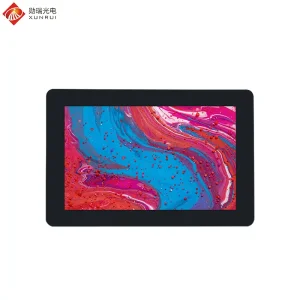
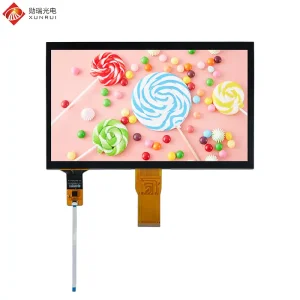
Precision Capacitive Touch Screen Solutions
Direct factory supply of high-definition, high-brightness capacitive touch panels featuring IPS viewing angles, wide temperature tolerances, and integrated controller architecture.








Capacitive Touch TFT LCD Industry Evolution & Trends
Navigating the paradigm shift from standard consumer glass to hardened, optically-bonded, intelligent Human-Machine Interfaces across high-reliability operating environments.
Optical Bonding & Anti-Reflective Stacks
Traditional air-gap lamination suffers from internal reflections (up to 8.5% light loss) and condensation traps. Industrial PCAP integration now demands direct optical bonding using liquid optical clear resin (LOCA) or sheet OCA.
- Eliminates internal surface reflection
- Dramatically elevates impact resistance (IK08–IK10)
- Prevents moisture ingress & thermal fogging
Electromagnetic Compatibility (EMC/EMI)
Variable frequency drives, brushless motors, and cellular radios introduce continuous conducted and radiated noise. Modern industrial CTP controllers rely on frequency hopping and mutual-capacitance algorithms.
- Robust operation under high electrical field interference
- High signal-to-noise ratio (SNR > 45dB)
- Compliant with EN 61000-4-6 conducted immunity
Water Rejection & Heavy-Glove Tracking
OEM hardware deployed outdoors or in operating rooms cannot afford false triggers caused by saline solutions, rain droplets, or thick protective industrial safety gloves.
- Differential sensing ignores static water pools
- Dynamic calibration for latex, nitrile, and leather gloves
- Cover lens thickness tuning up to 6.0mm chemically strengthened glass
Addressing Global Engineering & Sourcing Bottlenecks
B2B technical procurement managers, hardware system architects, and component supply managers require absolute predictability across life cycles, component reliability, and delivery pipelines.
| Procurement Challenge | Market Risk Exposure | XUNRUI Factory Engineering Countermeasure |
|---|---|---|
| Display Lifecycle & EOL | Consumer-grade consumer display glass suffers sudden end-of-life cycles (9-18 months), causing re-engineering costs. | Guaranteed 5 to 7-year form-fit-function product longevity with cross-pinning compatible controller architecture. |
| Sunlight Washout | Inadequate luminance (<400 nits) results in unreadable displays under direct solar exposure. | Custom high-efficiency LED arrays providing 800 to 1,500+ nits coupled with AG/AR surface coatings. |
| ESD & Mechanical Damage | Electrostatic discharges causing IC latch-up and cover lens micro-fracturing in field operations. | Contact ESD discharge up to ±8kV, Air discharge up to ±15kV; Corning Gorilla / Asahi Dragontrail cover glass customization. |
| Tooling & NRE Barriers | Rigid high-MOQ demands (>10k units) from mega-foundries prevent custom pilot product launches. | Flexible small-batch pilot validation runs (5 to 500 pcs) before entering standardized volume runs. |
Macro-Industry Optical Solutions
System-level capacitive touch panel configurations tailored to strict sector specifications, environmental stresses, and user operating demands.
Medical Diagnostics & Patient Monitors
Stringent compliance with medical electrical equipment standards requiring seamless, infection-resistant surfaces and non-touch galvanic isolation.
- Antimicrobial and Anti-Fingerprint (AF) chemical treatments
- Fluid rejection compatible with IPA and sodium hypochlorite wipe-down
- High-precision touch detection compatible with surgical nitrile gloves
Industrial Automation & Heavy Robotics
Continuous 24/7 duty cycles under wide thermal extremes, motor-induced harmonic vibrations, and aggressive electromagnetic environments.
- Extended operating range from -30°C to +85°C
- Industrial-grade touch controller ICs (Ilitek, EETI, Goodix)
- Integrated RS232, USB, or I²C touch bridge interfaces
Smart Metering & EV Charging Infrastructure
Unattended public kiosks, smart EVSE stations, and smart home dashboards exposed to vandalism, temperature spikes, and UV degradation.
- UV-resistant optical bonding films preventing screen yellowing
- Vandal-proof cover glass up to 4.0mm to 6.0mm with IK09 rating
- High-brightness backlights exceeding 1,200 nits with auto-dimming
Automotive & Transportation Cockpits
Next-gen commercial vehicle instrument clusters and telematics modules requiring rapid boot-up, wide aspect ratios, and superior viewing fidelity.
- AAS / IPS technology ensuring 89°/89°/89°/89° viewing angles
- Customized bar-type and curved capacitive glass shapes
- Automotive-grade components meeting thermal cycling profiles
End-to-End Quality Gates & Global Compliance
Our Shenzhen manufacturing hub follows a zero-defect production methodology. Every capacitive touch display undergoes systematic evaluation across five specialized cleanroom inspection stages.
IQC Raw Material Verification
100% incoming optical microscope inspection of raw glass substrates, touch controller ICs, LED backlight dies, and precision FPC ribbon flex cables.
FOG & COG Bonding Under Aging
High-precision automated anisotropic conductive film (ACF) thermo-compression bonding for Chip-on-Glass and Film-on-Glass configurations with thermal stress verification.
Optical Bonding & Alignment
Vacuum-assisted bubble-free cleanroom lamination of projected capacitive sensors to cover glass, followed by high-pressure autoclave curing.
Full Thermal Burn-In & OQC
Final multi-point touch coordinate accuracy mapping, linearity assessment, high/low-temperature operational burn-in (-20°C to +70°C), and static ESD validation before hermetic packing.
Next-Generation Technology Roadmap
Continuous innovation in high-transmittance touch materials, low-power display backlights, and embedded intelligence for forward-looking smart devices.
In-Cell & On-Cell Touch Integration
Eliminating discrete touch sensor substrates by depositing ITO sensing matrices directly onto the TFT color filter glass. This significantly reduces overall module thickness, decreases power loss, and sharpens visual clarity.
Haptic Feedback & Force Sensing
Integrating localized piezoelectric actuators directly beneath the capacitive frame. This provides confirmed mechanical tactile confirmation for critical inputs in industrial switches, vehicle dashboards, and surgical cockpits.
Mini-LED Backlighting Integration
Transitioning high-brightness panels to Mini-LED dynamic full-array local dimming (FALD). This yields 1,000,000:1 contrast ratios and up to 2,000 nits peak luminance while cutting backlight power consumption by up to 35%.
Frequently Asked Questions (FAQ)
Technical guidance and commercial parameters for hardware architects and procurement teams.
What are the core technical differences between PCAP and Resistive touch TFT LCDs?
Can XUNRUI customize the cover glass thickness, shape, and optical surface treatments?
How does optical bonding compare to tape/air-gap bonding in industrial environments?
What touch controller ICs and communication interfaces are supported?
What is the MOQ and development lead time for custom capacitive touch display modules?
High-Performance TFT Touch Display Assemblies
Explore additional standard and custom capacitive touch modules engineered for harsh operating environments, ultra-wide viewing angles, and long product life cycles.