
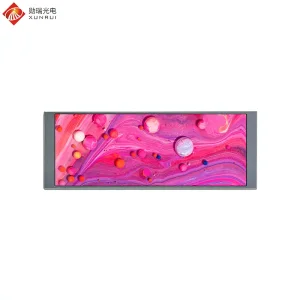
MIPI / 280×1424

Engineering-driven optoelectronic manufacturing linking Shenzhen R&D foundries with Ho Chi Minh City’s smart hardware, tier-1 electronics manufacturing service (EMS) hubs, and Southeast Asian export corridors.
Engineered for next-generation Human-Machine Interfaces (HMI), rotary IoT dials, automotive instrument clusters, and digital edge shelves deployed across Ho Chi Minh City automation parks.


Strategic deployment of specialized TFT LCD form factors within the Saigon Hi-Tech Park (SHTP), Binh Duong manufacturing belts, and Dong Nai automation clusters.
Over the past decade, Ho Chi Minh City (HCMC) and its contiguous industrial hinterland—spanning the Saigon Hi-Tech Park (SHTP) in Thu Duc City, the Vietnam-Singapore Industrial Parks (VSIP I, II, and III) in Binh Duong, and the Amata and Bien Hoa Industrial zones in Dong Nai—have transformed into one of the most prolific advanced electronics manufacturing corridors in the Asia-Pacific region. As global OEMs, Tier-1 Electronic Manufacturing Services (EMS), and specialized ODM enterprises implement "China+1" diversification strategies, the Southern Key Economic Zone of Vietnam has experienced exponential demand for non-commodity optoelectronic sub-assemblies. In particular, conventional 4:3 and 16:9 rectangular displays are increasingly being replaced by specialized Circular (Round), Ultra-Wide Stretched (Bar), and Square TFT LCD modules designed to integrate seamlessly into next-generation industrial architectures.
The procurement environment in Ho Chi Minh City is uniquely dual-faceted. On one side, multinational contract manufacturers assembling industrial IoT gateways, telecom base stations, and automotive telematic consoles require displays that withstand aggressive sub-equatorial environmental stressors—specifically continuous ambient humidity oscillating between 75% and 95% RH, coupled with thermal fluctuations exceeding 40°C in outdoor or non-conditioned manufacturing spaces. On the other side, an agile ecosystem of local Vietnamese engineering firms and consumer hardware startups is pioneering intelligent appliances, modern two-wheeler digital clusters, and commercial automation platforms. These systems demand rapid-turnaround customization: atypical aspect ratios, customized cover lenses with integrated anti-reflective (AR) and anti-fingerprint (AF) surface chemistry, and specialized capacitive touch controller tuning that eliminates false touches caused by condensation or sweat.
Widely adopted by consumer electronics and smart thermostat manufacturers in SHTP and Binh Duong. Circular TFT LCDs (from 1.28" to 4.0") are paired with precision optical rotary encoders, establishing intuitive, premium human-machine interfaces for high-end HVAC, washing machines, and luxury audio controls.
Deployed extensively across Ho Chi Minh City’s modern retail chains, automated warehousing facilities, and public transit terminals. Stretched strip LCDs (such as 6.86", 6.9", and 12.3") fit constrained shelf edges, 1U/2U server racks, and secondary dashboard information bars without requiring structural chassis redesigns.
Meeting the architectural demand for 86mm-box standard smart home wall switches, security access panels, and industrial elevator displays. Symmetrical 1:1 aspect ratio square modules (e.g., 3.4", 3.95", and 4.0") maximize visual canvas area while adhering strictly to standard modular enclosure dimensions.
Comprehensive breakdown of specialized manufacturing processes required to produce reliable circular, bar, and square liquid crystal assemblies.
The production of non-standard form factor TFT LCDs presents complex photolithographic, mechanical, and electro-optical challenges. Standard liquid crystal production lines are optimized for rectangular mother glass panels (such as Gen 4.5 or Gen 5.0). Realizing a circular or extreme aspect-ratio strip display requires deep expertise in either native mask layout design or precision picosecond laser scribing and specialized liquid crystal sealing.
In traditional Circular TFT LCD modules, signal routing around the perimeter of the active area cannot follow the orthogonal rows and columns of typical matrix addressing. Our foundries implement advanced Gate-in-Panel (GIP) architecture, integrating row driver circuits directly onto the glass substrate periphery. This eliminates massive external source and gate IC fanouts, reducing the border bezel width to sub-millimeter tolerances. Furthermore, circular scribing introduces extreme stress concentration vectors at curved edges; we apply high-frequency laser chamfering followed by UV-curable polymer edge passivation to eliminate micro-cracks and prevent micro-delamination under thermal cycling shock.
For Stretched Bar (Strip) Displays, light guide plate (LGP) engineering is equally critical. In extreme aspect ratios (such as 16:3 or 32:9), standard side-edge LED backlights suffer from severe luminous attenuation and severe center-to-edge color temperature drift. Our high-nits strip displays utilize bespoke micro-dot laser-etched light guides combined with dual-brightness enhancement films (DBEF). This yields optical uniformity ratings exceeding 85% across the entire active surface, paired with solid-state constant-current LED drivers designed to suppress electromagnetic interference (EMI) in high-voltage industrial enclosures.
| Form Factor | Common Diagonal Sizes | Native Resolution | Panel Technology | Typical Interface | Target Luminance | Ideal Application Scenario |
|---|---|---|---|---|---|---|
| Circular | 1.28", 1.8", 2.1", 3.4", 4.0" | 240×240, 360×360, 480×480, 720×720 | IPS (All-Viewing Angle) | SPI, QSPI, MIPI DSI (30-pin) | 350 to 800 cd/m² | Rotary UI knobs, smart thermostats, EV dials, avionics gauges |
| Stretched Strip | 6.86", 6.9", 8.8", 12.3", 14.9" | 480×1280, 280×1424, 1920×720 | IPS / Sunlight Readable | MIPI 40-pin, LVDS, eDP (60-pin) | 400 to 1200 cd/m² | Automotive telematic strips, retail shelf-edge digital tags, 1U rack servers |
| Square | 1.54", 3.4", 3.95", 4.0", 5.0" | 240×240, 480×480, 720×720 | IPS / Transflective | RGB 50-pin, SPI+RGB, MIPI | 400 to 1000 cd/m² | Standard 86-type smart switches, elevator control boxes, HVAC consoles |
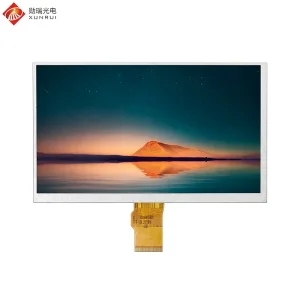
| Standard HMI | 4.3", 5.0", 7.0", 9.0", 10.1" | 480×272, 800×480, 1024×600 | TN & IPS wide temp | RGB 50-pin, LVDS, MCU 8/16-bit | 250 to 1000+ cd/m² | Factory PLC terminals, heavy equipment, medical diagnostics, EV chargers |
How advanced optical bonding and specialized liquid crystal chemistries prevent internal condensation, polarization fading, and solar blackening.
Standard commercial-grade TFT displays deployed in equatorial environments like Southern Vietnam experience accelerated degradation if not specifically hardened against moisture ingress, UV radiation, and high operational temperatures. When ambient humidity remains consistently above 80%, displays assembled using conventional Air Gap (perimeter tape) bonding develop internal moisture condensation on the inner surface of the cover glass during rapid diurnal cooling cycles. This condensation induces optical scattering, reduces contrast ratios from 1000:1 to less than 100:1, and corrodes conductive Indium Tin Oxide (ITO) traces on the Projected Capacitive (PCAP) sensor.
To mitigate this failure mechanism, our manufacturing protocols emphasize full Optical Bonding (OCR - Optically Clear Resin / LOCA - Liquid Optically Clear Adhesive). By filling the interstitial air gap between the TFT polarizer and the chemically strengthened cover glass with an index-matched optical adhesive (refractive index $n \approx 1.49$, matching soda-lime and aluminosilicate glass at $n \approx 1.51$), internal reflections are reduced by up to 92%. More importantly, the vacuum-cured polymer matrix completely eliminates internal voids, rendering moisture penetration physically impossible.
Furthermore, our direct-sunlight-readable modules integrate Wide-Temperature Liquid Crystal Formulations with high clearing points ($T_{ni} > 105^\circ\text{C}$). Standard liquid crystal molecules transition into an isotropic liquid state when exposed to continuous direct solar radiation and internal LED backlight thermals, causing irreversible dark spots (solar blackening). Our industrial-grade IPS fluids maintain full birefringent modulation across a $-30^\circ\text{C}$ to $+85^\circ\text{C}$ operating envelope, ensuring zero display blackouts on outdoor charging posts and motorcycle telematics navigating Ho Chi Minh City traffic.
Index-matched liquid silicone adhesive eliminates interstitial air layers, prevents dew formation during rainy seasons, and reinforces mechanical shatter resistance up to IK08 impact ratings.
Prevents isotropic phase-change blackening under intense solar radiation, guaranteeing crisp informational readouts on outdoor IoT kiosks and industrial monitoring stations.
Pre-tuned firmware within focal touch controller ICs (Goodix, FocalTech, Ilitek) suppresses water-drop capacitance shifts, enabling uncompromised operation with wet hands or heavy industrial gloves.
Bilateral supply chain resilience, multimodal transit options, Form E trade compliance, and small-batch trial prototyping.
Global procurement executives and manufacturing engineers managing production facilities in Vietnam understand that speed and regulatory compliance define project success. Shenzhen and Dongguan form the undisputed global epicenter of optoelectronic component engineering, driver board fabrication, and optical bonding automation. By coupling our Shenzhen manufacturing base with streamlined cross-border logistics lanes into Ho Chi Minh City, we provide international and Vietnamese enterprises with the agility of local supply combined with the scale and cost efficiencies of China’s mature component supply chain.
Our logistics architecture supports three distinct delivery lanes configured to balance time-to-market against landed freight costs:
All export consignments are supported with complete RCEP and ACFTA (Form E) Certificates of Origin, granting qualified Vietnamese assemblers preferential zero-tariff or reduced-tariff import classifications. Modules comply strictly with RoHS 2.0, REACH, CE, and FCC directives, featuring complete component traceability from glass fab down to driver IC wafer batch numbers.
Consult directly with our optoelectronic engineers. From initial 2D/3D mechanical drawings and FPC routing to small trial runs (5–500 pcs), we deliver samples validated for mass production.
Engineered for high reliability across smart wearables, industrial instrumentation, outdoor power equipment, and embedded automation consoles.







In-depth responses from our senior display engineers and international trade specialists for procurement teams operating in Vietnam.
Whether you are engineering a rotary IoT knob for an intelligent home appliance, an ultra-wide bar display for smart retail, or a sunlight-readable HMI for an outdoor EV charger in Vietnam, our optoelectronics engineering team is ready to evaluate your mechanical drawings, interface requirements, and environmental specifications.