
High-Demand Display Modules & Assemblies
Selected industrial-grade TFT LCD solutions ready for prototype sampling, custom FPC pin-out routing, and full mass production.
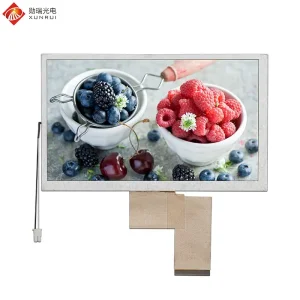







The Global Commercial & Industrial Status of 4-Inch Display Modules
Analyzing the pivotal evolution of 4.0-inch to 4.3-inch display architectures across edge computing, industrial automation, and smart human-machine interfaces.
In modern industrial hardware engineering, the 4-inch display class—encompassing 4.0-inch square (1:1), 4.0-inch rectangular (16:9 / 5:3), and neighboring 3.5 to 4.3-inch form factors—has established itself as the indispensable standard for compact Human-Machine Interfaces (HMIs). Once dominated by monochrome segmented LCDs and passive matrix STN panels, the global transition to high-definition Thin-Film Transistor Liquid Crystal Displays (TFT LCD) with In-Plane Switching (IPS) technology has redefined operator efficiency and spatial economics across factory floors, medical facilities, and smart building infrastructures.
According to current optoelectronic market intelligence, the demand for custom 4-inch display assemblies is accelerating at an annualized CAGR exceeding 8.4%. This shift is fueled primarily by the democratization of 32-bit embedded microcontrollers (such as STM32, ESP32-S3, NXP i.MX RT series) equipped with hardware graphics accelerators. These embedded engines allow engineers to render sophisticated graphical user interfaces (LVGL, TouchGFX, Qt for MCU) directly onto compact 480×480, 480×800, or 720×720 pixel matrices without incurring the thermal overhead or component cost of full single-board computers.
However, tier-one global OEMs increasingly encounter supply friction when sourcing 4-inch display stacks. Consumer-grade panels produced for legacy mobile devices suffer from abrupt end-of-life (EOL) cycles, volatile component allocations, fragile mechanical tolerances, and narrow operating temperatures. Shenzhen Xunrui Optoelectronic Technology Co., Ltd. (XUNRUI), founded in 2016, resolves this procurement vulnerability by delivering industrial-grade custom 4-inch display solutions backed by 5-to-7-year panel longevity commitments, verified ISO 9001 and ISO 14001 quality systems, and complete mechanical-electrical customization.
Form Factor Optimization
The 4.0" square (e.g., 480×480, 720×720) and 4.0" portrait formats provide optimal physical dimensions for standard 86-type wall switch boxes, DIN-rail instrumentation, and portable diagnostics without bezel overhang.
Silicon & BOM Economics
By fitting within low-cost memory envelopes (integrated PSRAM/SRAM), 4-inch display panels eliminate costly external SDRAM chips while offering vivid 24-bit true-color visualization and responsive touch response.
Harsh Environment Survivability
Unlike commercial mobile screens, industrial custom 4-inch panels leverage wide-temperature liquid crystal fluids (-30°C to +85°C), robust ESD protections (>8kV contact), and anti-corrosive FPC flex circuit substrates.
Technical Architecture & Optical Specifications
A rigorous examination of panel physics, optical bonding mechanics, interface protocols, and optical performance criteria.
Achieving optical legibility and electrical stability in field-deployed devices requires systematic matching of the display panel stack to the application's ambient stressors. Below is an engineering benchmark comparing the foundational display technologies utilized in the custom 4-inch category:
| Evaluation Parameter | Industrial IPS TFT (All Viewing) | Standard TN TFT (Directional) | High-Brightness Sunlight Readable | Transflective Hybrid TFT |
|---|---|---|---|---|
| Viewing Angle (U/D/L/R) | 85° / 85° / 85° / 85° (Symmetric) | 50° / 70° / 70° / 70° (Inversion Risk) | 85° / 85° / 85° / 85° (IPS Matrix) | 65° / 65° / 70° / 70° |
| Typical Luminance (Nits) | 350 to 500 cd/m² | 250 to 350 cd/m² | 800 to 1,500+ cd/m² | 200 nits internal + ambient gain |
| Contrast Ratio | 800:1 to 1200:1 | 400:1 to 500:1 | 900:1 to 1000:1 | 150:1 (Reflective) / 500:1 (Trans) |
| Operating Temperature | -20°C to +70°C (Std) / -30°C to +80°C | -20°C to +70°C | -30°C to +85°C (Enhanced fluid) | -20°C to +70°C |
| Primary Interface | RGB 24-bit / MIPI-DSI / SPI+RGB | MCU 8080 (8/16-bit) / SPI | RGB 24-bit / LVDS / MIPI | SPI / MCU 8-bit / RGB |
| Outdoor Direct Sunlight | Moderate (Washed out under >10k lux) | Poor (Not recommended) | Superior (>1000 nits + AR film) | Excellent (Utilizes direct sun) |
Optical Bonding vs. Air Bonding: Eliminating Parallax & Internal Reflections
In outdoor or high-vibration applications, the mechanical boundary between the protective cover lens and the 4-inch TFT polariser dictates optical clarity. Traditional air gap bonding uses double-sided foam tape around the perimeter. While cost-effective, the refractive index mismatch between air (n=1.0) and glass (n=1.52) induces internal reflections that consume up to 8.5% of display luminance while allowing condensation under sudden temperature swings.
Shenzhen Xunrui Optoelectronics deploys full Optical Clear Adhesive (OCA) and Optical Clear Resin (OCR/LOCA) lamination processes inside ISO Class 6 cleanrooms. Optical bonding fills the dielectric void entirely, achieving:
- Sunlight Contrast Enhancement: Reduces surface reflectance from ~9% down to less than 0.4%, preserving contrast in high ambient light without excessive backlight overdriving.
- Mechanical Shock Dissipation: Distributes external kinetic energy across the entire module surface, raising impact resistance up to IK08 or IK10 standards with tempered cover glass.
- Total Condensation Prevention: Eliminates internal air volumes, preventing moisture ingress and fogging in sub-zero or humid marine environments.
End-to-End Customization Engineering Pipeline
A gate-controlled, 6-stage workflow engineered to de-risk OEM development from initial CAD concept through high-volume mass production.
Demand & Environmental Feasibility
Evaluation of enclosure constraints, interface protocols (SPI, MCU, RGB, MIPI, LVDS), optical requirements, thermal ranges, and power budgets.
Engineering Drawing & FPC Routing
Issuance of comprehensive 2D/3D CAD drawings specifying mechanical envelope, active area, FPC pinouts, impedance lines, and connector targets.
Sample Prototyping & Calibration
Fabrication of physical engineering samples using calibrated FOG (Flex-on-Glass) alignment; fine-tuning gamma curves, initial VCOM, and touch firmware.
Small-Batch Pilot Run (5–500 Pcs)
One-time low-volume pilot run enabling system-level qualification, automated optical inspection calibration, and drop-testing without huge capital risk.
Mass Production (MOQ 1,000+ Pcs)
Full volume fabrication under automated cleanroom lines. High-speed COG/FOG bonding machines ensure precise pitch tolerances down to micron levels.
5-Checkpoint Quality Assurance
Rigorous IQC incoming check, polarizer surface inspection, FOG hot-bar bonding aging, 100% finished display burn-in, and OQC export release.
Macro Industry Solutions & Localized Use Scenarios
Purpose-built display and touch assemblies calibrated for demanding operational requirements across global industry verticals.
Smart Home & Building Automation
4.0-inch 480×480 and 720×720 square TFT displays are the benchmark standard for wall-mounted smart thermostats, luxury light switches, and scene controllers fitting EU/US electrical gang boxes.
- IPS 85/85/85/85 all-angle viewing
- 2.5D curved decorative cover glass
- Anti-fingerprint (AF) oleophobic coating
Industrial Test & Field Instrumentation
Handheld gas analyzers, digital multimeters, optical calibrators, and field communication terminals require rapid refresh rates, high pixel density, and resilience to dropped tools and static discharge.
- Glove & water-droplet touch support
- Enhanced ESD protection (15kV Air)
- Rugged 1.1mm to 2.0mm tempered glass
Medical Devices & Infusion Pumps
Medical monitors demand absolute chromatic accuracy, high signal-to-noise touch controllers immune to clinical electrocautery noise, and surfaces that endure harsh disinfectant wipe-downs.
- Anti-microbial, anti-glare etchings
- Strict medical 7-year life support
- High contrast for subtle vital cues
EV Charging Infrastructure & Metering
Outdoor Level-2 and DC Fast Charging payment user interfaces encounter relentless solar exposure, thermal cycling from blistering summers to freezing winters, and potential vandalism.
- 1,000 to 1,500 nits sunlight readability
- Optical bonding prevents solar yellowing
- Operating range: -30°C to +85°C
Access Control & Biometric Terminals
Facial recognition panels, video door intercoms, and biometric door locks demand rapid MIPI-DSI interfaces to eliminate motion blur and ensure instant visual verification at corporate entryways.
- 480×800 / 720×1280 high definition
- 60 FPS fluid rendering via MIPI
- Custom bezel logo printing
Rotary Dial Knob & Appliance HMIs
Incorporating custom 4.0-inch circular or square display modules inside mechanical rotating encoder rings for luxury ovens, coffee machines, and audio equipment with tactile feedback.
- True round & square cutouts
- Low-overhead SPI / QSPI bus
- High reliability under thermal cook cycles
Technology Roadmap & Future Outlook (2025–2030)
Strategic advancements in embedded display engineering shaping the next decade of industrial visualization.
In-Cell Touch Consolidation
Traditional displays require a separate glass touch sensor layered over the LCD. The industry is rapidly shifting to In-Cell touch, where capacitive sensing electrodes are embedded directly into the TFT pixel array. This drops total module thickness by 0.8mm, elevates optical transmission by 10%, and reduces BOM assembly labor.
Edge-AI Smart Display Integration
Display modules are transitioning from passive framebuffers to active compute nodes. Xunrui's advanced roadmap pairs 4-inch display substrates directly with surface-mounted System-in-Package (SiP) microcontrollers, hosting onboard flash and memory. Designers can push UI commands over a simple UART or CAN bus, offloading host processing.
Micro-LED & Mini-LED Backlights
While standard white LED arrays satisfy standard industrial requirements, demanding outdoor and aerospace terminals are adopting Mini-LED local dimming matrices. Mini-LED arrays in the 4-inch footprint achieve 2,500+ nits peak brightness, true HDR contrast (>100,000:1), and a 35% reduction in overall backlight power consumption.
Frequently Asked Questions for Custom 4-Inch Display Projects
Practical guidance from Xunrui's optoelectronic engineering and manufacturing team based on active OEM deployments worldwide.
What are the typical pixel resolutions and aspect ratios available for 4-inch displays?
1. 1:1 Square: 480×480 and 720×720 pixels. Extremely popular for building automation, thermostats, and rotary encoder dials.
2. Long Rectangular / Portrait: 480×800 (WVGA) and 720×1280 (HD). Ideal for handheld mobile computers, barcode scanners, and access control terminals.
Additionally, adjacent sizes like 4.3-inch standard (480×272 or 800×480) offer a legacy 16:9 widescreen layout for industrial HMIs.
What is the Minimum Order Quantity (MOQ) for custom 4-inch display designs?
Which parameters can be completely customized for our project?
- FPC Flex Tail: Length, bend radius, connector interface (ZIF, BTB), and customized pinout routing for direct board mating.
- Backlight Assembly: High-efficiency LED binning, thermal heat spreader substrates, and custom luminance from 300 up to 1,500+ nits.
- Touch Screen (PCAP/RTP): Custom cover glass dimensions, thicknesses (0.55mm up to 6mm), chamfered 2.5D edges, silk-screened logos, optical coatings (AG/AR/AF), and controller ICs (FocalTech, Goodix, Ilitek).
- Interface Electronics: Embedded AV, HDMI, VGA, or LVDS adapter driver boards.
Should our team choose Capacitive (PCAP) or Resistive (RTP) touch for a 4-inch display?
• Projected Capacitive (PCAP): Supports multi-touch gestures (pinch, zoom, swipe), features a smooth flush tempered glass surface that is easy to sanitize, and offers modern smartphone-like responsiveness. Ideal for medical equipment, smart home devices, and retail terminals.
• Resistive Touch (RTP): Pressure-activated mechanical actuation. Ideal for industrial workshops where operators wear heavy dielectric work gloves, marine consoles exposed to continuous water spray, or high-EMI environments.
How does Xunrui guarantee continuous display supply for long-lifecycle industrial products?
What quality checkpoints are conducted before displays ship from the factory?
1. IQC (Incoming Quality Control): Spectrophotometer and microscope testing of raw glass, driver ICs, and polarizers.
2. Bare Glass Inspection: Automated optical inspection (AOI) for particle inclusions or micro-cracks.
3. FOG Inspection & Thermal Pre-Aging: Hot-bar bonding pull testing and electrical continuity validation.
4. Finished Product 100% High-Temperature Aging: Continuous 48-to-72-hour burn-in under elevated thermal cycling.
5. OQC (Outgoing Quality Control): Final optical clarity, luminance verification, cosmetic inspection, and vacuum anti-static export packing.
Integrated Touch & Specialized Form Factor Modules
Explore our complete manufacturing portfolio spanning compact 3.5-inch screens through ultra-large 23.8-inch industrial human-machine interfaces.







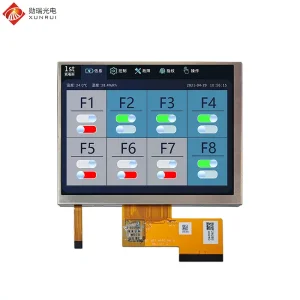
Accelerate Your Custom 4-Inch Display Project
Direct factory engineering consultation with Shenzhen Xunrui Optoelectronics. Send your CAD drawings, interface targets, or luminance requirements for rapid feasibility review and sample dispatch.