

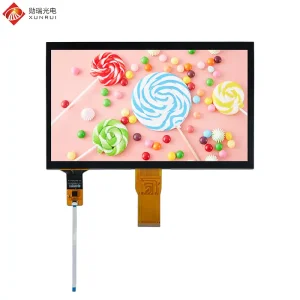
Doha Kiosk Grade 10.1" 1024×600 1000nit High Brightness TN TFT LCD
- Optical Luminance: 1000 cd/m² Sunlight Legible
- Interface: LVDS 40-Pin Configurable
- Thermal Tolerance: -20°C to +70°C Operating
Engineered for Qatar's hyper-arid desert climate: 1,000 to 2,500+ Nits sunlight-readable TFT LCD displays, wide-temperature liquid crystal fluid, and optical bonding built for Hamad Port logistics, Ras Laffan oil & gas telemetry, and Lusail smart city terminals.
Field-ready display configurations built to withstand intense solar luminance (100,000+ Lux) and ambient heat cycles encountered across Doha industrial parks and outdoor infrastructure.



Deploying human-machine interfaces (HMIs) and smart visual terminals in Doha, Qatar, presents one of the most punishing electronic operating environments globally.
Qatar experiences exceptional horizontal solar irradiance that frequently eclipses standard consumer displays. Unmodified 250–350 nit panels suffer immediate image washout, resulting in unusable digital touchpoints across outdoor toll booths, EV charging corridors, and marina interfaces.
During Doha summers, sealed metal kiosks and unattended roadside cabinets build internal cavity temperatures surpassing 75°C. Without industrial-grade clearing points ($T_{ni} > 105^\circ\text{C}$), standard liquid crystal fluids experience isotropic phase transformation, creating massive dark blotches.
The confluence of fine desert dust (Shamál wind events) and Persian Gulf marine humidity generates abrasive, electrically conductive salt deposits. Display modules require complete surface hermetic sealing, optical bonding, and robust anti-corrosion FPC conformal coatings.
Qatar’s multi-billion-dollar infrastructure expansion across the Lusail Smart City, Hamad Port automated container terminals, and Ras Laffan Industrial City LNG production complexes has established high demand for ruggedized optoelectronic systems. Engineering teams based in West Bay and Industrial Area Doha require reliable Chinese manufacturing partners capable of delivering specialized high-brightness TFT LCDs that fulfill both municipal aesthetic standards and rigorous petrochemical safety protocols (IECEx/ATEX compatibility).
Achieving long-term optical readability under Doha’s noon sunlight involves a comprehensive optomechanical display stack rather than merely over-driving the backlight LEDs.
In standard air-gap assemblies, the refractive index mismatch between air ($n = 1.0$) and glass ($n = 1.5$) creates an internal light bounce of approximately 4.5% to 5.0% per surface boundary. In Doha’s high-irradiance ambient environments, this reflection completely obscures displayed data.
Our Shenzhen factory utilizes cleanroom LOCA (Liquid Optical Clear Adhesive) and optical-grade OCA silicone formulations to mechanically unite the TFT glass with the protective cover plate. This drops internal boundary reflection below 0.2%, dramatically enhances the effective contrast ratio, prevents internal condensation during high-humidity coastal evenings, and bolsters structural impact resistance against blown sand.
Generating 1,000 to 2,000 nits of light emission generates substantial operational thermal waste. Traditional FR4 PCB backlight strips fail under Doha ambient conditions because thermal buildup rapidly degrades the blue LED dies and phosphor coatings, turning displays yellow within months.
Xunrui utilizes aircraft-grade aluminum core metal-backed PCBs (MCPCB) paired with high-lumen-per-watt Nichia/Osram LED chips. Connected to pulse-width modulation (PWM) constant current driver boards equipped with integrated NTC ambient temperature sensors, our modules automatically throttle luminous output at night to avoid glare while keeping operating junction temperatures well below critical failure thresholds.
| Performance Parameter | Commercial Grade Display | Standard Outdoor Industrial | Xunrui Doha-Optimized TFT Module |
|---|---|---|---|
| Luminance Rating | 250 – 350 cd/m² | 600 – 800 cd/m² | 1,000 – 2,500 cd/m² (Customizable) |
| Optical Bonding | Air Gap (Double-Sided Tape) | Selective Air-Gap or Basic OCA | Full Vacuum LOCA / OCR Optical Bonding |
| Liquid Crystal Phase Clearing ($T_{ni}$) | +70°C (Blackens in Direct Sun) | +85°C to +90°C | High-Tni Fluid > +110°C (Anti-Blackout) |
| Surface Glass Coating | Uncoated Soda Lime | Basic Anti-Glare (AG) | AR (Anti-Reflective) + AG + AF (Oleophobic) |
| Backlight Lifespan (Half Life) | 20,000 – 30,000 Hours | 50,000 Hours | 70,000+ Hours with MCPCB Heat Sinks |
| Touch Controller Reliability | Standard Consumer PCAP | Industrial PCAP | Salt-water rejection, 6mm glove operation |
Procurement managers sourcing optoelectronics for major Middle Eastern projects understand that initial unit cost (BOM) represents only a fraction of the total system expenditure. Field maintenance along the Salwa Highway or at the Ras Laffan offshore gas platforms can quickly negate initial savings from cheaper, commercial-grade panels.
Consumer display glass vendors constantly update silicon fabrication lines, making displays obsolete every 9 to 18 months. Xunrui guarantees a 5-to-7-year locked BOM production cycle for industrial client contracts in Doha, preventing redesign costs and system recertifications.
Major civil and enterprise ventures in Qatar often require rigorous phase-one pilot validations before deploying thousands of units. We provide low-risk engineering trial runs between 5 and 500 units, letting you test assemblies under local ambient conditions before volume tooling.
Sourcing glass from one vendor, touch sensors from another, and backlight assemblies from a third creates cross-liability disputes when units fail under extreme thermal load. Xunrui operates integrated Class 1,000 / Class 100 cleanrooms to produce the complete display stack under ISO 9001 quality controls.
Importing optoelectronic subsystems into Qatar requires strict adherence to Gulf Cooperation Council (GSO) technical regulations, environmental standardizations, and dependable air and maritime freight logistics.
Every shipment dispatched to Doha undergoes stringent outgoing testing and comes with fully traceable documentation:
Located in Bao'an, Shenzhen—close to Shenzhen Bao'an International Airport (SZX) and Hong Kong International Airport (HKG)—we coordinate direct logistics to Hamad International Airport (DOH) via Qatar Airways Cargo for urgent prototypes within 3 to 5 business days.
For large container production volumes, shipments route through the modern maritime gateway of Hamad Port (Umm Al-Houl), packed in moisture-barrier anti-static bags (ESD), desiccant containers, and reinforced export cartons designed to prevent humidity ingress during ocean transit.
As smart city infrastructure, autonomous transportation, and industrial automation mature across Qatar, display technology is evolving beyond conventional LED edge-lighting.
Deploying thousands of microscopic LED diodes partitioned into over 1,000 independent local dimming zones. This provides extreme contrast (100,000:1) and cuts backlight power consumption by up to 40% under direct sun, significantly lowering internal kiosk heat.
Advanced liquid crystal cells engineered to reflect Doha's intense ambient sunlight back out through the pixel stack, turning high ambient solar lux into an asset rather than a liability while reducing backlight demand.
Integrating photostable quantum dot enhancement films (QDEF) that resist high operating temperatures, ensuring 100%+ DCI-P3 wide color gamut coverage for outdoor digital signage and control rooms without rapid chromatic drift.
Comprehensive form factors spanning 1.44" to 10.1" engineered for Gulf enterprise applications, from pipeline telemetry sensors to interactive city navigation points.







Clarifications addressing common optical, mechanical, and procurement questions raised by regional systems integrators in Doha.
This issue is known as solar-induced isotropic phase transition. When unshaded displays absorb direct solar radiation on 45°C–50°C summer days, the glass surface temperature can exceed 80°C. Standard commercial liquid crystal fluid transitions from its twisted nematic state into an isotropic liquid state, producing dark black blotches. Xunrui solves this by using high-clearing-point liquid crystal fluid rated for $T_{ni} \ge +105^\circ\text{C}$ to $+115^\circ\text{C}$, keeping the display clear even in unshaded desert conditions.
For indirect or shaded outdoor applications, a minimum of 800 to 1,000 cd/m² (nits) is required. However, for terminals subjected to direct, unfiltered sunlight—such as smart parking kiosks in Lusail or marine equipment at Hamad Port—we recommend 1,200 to 1,800+ nits paired with anti-reflective (AR) etched glass and optical bonding to maintain contrast without excessive power draw.
Yes. We design and manufacture custom Flexible Printed Circuits (FPC), tuning pinouts, trace shielding, and lengths to mate with your existing motherboard. We also provide integrated industrial HDMI, VGA, and LVDS conversion driver boards, along with dedicated DC-DC step-down modules that support 12V/24V vehicular or industrial power lines.
Standard consumer touch chips produce false inputs when exposed to moisture or thick gloves. Our industrial Projected Capacitive (PCAP) solutions use automotive-grade Ilitek or EETI touch ICs tuned with custom firmware. This provides reliable multi-touch tracking even with 5mm industrial gloves, and filters out false touches caused by saline spray or moisture along the Doha Corniche.
Custom tooling and mechanical drawing sign-offs typically require 7 to 10 working days. Engineering prototype fabrication spans 2 to 3 weeks. Once quality-verified by our 5-stage QC testing, samples are shipped directly from Shenzhen to Doha via international air express, arriving at your facility in approximately 3 to 5 business days.
To support client field validation, we provide initial small-batch trial runs of 5 to 500 units following sample sign-off. For ongoing mass-production batches involving bespoke cover glass or custom tooling, our standard baseline MOQ starts at 1,000 units, with volume discounts available for multi-year project contracts.
Send us your mechanical drawings, interface requirements, and target optical specifications. Xunrui engineers will provide complete optoelectronic analysis, thermal modeling advice, and custom sample schedules for your Qatar deployments within 24 business hours.