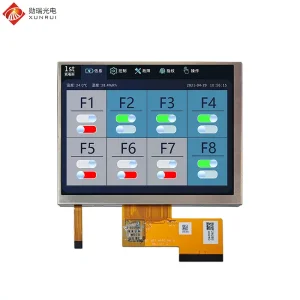
High Brightness TFT LCD Flagship Engineering Modules (Canada Spec)
Fully compliant with harsh sub-zero Canadian thermal standards (-30°C to +85°C) and extreme direct sunlight luminance thresholding.




Engineering TFT LCDs for the Canadian Cold & Solar Glare Matrix
Canada represents one of the most uniquely demanding operating environments for industrial optoelectronics on Earth. From maritime offshore logistics in Atlantic Canada (Halifax and St. John's) to intensive sub-surface mining throughout Northern Ontario and open-pit oil sand installations in Alberta, optoelectronic display architectures face relentless dual-stress triggers: polar sub-zero thermals down to -40°C paired with high-albedo daylight glare from snow reflection (exceeding 85,000 lux).
Standard commercial TFT panels fail prematurely in Canada due to liquid crystal sluggishness, clearing point phase transitions (liquid crystals turning isotropic under thermal direct solar load), and delamination caused by freeze-thaw condensation cycles. Our custom factory engineering addresses these specific structural challenges:
- Wide-Temp Fluitic Formulations: Liquid crystals engineered with operating ranges from -30°C to +85°C, eliminating response lag down to microsecond refresh speeds even during Alberta blizzards.
- Optical Bonding (LOCA / OCA): Eliminating the internal air gap between the cover glass, touch sensor, and LCD stack prevents condensation, internal fogging, and moisture ingress.
- High-Efficiency High-CRI LED Bars: Solid-state side and direct backlights yielding 1000–2500 nits while dissipating heat via aviation-grade aluminum heat spreaders.
Canadian Regulatory & Environmental Benchmarks
Industrial OEMs across Ontario, Quebec, British Columbia, and Alberta demand strict adherence to international and local mechanical resilience criteria:
- CSA C22.2 & Class I Div 2 Compliance: Intrinsic safety requirements for hazardous monitoring in Calgary oil refineries and mining sites.
- IK08 to IK10 Impact Resistance: Chemically strengthened cover glass (Corning Gorilla or AGC Dragontrail) up to 6mm thickness to withstand heavy tool drops.
- Polarized Sunglasses Readability: Retardation films (1/4λ waveplates) that ensure complete visibility across all 360-degree viewing azimuths for heavy machinery operators.
Macro Industry Trajectory & Optical Evolution
The global high-brightness display sector is transitioning from high-power commodity backlighting to intelligent, thermal-balanced optical engines designed for 24/7 autonomous infrastructure.
Mini-LED & Micro-Zone Dimming
Global demand is rapidly shifting away from conventional CCFL and standard edge-lit LED architectures toward multi-zone local dimming Mini-LED matrices. This provides 2,000+ nits luminance with up to 45% less power consumption, crucial for battery-powered mining gear and EV charging kiosks.
Transflective & Low-Reflective Hybrids
Advanced optical stacks integrate transflective micro-structures that leverage incoming Canadian solar ambient radiation instead of fighting it. The brighter the external sunlight, the clearer the screen, slashing the thermal load on backlights and extending LCD operational lifespans past 100,000 hours.
Automated Thermal & PWM Regulation
Modern HMI systems utilize integrated micro-thermal sensors and external ambient light transducers (LDR/I2C lux meters). Dynamic PWM dimming smoothly modulates the display from 2500 nits in bright midday snow to 5 nits under pitch-black night skies, preventing driver flash blindness.
High-Brightness TFT Implementations Across Canadian Industries
Reliable optical performance engineered for Canadian environmental, commercial, and industrial ecosystems.
EV Charging & Smart Grid Infrastructure
For installations in Vancouver, Toronto, and Montreal outdoor parking grids. Features anti-UV, anti-glare (AG), and anti-reflective (AR) surface treatments that resist yellowing and vandalism while maintaining full legibility under noon-sun angles.
Mining Telemetry & Heavy Earthmoving
Equipped inside open-pit mining loaders, excavators, and drilling rigs across Sudbury and the Northwest Territories. Withstands continuous 5G shock and vibration, paired with projected capacitive (PCAP) touch sensors calibrated for heavy-duty winter work gloves.
Marine Navigation & Fisheries Systems
Deployed in Saint Lawrence Seaway cargo vessels and Atlantic coastal trawlers. True salt-spray-resistant conformal coatings on all internal driver boards, paired with optical bonding that repels optical refraction, condensation, and sea spray glare.
Precision Agriculture & Forestry
Tractor guidance consoles, GPS spray controllers, and forestry harvesters operating in Saskatchewan grain belts and British Columbia timber reserves. 1000–1500 nit IPS panels preserve true color accuracy across extreme 85/85/85/85 viewing angles.
Next-Generation Optoelectronic Evolution (2025–2030)
Architectural milestones engineered to tackle the next phase of human-machine interaction in sub-zero and outdoor applications.
Direct ITO Heater Integration
Indium Tin Oxide (ITO) micro-thin heating elements laminated into the display stack to instantly pre-warm liquid crystal fluid at -40°C startup, avoiding black screen cold locks.
Quantum Dot Enhancement Film (QDEF)
Replacing standard blue phosphor LED convertors with QD films, achieving over 100% DCI-P3 color gamuts with up to 30% higher light efficiency under 1500+ nit sunlight exposure.
Wet-Surface & 10mm Glove Firmware
Custom self-and-mutual capacitance tuning algorithms that eliminate false touches caused by heavy rain, sleet, or melted snow on the display glass surface.
Direct MIPI DSI & eDP 1.4 Integration
Streamlined board-to-board high-speed serial connectivity with unified power delivery, EMI-shielded flex cables, and custom ESD protection meeting 15kV air discharge specifications.
High Brightness Optoelectronic Spec Matrix
Comprehensive performance parameters: Standard Commercial vs. Xunrui Custom Canadian Industrial Modules.
| Performance Parameter | Standard Commercial LCD | Xunrui High-Brightness Industrial Module | Benefit to Canadian OEMs |
|---|---|---|---|
| Luminance Output | 250 – 350 nits | 1000 – 2500 nits (Configurable) | 100% readable in intense snow albedo & bright sun |
| Operating Temperature | 0°C to +50°C | -30°C to +85°C (Extended Fluid) | Immediate boot without ghosting during Canadian winters |
| Optical Bonding | Air gap (perimeter tape only) | Full LOCA / OCA Optical Bonding | Zero condensation, anti-reflective, high shock absorption |
| Viewing Angle (CR≥10) | 6 o'clock or 12 o'clock color inversion | Full IPS (85/85/85/85) All Azimuths | Crystal-clear readability for off-axis cab operators |
| Cover Lens Durability | 0.7mm soda-lime glass (IK03) | Up to 6.0mm Tempered Glass (IK10) | Vandal-proof, sledgehammer-resistant industrial resilience |
| Backlight Lifespan | 20,000 – 30,000 Hours | 50,000 – 100,000 Hours (Constant-Current) | Minimal maintenance costs across remote Canadian terrain |
Need a Tailored Sunlight-Readable Display Solution?
Share your CAD dimensional envelope, interface protocol (RGB, LVDS, MIPI, eDP), and target operating environment with our Shenzhen R&D engineering hub.
Frequently Asked Questions on High-Brightness TFT LCDs in Canada
In-depth technical answers from our senior optoelectronic integration engineers.
What brightness level is strictly required for outdoor sunlight readability in Canada?
How do you prevent LCD displays from freezing or lagging in Canadian -30°C winter conditions?
Why is Optical Bonding (LOCA/OCA) superior to air bonding for Canadian equipment?
Can capacitive touch panels (PCAP) function reliably with thick winter gloves and snow?
What is your factory sample lead time and custom project minimum order quantity (MOQ)?
High Brightness TFT LCD Catalog for Canadian Engineering Projects
Explore our complete production matrix featuring high-reliability sunlight readable displays, wide-temperature driver boards, and custom industrial touch stacks.