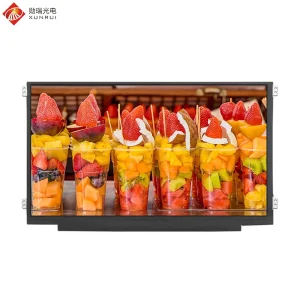
Featured Precision Display Portfolio (Group A)
Explore our industrial-grade product selection built for harsh environments, high durability, and versatile touch protocols.







The Strategic Edge of Sourcing 6.2" TFT LCD Modules from China
In-depth supply chain integration, precision engineering, and specialized display customization deliver definitive commercial advantages.
Localized Supply Density
By centering production within Shenzhen's optoelectronic cluster, we achieve rapid raw material sourcing—from precision optical film cuts to high-efficiency LED chips. This proximity minimizes raw component lead times, translating to faster rapid prototyping and lower bill-of-materials costs for customized 6.2-inch assemblies.
Rigorous 5-Gate Quality Testing
Every module undergoes 5 distinct inspection gates: IQC raw material screening, glass substrate inspection, FOG (Flex-on-Glass) bonding verification with burn-in aging, final product functional testing, and exhaustive OQC before shipping. This structured workflow reduces field failure rates in demanding industrial setups.
Total Stack Customization
Our engineering services extend far beyond off-the-shelf catalog panels. We tailor flexible printed circuit (FPC) routing, integrate anti-fingerprint (AF), anti-glare (AG), and anti-reflective (AR) surface treatments, modify backlight luminance from 250 to over 1,500 nits, and provide bespoke driver logic boards matching host controllers.
De-risked Pilot Production
We provide a dedicated validation step with agile 5 to 500 unit pilot trial batches. This structure allows engineering leads to confirm mechanical tolerances, electromagnetic compliance, and touch driver integration under real operating conditions prior to scaling up to mass production runs (MOQ 1,000+ units).
Industry Technology Trends: The Evolution of 6.2-Inch Displays
Analyzing the shift from standard panels toward hardened, high-efficiency, multi-touch interactive displays.
Optical Bonding Over Air-Gap
Standard air-gap bonding introduces internal boundary reflections that wash out displays in bright light. The sector is moving rapidly toward Full Optical Bonding (OCA/OCR) for 6.2-inch assemblies, which unites the TFT panel and cover lens with an index-matched adhesive. This eliminates internal internal condensation, cuts reflection by over 60%, and increases structural impact resilience.
High-Efficiency Backlighting
Thermal management is a critical factor for vehicle dashboards and handheld devices. Modern 6.2-inch TFT panels combine high-efficiency LED arrays with enhanced prismatic diffusers. This setup produces brightness levels up to 1200+ nits while keeping current draw and operating temperatures within conservative margins.
Interference-Immune Touch ICs
Modern capacitive touch panels (PCAP) now feature signal-to-noise ratios (SNR) built to handle harsh electrical interference. Modern controller chips support active water-rejection firmware, full 5-point multi-touch tracking through 5mm tempered cover glass, and reliable operation with thick safety gloves.
Comprehensive Technical Specifications: 6.2" Module Matrix
Reference technical profiles and baseline electrical parameters for standard and specialized configurations.
| Feature Parameter | Standard Commercial Tier | Industrial High-Reliability Tier | Automotive / Rugged Outdoor Tier |
|---|---|---|---|
| Screen Size & Aspect | 6.2 Inch (16:9 / 18:9 Custom Bar) | 6.2 Inch Active Matrix IPS | 6.2 Inch Wide-Format Transflective / IPS |
| Resolution Options | 800×480 / 720×1280 | 720×1560 / 1080×2160 | 720×1560 / 1920×1080 Custom |
| Luminance (Nits) | 250 – 350 cd/m² | 500 – 800 cd/m² | 1000 – 1500+ cd/m² (Direct Sunlight) |
| Touch Screen Architecture | 4-Wire Resistive / Basic PCAP | Multi-Touch PCAP (I2C / USB) | Thick Lens PCAP with Water/Glove Tracking |
| Viewing Angles (U/D/L/R) | 70/70/60/70 (TN Mode) | 85/85/85/85 (Full IPS) | 89/89/89/89 (Free Viewing Angle) |
| Signal Interfaces | RGB 24-bit / MCU 8/16-bit | MIPI DSI 4-Lane / LVDS | MIPI DSI / eDP / Serial Bridge |
| Operating Temperature | -10°C to +60°C | -20°C to +70°C | -30°C to +85°C (Extended Environmental) |
| Cover Glass Processing | 0.7mm Chemically Strengthened | 1.1mm–2.0mm + Anti-Glare (AG) | 3.0mm–5.0mm IK08/IK09 + AG/AR/AF |
Localized Application Scenarios & Sector Blueprints
How engineering teams deploy the 6.2-inch form factor across diverse industrial and commercial setups.
Automotive Telematics & 2-Wheeler Dashboards
The elongated aspect ratio makes 6.2-inch modules ideal for motorcycle instrument clusters, electric vehicle dashboard strips, and secondary console readouts. Equipped with high-brightness LED arrays (1,000+ nits) and anti-glare etching, these panels remain easy to read in direct sunlight while handling ambient temperatures up to 85°C.
Handheld Terminals & Rugged Scanners
Handheld inventory scanners, surveying tools, and outdoor field computers require a compact footprint combined with modern portrait layouts. Our 6.2" IPS configurations provide wide viewing angles, robust ESD protection (up to ±8kV contact / ±15kV air), and responsive touch performance when used in damp conditions.
Access Control & Video Intercoms
Smart building security infrastructure relies on 6.2-inch vertical displays for facial recognition terminals, touch-enabled keypads, and video intercoms. Optical bonding protects against internal fogging caused by daily temperature changes, while IK08-rated cover glass adds physical protection against vandalism.
Global Procurement: Critical Checkpoints for Sourcing Engineers
Key technical criteria international procurement teams should address when sourcing custom 6.2-inch displays.
Long-Term Supply Lifecycle
Industrial programs require stable production lifecycles spanning 5 to 7+ years. We work directly with major glass foundries to guarantee availability, issue advance PCN notices (Product Change Notifications) at least 6 months ahead, and provide drop-in compatible solutions if an underlying component changes.
Electromagnetic Compatibility (EMC/EMI)
Medical and industrial environments often deal with high levels of radiated and conducted electromagnetic noise. We integrate ITO shielding layers, ground-isolated FPC layouts, and ferrite beads directly onto the display assembly. This approach helps host systems pass strict CE, FCC, and medical CISPR standards.
Thermal Dissipation & Polarizer Integrity
High-brightness backlights generate internal heat that can degrade standard polarizing films, leading to isotropic black spots in hot climates. We use wide-temperature polarizers (up to 85°C/90°C), thermal-conductive graphite pads, and aluminum backplanes to protect image quality in the field.
Frequently Asked Questions (FAQ)
Direct answers covering engineering customization, interfaces, touch integration, and factory logistics.
Can the 6.2" TFT LCD panel be driven via Raspberry Pi or low-cost MCUs?
Yes. While native 6.2-inch panels typically rely on high-speed MIPI DSI or RGB interfaces, our engineering team supplies custom HDMI, LVDS, or SPI converter boards. These enable plug-and-play prototyping with Raspberry Pi, STM32, and standard x86 industrial SBC platforms.
How do you achieve outdoor sunlight readability on a 6.2" screen?
We combine three engineering techniques: deploying high-efficiency LED arrays driven up to 1200+ cd/m², using full optical bonding (OCA) to prevent internal air-layer reflections, and applying anti-glare (AG) / anti-reflective (AR) surface treatments to the exterior cover glass.
What is the typical tooling fee and lead time for custom glass and FPC?
FPC alterations and custom cover-glass tooling generally require a 15 to 25 business-day engineering turnaround for initial prototype delivery. NRE (tooling) charges remain competitive within Shenzhen's component ecosystem and can often be rebated against volume production runs.
Can the capacitive touch screen operate with wet hands and industrial gloves?
Yes. By tuning the touch controller firmware (e.g., Ilitek, Goodix, or FocalTech), we adjust mutual and self-capacitance sensing algorithms. This allows responsive touch recognition even through running water droplets and industrial latex, leather, or synthetic work gloves.
Featured Precision Display Portfolio (Group B)
Additional standard and specialized display configurations manufactured for global OEM and ODM systems.