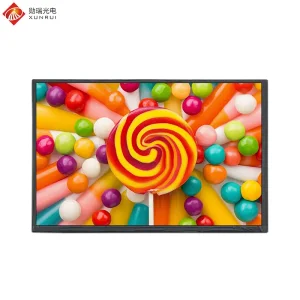
Production Portfolio
High-Reliability Industrial Display Modules
Explore our core verified optoelectronic hardware ready for direct sample sampling, testing, and full OEM lifecycle development.







Engineering Whitepaper
Critical Physics of 6.2" Wide Temperature TFT Displays
Bridging the operational divide between standard commercial liquid crystals and sub-zero / extreme-heat industrial operational environments.
In modern industrial automation, vehicular telematics, and avionics, the custom 6.2 inch wide temperature LCD screen has emerged as an indispensable form factor. Characterized by high pixel density, balanced mechanical dimensions, and adaptability to narrow-bezel enclosures, a standard 6.2" panel often fails when deployed in uncontrolled climatic conditions. When conventional displays operate outside typical 0°C to 50°C environments, liquid crystal molecular kinetics exhibit severe sluggishness at sub-zero temperatures (causing screen lag, frame dropping, and ghosting) or undergo isotropic phase transitions at high temperatures, producing catastrophic visual black spots (clearing points).
Wide Fluid Chemistry
Deploying specialized nematic fluid compounds with low viscosity coefficients at -40°C, ensuring rapid millisecond response times and completely preventing clearing phase failures up to +90°C ambient exposure.
Thermally Dissipating BLU
Custom LED backlights engineered with ceramic-substrate matrix arrays and high-thermal-conductivity aluminum extrusion profiles, ensuring 1000+ nits luminance without chromatic shift.
Optical Bonding & Hardness
Full OCA/OCR refractive-index-matched optical bonding that eliminates internal air gaps, mitigates condensation/fogging under high humidity, and achieves IK08 to IK10 mechanical impact ratings.
| Performance Vector | Standard Commercial 6.2" Screen | Xunrui Industrial Wide-Temperature 6.2" | System Engineering Advantage |
|---|---|---|---|
| Operating Range | 0°C to +50°C | -30°C to +85°C (Optional -40°C start) | Zero cold-start delay in sub-zero alpine and polar deployments |
| Luminance Degradation | Drops 50% after 15,000 hrs at 40°C | MTBF > 50,000 hrs (Constant drive current) | Significantly reduces field replacement cycles for critical infrastructure |
| Optical Air Gap | Air gap bonding (Prone to condensation) | Full OCR/OCA Optical Lamination | Eliminates internal surface reflection; 100% moisture ingress prevention |
| Touch Controller Stability | Standard I2C Consumer Controller | Automotive-Grade ILITEK / EETI IC | Full waterproof operation, palm rejection, and 5mm thick gloved input |
Shenzhen Manufacturing Agility
Supply Chain Resilience & Cleanroom Production
Operating a modernized 5,000 m² cleanroom infrastructure with direct supply chain vertical integration to guarantee long-term availability.
Located in the Bao'an advanced manufacturing corridor of Shenzhen, Shenzhen Xunrui Optoelectronic Technology Co., Ltd. leverages the world’s most concentrated optoelectronics ecosystem. Our comprehensive manufacturing layout eliminates external dependencies through in-house ITO laser etching, high-speed COG/FOG bonding, automatic polarizer lamination, and Class 100 cleanroom optical bonding lines. This deep verticality guarantees our international B2B clients unmatched lead-time stability, complete lifecycle management, and transparent pricing unaffected by middle-tier brokerages.
5-Stage Verification Gate
Every module passes rigorous incoming IQC, laser glass profile testing, automated FOG bonding alignment, prolonged high-temperature thermal stress aging, and outgoing OQC functional scanning.
5 to 7 Years Longevity
Industrial programs require stability. We maintain long-term institutional relationships with glass foundries, ensuring 5 to 7 years of pin-compatible continuity without unexpected end-of-life notices.
Rapid Pilot Prototyping
From initial CAD envelope drafting to physical engineering sample dispatch in as little as 14 business days, backed by trial batch flexibility ranging from 5 to 500 units before mass tooling.
2,000,000
Monthly Module Output
5,000 m²
Cleanroom Floor Area
ISO 9001 / 14001
Certified Quality Auditing
100% In-House
Aging & Thermal Testing
Application Scenarios
Where Precision 6.2" Wide-Temp Screens Excel
Engineered to resolve real-world field failures in challenging environmental contexts across key global markets.
EV Dashboards & Fleet Telematics
Engineered for dashboard compartments enduring scorching closed-cabin solar heating (+75°C) and northern winter freeze (-30°C). Anti-glare coatings preserve critical telemetry data legibility in high ambient glare.
Field Medical Diagnostics
Portable resuscitation monitors and field diagnostic scanners require instantaneous activation without preheating. Features optical surface lamination resistant to chemical disinfectant washdowns.
Smart City Outdoor Kiosks & EVSE
Commercial EV chargers, parking payment terminals, and municipal kiosks exposed directly to rain and sunlight. Integrated UV-blocking polarizers prevent yellowing and panel delamination over years of continuous exposure.
Strategic Evolution
Technology Roadmap & Regulatory Compliance
Continuous innovation in liquid crystal efficiency, active-matrix backplanes, and low-power high-performance driver architectures.
Mini-LED Backlighting
Transitioning from traditional edge-lit arrays to full-array local dimming (FALD) Mini-LED architectures. This delivers dynamic contrast ratios exceeding 100,000:1 while reducing backlight power consumption by up to 35%.
All-Weather Low Viscosity LC
Collaborative chemical synthesis creating next-generation nematic fluid matrices targeting stable switching states down to -50°C, removing the need for auxiliary ITO heating glass elements.
Global Certification Rigor
Fully compliant with RoHS Directive 2011/65/EU, REACH (EC 1907/2006), and automotive emission EMC specifications (CISPR 25 Class 3/5), guaranteeing frictionless market authorization across North America and Europe.
Technical Knowledge Base
Frequently Asked Engineering Questions
Comprehensive design and procurement answers directly addressed by our optoelectronic systems engineering team.
How does sub-zero temperature affect 6.2" LCD response times?
Standard liquid crystal mixtures thicken exponentially as temperatures approach 0°C, causing grey-to-grey transition times to surge from 15ms up to 250ms+ at -20°C. Our wide-temperature custom 6.2" screens utilize fluorinated, ultra-low viscosity liquid crystal fluids coupled with high-slew-rate source drivers, sustaining responsive refresh rates without display ghosting down to -30°C.
What interface protocols are available for custom 6.2" integration?
Depending on your host processor architecture (NXP i.MX, STM32, Rockchip, or Qualcomm), we offer customizable pinouts for RGB (18/24-bit), Single-link LVDS for industrial noise mitigation, high-speed 4-lane MIPI-DSI for streamlined compact routing, or bridge IC solutions for direct HDMI/Type-C connection.
Can touch functionality perform in rain or while wearing thick gloves?
Yes. We integrate high-SNR industrial touch controller ICs (EETI or ILITEK) utilizing proprietary mutual-capacitance algorithms. We tune driving channels to recognize touch through 5mm tempered cover glass, heavy industrial work gloves, and continuous water film on the surface without false triggers.
What is the typical sampling-to-production schedule?
After CAD mechanical review and interface sign-off, functional engineering samples are produced within 2 to 3 weeks. Following sample verification, a low-volume qualification run of 5 to 500 units can be immediately initiated to validate customer enclosure molds and firmware, followed by steady-state mass manufacturing with MOQs starting at 1,000 units.
Extended Product Lineup
Engineered Display Modules & Subassemblies
Explore our diverse form factors, high-resolution panels, and customizable touch displays engineered for OEM platforms.