

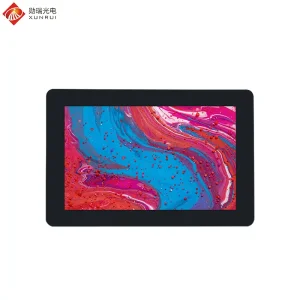
Custom 7 inch 800×480 TN TFT LCD Display with Resistive Touch Panel (Ethiopia Edition)
View Specifications
Engineered for mission-critical reliability across manufacturing hubs in Addis Ababa, Hawassa, and Dire Dawa.



Examining operational stress parameters in East Africa: why pressure-based resistive interfaces outperform capacitive alternatives in emerging industrial economies.
Ethiopia's rapid development under the "Homegrown Economic Reform Agenda" has accelerated output across industrial zones like Bole Lemi, Hawassa, and Kilinto. Assembly lines require Human-Machine Interfaces (HMIs) capable of withstanding mechanical impact, dust accumulation, and non-cleanroom operational standards.
Capacitive touch controllers struggle when unstable power feeds cause electrical noise, leading to phantom touches. Resistive Touch TFTs use physical contact layers to detect input via analog voltage dividers, making them intrinsically impervious to electrical grid variations and heavy motor EMI.
For large-scale agricultural machinery, logistics terminals, and retail ticketing systems deployed outside Addis Ababa, maintenance simplicity is critical. Resistive panels feature lower bill-of-materials (BOM) costs, simple calibration matrices, and dependable durability with gloved field workers.
Shenzhen Xunrui Optoelectronic delivers precision engineering, reliable FPC customization, and agile batch verification direct to East African developers.
We modify backlight brightness arrays from 250 nits up to sunlight-readable 1,000+ nits, applying anti-glare (AG) surface films suited to Ethiopia's high-altitude solar irradiance levels.
Ethiopian technical projects often require iterative testing. Our validation model supports trial runs of 5 to 500 units before ramping to full custom mass production of 1,000+ units.
With Shenzhen's streamlined export corridors connecting directly via air freight to Bole International Airport, Ethiopian OEMs enjoy stable supply chains and transparent technical documentation.
From compact handheld diagnostic screens to high-definition industrial human-machine interfaces.







Field-proven deployments matching local infrastructure constraints and environmental factors.
Ethiopia is Africa's largest coffee producer. From Sidama to Yirgacheffe, sorting, hulling, and roasting mills utilize resistive touch screen terminals that workers can easily operate with dusty fingers or work gloves during heavy harvest processing.
Freight corridor tracking systems, handheld barcode checkers, and depot weighing terminals rely on 4.3" and 7" resistive displays for durable resistance to vibration, humidity shifts, and constant mechanical pressure input.
The explosive rollout of digital payments and mobile banking stations requires cost-effective, durable transaction interfaces resistant to rain, dust, and heavy daily usage in suburban markets.
Essential guidance on importing, customizing, and integrating resistive touch TFT LCD displays.