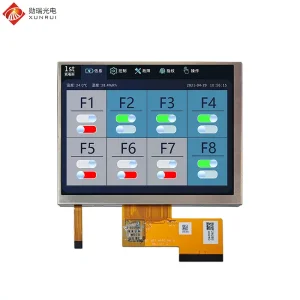
Featured Resistive Touch TFT LCD Modules for Ireland
Engineered for high-EMI resistance, glove interaction, and moisture insensitivity across OEM instrumentation and industrial controllers.




The Irish Market: Precision Demands across Galway, Cork, and Dublin
Ireland has consolidated its position as a global Tier-1 cluster for Medical Technology (MedTech), Bio-pharmaceutical manufacturing, and specialized Industrial Automation. Sourcing requirements here require surgical precision and zero tolerance for field failure.
MedTech Cleanroom Operability
Ireland's MedTech ecosystem, anchored extensively around Galway and Shannon, designs in vitro diagnostics, autoclaves, and surgical fluid pumps. Unlike capacitive screens which trigger ghost inputs when sterilizing sprays or saline solutions sit on the glass, 4-wire and 5-wire resistive touch TFTs trigger solely on physical actuation pressure.
- Immunity to liquid spills, gels, and washdown spray
- Direct stylus and double-layered surgical glove operation
- Zero false-touch incidents during critical clinical procedures
Agri-Tech & Marine Toughness
From automated dairy monitoring systems in County Tipperary to marine navigation gear operating off the Atlantic coast, Irish outdoor electronics face heavy precipitation, mud, and maritime fog. Resistive touch provides continuous tactile responsiveness regardless of atmospheric moisture.
- Operable under condensation and torrential rain
- Custom high-brightness backlighting up to 1,000+ nits
- UV-resistant top films mitigating delamination and yellowing
EMC Rigor in Industrial Power
High-power pharmaceutical bioreactors, brewery fermentation tanks, and automated bottling lines generate intense electromagnetic noise. Projected Capacitive (PCAP) sensors can struggle with signal-to-noise ratio drops near massive servo drives and VFD inverters, while resistive arrays stay exceptionally silent.
- Pure analog resistive voltage-divider operation eliminates EMI coupling
- Compliant with stringent CE, EMC Directive 2014/30/EU
- Uncompromising stability alongside high-frequency welding and motor controls
Global Industry Perspective: The Enduring Dominance of Resistive Touch in HMI
While consumer consumer electronics shifted definitively to multi-touch PCAP, specialized industrial, aerospace, and medical sectors worldwide continue to mandate resistive architectures for mission-critical reliability.
Fault Prevention & Operator Safety
In heavy industrial equipment and critical care monitoring, unintentional contact (such as a cord brushing against the panel, water splash, or dust accumulation) must never trigger an actuator or stop an infusion cycle. Resistive touch screens require distinct pressure, creating an innate mechanical confirmation step.
Total System Cost Efficiency
Resistive interfaces do not demand complex calibration algorithms, multi-layer shielding coatings, or high-tier controller processors. Sourcing resistive touch TFT displays yields significant BOM savings, straightforward microcontroller interface design via standard A/D channels, and low repair cost over 10-year deployment windows.
High-Brightness Sunlight Readability
Modern industrial resistive displays integrate advanced anti-glare (AG), anti-reflective (AR) surface treatments and optical clear bonding (OCA/OCR). With customized LED backlighting pushing luminescence up to 1,000–1,500 nits, high optical clarity is maintained even in direct sunlight environments.
Chinese Factory Agility: Engineering Precision and Supply Chain Speed
Shenzhen Xunrui Optoelectronic Technology combines Class 1000 cleanroom manufacturing with flexible engineering iteration to support European procurement cycles with precision and rapid fulfillment.
5-Gate Rigorous Quality Control
All display stacks pass through IQC incoming inspection, micro-defect glass array inspection, FOG hot-bar bonding aging tests, final display-assembly burn-in, and OQC outgoing inspection under ISO 9001:2015 / ISO 14001 certified protocols.
FPC, Interface & Brightness Tailoring
We configure customized flexible printed circuits (FPC lengths, pin-outs, EMI grounding shields), support RGB, LVDS, MCU, and SPI interfaces, and deliver matched AD driver boards with HDMI, VGA, and AV input support tailored to your housing enclosures.
Rapid Ireland Delivery & Low MOQs
To support early R&D prototyping across Irish universities and tech parks, we support 5–500 pcs pilot batch validation before jumping to volume runs. Integrated express air freight connects Shenzhen direct to Dublin and Shannon within 3–5 business days.
Engineering & Procurement FAQ for Irish Buyers
Key technical parameters, compliance queries, and sourcing specifications answered by display engineering specialists.
Why choose Resistive Touch over Capacitive (PCAP) for industrial equipment in Ireland?
Resistive touch screens rely on mechanical contact pressure between two conductive ITO layers, rather than electrostatic field variations. This means they remain 100% functional when operators wear heavy leather or insulated cleanroom gloves, when saltwater or chemicals splash the surface, or in facilities running heavy motors that produce high electromagnetic interference.
What is the typical lead time for custom display modules shipped to Ireland?
Initial engineering CAD drawings and pin-out schematics are delivered within 48–72 hours. Prototype toolings and sample fabrication take 2–3 weeks. Once samples are tested and approved, mass production orders are fulfilled in 4–5 weeks and shipped direct via air courier (DHL, FedEx, UPS) to Dublin, Shannon, or Cork within 3–5 working days.
Do your TFT LCD modules comply with EU environmental and quality standards?
Yes. All display assemblies, FPC cables, backlights, and touch overlays are fully compliant with EU RoHS Directive (EU) 2015/863 and REACH regulations. Our production processes operate strictly under certified ISO 9001:2015 Quality Management and ISO 14001:2015 Environmental Management frameworks, accompanied by full material declarations.
How do you support long life-cycle projects in the medical and industrial sectors?
We maintain guaranteed production longevity of 5 to 7+ years on industrial-grade glass and driver ICs. If glass master components undergo planned obsolescence, we issue early Last Time Buy (LTB) notices and deliver pin-to-pin, form-fit-function alternative modules without requiring mechanical changes to your enclosure.
Comprehensive TFT LCD & Touch Module Portfolio
Explore our extended series of compact handheld, wide-temperature, and ultra-bright sunlight-readable modules ready for immediate engineering sample dispatch.