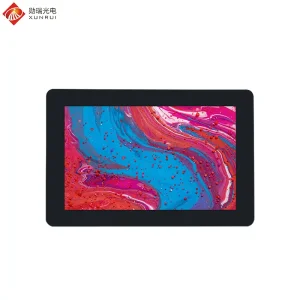
Featured Display & Touch Solutions (Batch 01)
Direct OEM industrial modules engineered for high durability, interface agility, and precise touch calibration.








Executive Summary: Global Landscape of 6.2-Inch LCD Touch Modules
In modern industrial Human-Machine Interface (HMI) design, medical diagnostics, point-of-sale (POS) systems, and telematics consoles, the 6.2-inch LCD touch screen has emerged as a high-density, versatile form factor. Bridging the gap between ultra-compact 5.0-inch panels and broader 7.0-inch displays, the 6.2-inch profile offers optimal aspect ratios (typically 16:9, 18:9, or custom stretched bar proportions) that maximize active display area without compromising housing ergonomics or thermal budgets.
As global hardware developers shift from legacy passive matrix displays toward active-matrix TFT displays integrated with Projected Capacitive (PCAP) and Resistive Touch Panels (RTP), China's manufacturing clusters have consolidated their role as premier production epicenters. Chinese fabrication facilities combine localized photolithography, automated COG (Chip-on-Glass) and FOG (Flex-on-Glass) bonding, alongside optical bonding lines to deliver commercial and industrial displays with unmatched cost-performance metrics.
Industrial Architecture: Optical Performance and Stack-up Options
A precision-built 6.2-inch touch display assembly is composed of three critical engineering layers: the active matrix TFT cell (utilizing either high-aperture IPS or fast-response TN technology), the backlight unit (BLU) equipped with constant-current drivers, and the touch sensor layer paired with customized cover lens glass.
- IPS vs. TN Substrates: For clinical and automotive deployments, In-Plane Switching (IPS) is universally selected for its 80/80/80/80 symmetrical viewing angles and zero color-shift. For high-volume, cost-constrained industrial meters, optimized TN cells maintain rapid refresh characteristics and attractive bill-of-materials (BOM) advantages.
- Touch Integration Stack: Capacitive touch screens integrate multi-finger controllers (e.g., Goodix, FocalTech, Ilitek) supporting I²C and USB HID protocols. Cover lens customizations include chemically strengthened soda-lime or Corning Gorilla Glass, treated with Anti-Glare (AG), Anti-Reflective (AR), and Anti-Fingerprint (AF) vacuum coatings.
- Interfacing Standards: Industrial systems utilize varied transmission buses. Our factories engineer native solutions across MIPI DSI (high-speed data, low EMI), RGB 24-bit (direct microcontroller integration), and single/dual-channel LVDS for extended cable reach in noisy environments.
Why Global OEMs Source 6.2-Inch LCDs from Chinese Factories
The convergence of mature component supply ecosystems, robotic assembly lines, and rigorous quality inspection regimes.
Fully Integrated Supply Ecosystem
From polarizers, color filters, and driver ICs to customized FPC cables and cold-pressed cover lenses, Shenzhen and Guangdong industrial clusters provide component delivery cycles measured in hours rather than weeks, dramatically shortening NPI (New Product Introduction) cycles.
Automated Cleanroom Assembly
Class 1,000 and Class 100 cleanroom environments house automated COG/FOG bonding and visual inspection robots. Automated vision alignment systems eliminate human error, ensuring particle-free optical bonding and consistent pitch accuracy below 30 microns.
Flexible Volume Scalability
Unlike monolithic Tier-1 foundries requiring tens of thousands of units upfront, Chinese specialty factories offer agile pilot validation runs (5 to 500 pcs) before committing to customized mass production runs (MOQ 1,000+ pcs), de-risking overseas OEM capital deployment.
Stringent 5-Stage Reliability Testing
Modules undergo complete IQC material screening, polarizing glass inspections, high-temperature/high-humidity storage aging (60°C/90% RH), thermal shock testing (-30°C to +80°C), and 100% OQC functional calibration before packaging.
Turnkey Embedded Engineering
Factory-direct engineering teams deliver integrated driver boards (HDMI, VGA, Type-C, AV) and customized MCU/SPI bridge adapters, enabling plug-and-play development for Linux, Android, and Windows IoT ecosystems.
Export Compliance & Traceability
Adherence to ISO 9001 and ISO 14001 operational standards ensures absolute batch traceability, RoHS/REACH compliance, and global logistics packaging capable of withstanding transatlantic transit vibrations.
Localized Application Scenarios for 6.2" Touch Panels
Delivering tailored electro-optical characteristics for extreme environments, commercial interaction, and diagnostic precision.
Automotive & Fleet Systems
Smart vehicle consoles, electronic rearview mirrors, and fleet dash displays require high-luminance backlights (800–1200 nits) to maintain sunlight legibility, alongside AEC-Q100 compliant touch driver ICs.
Medical Diagnostics & Infusion
Portable patient monitors, anesthesia controls, and dialysis interfaces require noise-immune capacitive touch layers supporting surgical glove operation, saline splash resistance, and non-porous antimicrobial cover glass.
Heavy Machinery HMIs
Factory automation panels operating alongside welding robots and frequency drives demand ruggedized 4-wire/5-wire resistive touch modules or EMC-hardened PCAP panels immune to intense electromagnetic noise.
Smart POS & Mobile Terminals
Handheld payment terminals and inventory scanners require low-power LED matrices, thin module profiles (<2.5 mm), and surface hardness ratings of 7H to endure drop impacts and everyday abrasive wear.
Industry Trends & Technical Procurement Matrix
Benchmark technical options before finalizing custom tooling parameters and tooling agreements.
| Feature Parameter | Standard Commercial Grade | Industrial High-Reliability | Outdoor / Marine Grade |
|---|---|---|---|
| Luminance (Brightness) | 250 – 350 nits | 400 – 600 nits | 800 – 1500 nits (Sunlight Readable) |
| Operating Temperature | -10°C to +60°C | -20°C to +70°C | -30°C to +85°C (Wide Temperature) |
| Touch Sensor Technology | Air-Bonded PCAP / G+F | OCA Optical Bonded PCAP (G+G) | OCR Liquid Optical Bonded (G+G+AG/AR) |
| Input Method Compatibility | Bare Finger Multi-Touch | Glove Touch (Up to 3mm latex/leather) | Water Mist Rejection & Thick Glass (5mm) |
| Backlight Lifespan | 20,000 Hours (Half-brightness) | 30,000 – 50,000 Hours | >50,000 Hours (Replaceable BLU options) |
| Interface Bus | RGB 24-bit / SPI / MCU | MIPI DSI / LVDS | LVDS / eDP with Shielded EMI Gaskets |
Procurement Trends Shaping 2026–2030 Hardware Cycles
Global hardware vendors are actively shifting procurement strategies toward consolidated system providers. Rather than purchasing a bare TFT panel from one source, a touch digitizer from a second, and a conversion controller board from a third, procurement managers now demand complete optical-touch-controller stacks from a single Chinese manufacturing facility. This vertical integration mitigates finger-pointing during warranty events, reduces stack height tolerances, and cuts air-freight logistics weight.
Furthermore, the demand for extended product life cycles (5–7 years availability without silicon obsolescence) has become a non-negotiable metric for medical and industrial procurement. Leading Chinese factories provide pin-compatible secondary sourcing roadmaps to protect customer designs from unpredictable raw glass discontinuations.
Technical & Commercial FAQ for Sourcing Engineers
Direct responses regarding tooling costs, optical bonding, noise immunity, and lead times.
Q1: What is the typical NRE and lead time for a custom 6.2" touch cover lens?
Custom cover lens tooling (including custom black silk screening, cutouts, chamfered edges, and AG/AR treatment) typically costs between $800 to $1,800 depending on glass thickness (0.7mm to 4.0mm). First-article tooling samples are delivered within 12–18 business days.
Q2: How do your factories solve electrical noise on PCAP touch panels in industrial settings?
We utilize industrial-grade touch controller ICs (such as Ilitek or EETI) paired with high SNR (Signal-to-Noise Ratio) firmware. Hardware-level defenses include ITO shield layers on the FPC, ferrite bead filtering on power rails, and tuned frequency-hopping algorithms that prevent false touches caused by inverters or motors.
Q3: Should our project adopt Air Bonding or Full Optical Bonding?
Air bonding (using double-sided 3M foam adhesive around the perimeter) offers lower unit costs and simpler reworkability for indoor devices. Full optical bonding (using optically clear adhesive - OCA or OCR) fills the air gap, preventing internal condensation, dramatically improving sunlight contrast, and enhancing IK-rated impact shock tolerance.
Q4: Can we drive a 6.2-inch TFT module directly from an STM32 or ESP32 MCU?
Yes. While native 6.2" panels frequently use MIPI or RGB interfaces, our engineering team can provide custom driver boards with built-in SSD1963, RA8875, or similar controller chips, allowing direct interfacing via standard 8-bit/16-bit 8080 MCU parallel buses or SPI protocols.
Q5: What are the minimum order quantities (MOQ) for trial batches versus mass production?
Following drawing approvals, pilot batch evaluations allow prototype quantities of 5 to 500 pieces. For ongoing customized mass production containing unique FPC or silk-screen tooling, standard MOQs are set at 1,000 units per production run.
Q6: What certifications accompany your display modules for overseas import?
All display stacks and touch sensors comply fully with RoHS 2.0 and REACH environmental standards. Production plants operate under certified ISO 9001:2015 Quality Management and ISO 14001:2015 Environmental Systems. CE and FCC compliance reports are provided alongside customized controller assemblies.
Featured Display & Touch Solutions (Batch 02)
Explore customized screen sizes, strip formats, wide-luminance backlights, and integrated driver electronics.