
High-Performance Industrial TFT LCD Modules
Engineered to withstand rigorous commercial and industrial conditions. Explore our standard and custom-configured display panels ready for rapid deployment.


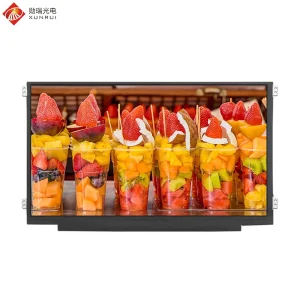


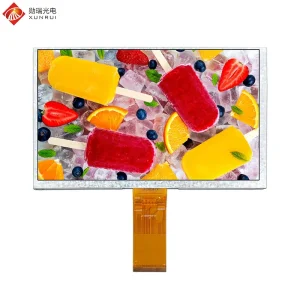


The Strategic Evolution of 8.8-Inch Ultra-Wide Displays
Why precision stretched-bar optoelectronics have transitioned from niche automotive dashboards into indispensable Human-Machine Interfaces across high-density telematics, edge AI computing, and precision medical engineering.
High-Density Aspect Ratios (1920×480)
The standard 8.8 inch screen operates predominantly at a 24:6 or 32:9 stretched aspect ratio, delivering Full HD horizontal clarity (typically 1920×480 or 1280×320 pixels). This geometric advantage allows mechanical engineers to embed rich telemetry data into constrained vertical heights such as 1U rack enclosures, secondary EV center consoles, and luxury smart appliances without occupying critical vertical envelope space.
Shenzhen Optoelectronic Cluster Prowess
As a seasoned high-tech enterprise established in 2016 in Shenzhen, Xunrui leverages China's world-leading flat panel display supply chain. By integrating glass substrate cutting, high-yield Chip-On-Glass (COG) and Fog bonding, along with customized high-efficiency LED backlight matrixes, we offer OEM buyers tier-one optical performance at rationalized procurement budgets.
Environmental & Thermal Hardening
Unlike standard consumer screens prone to blacking out under solar heat, industrial-grade 8.8-inch screens feature high-clearing-point liquid crystal fluids (Tni up to +110°C) and custom multi-die LED arrays producing 800 to 1,500 nits. Combined with operating temperature thresholds from -30°C to +85°C, these panels maintain zero-flicker optical clarity under extreme external conditions.
Optical, Electrical & Mechanical Architecture
Detailed engineering benchmarks for selecting the optimal 8.8-inch bar-type LCD stack. Compare standard industrial configurations against customized sunlight-readable and automotive variants.
| Display Parameter | Standard Industrial Configuration | Automotive / High-Brightness Spec | Custom Engineering Capabilities |
|---|---|---|---|
| Active Diagonal & Aspect | 8.8 Inch Stretched Bar (24:6 / 32:9) | 8.8 Inch Stretched Bar (24:6 / 32:9) | Custom glass cutting and edge sealing |
| Native Resolution | 1920 × 480 or 1280 × 320 Pixels | 1920 × 480 Full HD Stretched | Custom sub-pixel timing & scaling chips |
| Liquid Crystal Mode | IPS (In-Plane Switching) Normally Black | IPS All-Viewing Angle (85/85/85/85) | TN (Cost-sensitive) or IPS (Ultra-wide view) |
| Luminance (Brightness) | 350 – 500 cd/m² (Nits) | 1,000 – 1,500 cd/m² (Sunlight Readable) | Step-less PWM dimming down to 1 nit for night use |
| Contrast Ratio | 800:1 Typ. | 1000:1 to 1200:1 Typ. | Enhanced optical polarizers for deep black states |
| Signal Interfaces | 4-lane MIPI DSI / Single LVDS (40-Pin) | eDP (Embedded DisplayPort) / Dual LVDS | HDMI / Type-C bridge boards with auto-sensing |
| Touch Sensor Technology | Projected Capacitive (PCAP) I²C | Automotive PCAP with Water/Glove Rejection | 4-Wire Resistive / Optical Bonding / 6H-9H Cover Glass |
| Operating Temperature | -20°C to +70°C | -30°C to +85°C (Extreme Ambient) | Built-in thermal sensors & transparent ITO heating |
| Surface Treatment | Anti-Glare (AG) Hard Coating (3H) | AG + Anti-Reflective (AR) + Anti-Fingerprint (AF) | Custom screen printing, logo embedding, vandal-proof |
Optical Bonding Advantage
Air-bonding leaves a 0.2-0.5mm air gap between the touch panel and LCD cell, causing internal reflections of ~4.5%. By injecting optical-grade silicone or UV-curable OCA adhesive, we eliminate air interfaces, increase contrast under sunlight by 300%, and prevent internal fogging in humid maritime or outdoor climates.
Electromagnetic Compatibility (EMC)
Industrial machinery and electric vehicles generate intense EMI spikes. Xunrui's 8.8-inch display modules integrate shielded FPC lines, ferrite-choked power inputs, and custom Ground Plane routing to achieve seamless compliance with EN 55032 Class B, FCC Part 15, and automotive CISPR 25 standards.
Driver & Touch Controller Tuning
We supply turnkey bridge boards supporting direct HDMI, USB Type-C, or VGA input. Integrated PCAP controllers (Goodix, Ilitek, FocalTech) are pre-calibrated for precision touch performance through 4mm vandal-proof tempered glass, liquid droplet resistance, and thick leather industrial glove operation.
Where 8.8-Inch Bar Displays Deliver Strategic Impact
From mission-critical medical wards to next-generation connected cockpits, examine how international hardware developers utilize our 8.8-inch display platforms.
Automotive & Electric Mobility
In electric vehicles, commercial fleet telematics, and high-end motorcycles, the 8.8-inch format serves as an ideal A-pillar blind-spot monitor, secondary transmission console, or streamlined digital dashboard. Engineered with 1,200+ nits luminance and wide operating temperatures (-30°C to +85°C), our panels resist solar thermal aging and maintain crisp navigation rendering under direct noon sunlight.
1U / 2U Server Telemetry & Audio Racks
Standard 19-inch enterprise rack enclosures possess strict 1U (44.45 mm) or 2U (88.9 mm) vertical restrictions. An 8.8-inch ultra-wide stretched screen mounts horizontally across the faceplate, providing data center technicians with real-time CPU thermal loads, network throughput bandwidth graphs, and multi-channel audio VU meters without requiring external monitors.
Medical Diagnostics & Infusion Carts
Modern anesthesia monitors, dialysis consoles, and surgical bed controls require continuous, uncluttered physiological data visualization. The 1920×480 resolution permits clean parallel display of multi-lead ECG waveforms, SpO2 bars, and vitals. Sealed behind antimicrobial, chemically strengthened cover glass, our displays withstand aggressive isopropyl alcohol and hospital sterilization disinfectants.
Luxury Smart Home & IoT Appliances
High-end architectural range hoods, built-in induction ovens, and multi-room audio switchboards adopt the 8.8-inch stretched display to replace legacy physical dials with sleek, full-color dynamic touch interfaces. Integrated with customized decorative cover lenses, bevel-cut glass edges, and hidden-until-lit silk printing, these screens add aesthetic prestige to modern consumer electronics.
Mass Transit & Dynamic Wayfinding
Railway carriages, metro door headers, and bus route signboards demand continuous 24/7 reliability, anti-shock construction, and low power dissipation. Xunrui builds ultra-wide stretched bar systems featuring wide-voltage power supplies, constant-current LED backlights, and vibration-resistant locking connectors (Hirose / JST) to prevent field failures.
Industrial Robotics & CNC Teach Pendants
Heavy machinery operators need instant parameter access without swapping screens. An 8.8-inch bar module provides a dedicated split-screen telemetry strip for axis position coordinates, spindle torque metrics, and emergency alert banners, leaving the primary human operator interface unobstructed and safe.
Zero-Defect Quality Control & Testing Methodology
Every TFT LCD panel manufactured at our Shenzhen facility undergoes a five-checkpoint inspection framework governed by ISO 9001 quality and ISO 14001 environmental management standards.
IQC Material Audit
Rigorous incoming quality inspection across all raw components. Glass substrates, polarizing films, driver ICs (COG), high-CRI LED dies, and flexible printed circuits (FPC) undergo 100% optical and electrical batch sampling before cleanroom entry.
Precision Glass & ITO Inspection
Substrates are inspected under polarized optical microscopes to verify zero micro-cracks, ITO impedance uniformity, and clean cut edges. Laser etching is audited to prevent line shorts and guarantee microscopic circuit fidelity.
FOG Bonding & Initial Thermal Aging
Automated ACF anisotropic conductive film bonding of Driver IC and FPC under controlled heat and micrometer pressure. Semi-finished cells undergo initial thermal burn-in aging to filter infant mortality and ensure bonding peel strength exceeds 8N/cm.
Full Module Assembly & High-Temp Aging
Backlight matrix, diffuser sheets, and touch panels are laminated in Class 1,000 cleanrooms. Assembled 8.8-inch units undergo 4 to 24 hours of continuous dynamic pattern burn-in under elevated ambient temperatures (+50°C to +60°C).
Optical Spectroradiometer Calibration
Each display is calibrated using Konica Minolta optical analyzers. Luminance uniformity (9-point audit >85%), color coordinates (CIE 1931), white balance, contrast ratio, and gamma curves are logged into our digital quality archive.
OQC Pre-Shipment & Drop Testing
Final Outgoing Quality Control checks ESD anti-static packaging, drop and vibration resistance simulation, barcode serial tracking, and export pallet sealing to ensure zero transportation degradation across transoceanic freight.
Structured 6-Stage Display Customization Workflow
We eliminate product development friction. Our transparent, gate-controlled development path enables engineering teams to validate optical, mechanical, and firmware compatibility before committing capital.
Stage 1: Engineering Review & Feasibility
Submit your 3D CAD step files, electrical pinout constraints, luminance expectations, and operating environment specs. Our senior optoelectronic team conducts a 48-hour DFM (Design for Manufacturability) analysis to confirm optical efficiency and thermal thresholds.
Stage 2: Official 2D/3D Drawing Approval
Within 3 to 5 business days, Xunrui issues comprehensive 2D mechanical engineering drawings and FPC schematics. Every dimensional tolerance (±0.15mm), glass chamfer radius, mounting ear position, and pin allocation is locked down and co-signed.
Stage 3: Rapid Prototyping & Samples
Custom tooling of FPC dies and prototype backlight assembly begins. Functional golden engineering samples (3 to 10 units) are built, rigorously benchmarked in-house, and couriered via DHL/FedEx with complete optical inspection reports.
Stage 4: Pilot Batch Trial (5–500 Pcs)
After customer sample approval, we offer a dedicated pilot trial run between 5 and 500 units. This crucial bridge phase de-risks customer assembly lines, verifies SMT driver compatibility, and confirms real-world field enclosure fit.
Stage 5: Full Mass Production (MOQ 1,000+)
Following final validation, our ISO-certified Shenzhen production lines ramp into high-volume manufacturing. Automated laser bonding, SMT placement, and aging cells guarantee batch-to-batch color temperature consistency and structural integrity.
Stage 6: Lifecycle & EOL Protection
We provide industrial OEM buyers with a committed 5 to 7+ year product availability roadmap. In the event of an upstream glass panel or driver IC obsolescence, Xunrui guarantees 6-month Last-Time-Buy (LTB) notification and form-fit-function drop-in replacements.
Global Standards, Compliance & Supply Chain Resilience
Meeting international compliance is mandatory for tier-one industrial and automotive OEMs. Our display manufacturing ecosystem is engineered for seamless global export and regulatory audits.
RoHS & REACH Environmental Compliance
All raw materials—including optical adhesives, polarizers, soldering alloys, and liquid crystal fluids—comply strictly with EU Directive 2011/65/EU (RoHS 2.0) and REACH (EC 1907/2006). SGS testing certificates are renewed annually for complete downstream export audit trails.
ISO 9001 & ISO 14001 Certification
Xunrui's manufacturing operations are externally audited to ISO 9001:2015 for quality management and ISO 14001:2015 for environmental management. Production records, operator skill matrices, cleanroom air particulate levels, and calibration certificates are traceable across all batch runs.
Localized Global Technical Support
Our sales engineering network supports clients throughout North America, Europe, East Asia, and the Middle East. With multilingual direct technical liaison (English and Chinese), we assist your software developers with Linux kernel device tree configurations, Android display timing registers, and RTOS driver init code.
Technology Roadmap: The Future of Stretched Displays
As edge processing and smart cockpits demand deeper contrasts, lower power budgets, and slimmer packaging, Xunrui is pioneering transformative optoelectronic technologies for the 8.8-inch form factor.
Mini-LED Local Dimming Backlights
Transitioning from traditional edge-lit LED strips to custom 512-zone to 1,024-zone Mini-LED array backlights. This architectural leap raises contrast ratios to 100,000:1, achieves true HDR10 compliance, and reduces power consumption by up to 35% during dark GUI states in nighttime driving conditions.
Quantum Dot (QD) Film Integration
By laminating cadmium-free Quantum Dot enhancement films (QDEF) between the light guide and liquid crystal cell, color gamut expands from typical 70% NTSC to over 95% DCI-P3. This yields vivid, broadcast-grade color fidelity vital for surgical endoscopy and premium automotive cockpits.
Single-Cable Embedded eDP & MIPI DSI-2
Integrating high-bandwidth serial bridge architectures directly onto the module's flex circuit. Next-generation designs eliminate bulky external daughterboards, accepting direct USB Type-C DisplayPort Alternate Mode video and power negotiation on a single ultra-flat harness.
Frequently Asked Engineering & Sourcing Questions
Direct technical clarity on lead times, signal conversions, sunlight readability, touch calibration, and small-batch pilot prototyping.
Explore Additional Compact & Wide Display Formats
From compact 1.44-inch SPI micro-panels to 10.1-inch industrial operator screens, select from Xunrui's extensive portfolio of high-reliability TFT LCD modules.







