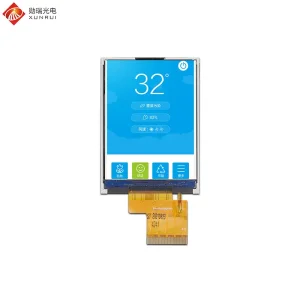
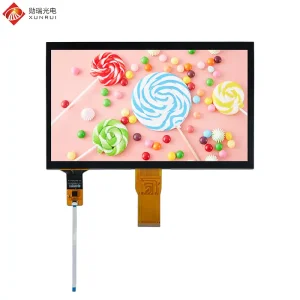
Precision Small & Medium Industrial TFT LCD Modules
Explore our core engineering catalog featuring TN/IPS viewing matrices, ultra-responsive capacitive and resistive touch assemblies, and custom backlight options.

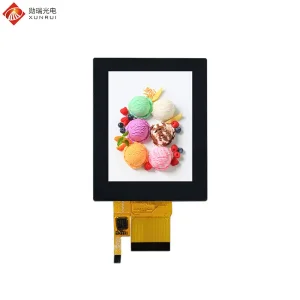
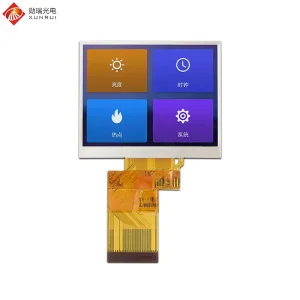
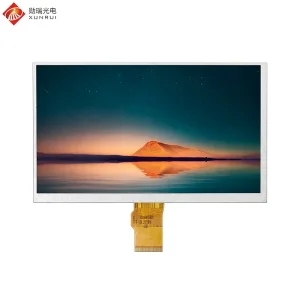




Engineering 4-Inch High Brightness Displays for Uncompromising Sunlight Readability
Achieving true outdoor readability requires far more than merely driving up current to LED lightbars. Our optoelectronic factory masters optical enhancement, advanced thermal paths, and anti-reflective polarization.
Custom LED Backlight Architecture
Standard displays emit between 250 and 350 nits, which washes out completely in direct solar exposure (10,000+ lux). Our custom 4-inch high-luminance designs employ custom-binned Nichia or Epistar LED arrays generating 800 to 1,500+ nits. Coupled with enhanced Light Guide Plates (LGP) and Dual Brightness Enhancement Films (DBEF), we maximize forward-collimated luminous efficiency while maintaining low overall wattage.
Full Optical Bonding (OCA/OCR)
Traditional air-gap bonding leaves two internal refractive boundary layers that bounce ambient light back to the viewer, washing out contrast. Our dust-free Class 1,000 cleanroom facilities perform full optical bonding using optical grade silicone or UV curable adhesives (OCA/OCR). This technique eliminates internal reflections, boosts ruggedized impact resistance, prevents condensation fogging, and achieves clear readability in broad daylight.
Thermodynamics & LED Aging Defense
High-candela backlights generate localized thermal buildup that causes traditional nematic liquid crystals to transit into an isotropic black phase (solar clearing failure). We engineer high-clearing-point liquid crystal fluids (Tni > 105°C) combined with thermal interface graphite sheets, cold-rolled copper heat Spreaders, and integrated FPC thermistors for automated Pulse-Width Modulation (PWM) thermal throttling.
| Performance Parameter | Standard Commercial Display | Xunrui Enhanced 4" High Brightness | Engineering Benefit |
|---|---|---|---|
| Luminance Output | 250 – 350 cd/m² (Nits) | 800 – 1,500 cd/m² (Customizable) | Crisp visibility under direct 10,000+ Lux solar illuminance |
| Bonding Technology | Perimeter Tape (Air Gap) | Full Optical Bonding (OCA/OCR) | Eliminates internal air bounce, blocks moisture, adds impact strength |
| Operating Temperature | -10°C to +60°C | -30°C to +85°C (Extended Automotive) | No crystallization freezing in sub-zero or black screen solar clearing |
| Surface Optical Coatings | Clear Glossy Polycarbonate | AG (Anti-Glare) + AR (Anti-Reflective) + AF | Reflectance reduced below 1.2%, resists surface dirt and smudges |
| Backlight MTBF Lifetime | 20,000 – 30,000 Hours | 50,000 – 70,000 Hours (Half-life) | Reduced field RMA overhead and extended operational life |
Localized Applications for Custom 4-Inch High Brightness Displays
The compact 4-inch form factor balances dense information delivery with tight physical dimensions. Here is how our custom high-nit displays perform across harsh environments.
Electric Two-Wheelers & E-Bikes
Motorcycle instrumentation clusters and smart e-bike dashboards require compact, waterproof displays exposed to changing light. Our 4-inch square and 720x720 IPS round/square formats provide 1,200 nits, wide angles, and glove-operable capacitive touch surfaces resistant to rainwater pooling.
Field Barcode & RFID Scanners
Warehouse yards, intermodal shipping ports, and cross-docking hubs require handheld terminals that survive direct sunlight. Our customized 4-inch 480x800 portrait IPS modules offer 1,000-nit luminance with power-saving backlights that safeguard mobile battery cycles.
Commercial EV Charging Pedestals
Exposed directly to sun and weather, EV charging kiosks require UV-stabilized cover glass and high luminance. Xunrui supplies customized 4-inch auxiliary payment screens with IK08-rated chemically strengthened glass and polarizers that resist solar degradation.
Smart Agriculture & Marine Electronics
Tractor guidance consoles, irrigation gateways, and fishfinders demand moisture protection and daylight visibility. Our optical bonding with anti-glare etching prevents internal fogging and keeps displays readable through polarized sunglasses.
China Factory Direct: Shenzhen Supply Chain Resilience & Efficiency
Shenzhen Xunrui Optoelectronic Technology Co., Ltd. combines localized supply cluster advantages with rigorous ISO management, providing tier-one display customization to global OEMs.
Supply Chain Cluster Integration
Our facility in Bao'an District, Shenzhen, sits within an established optoelectronic ecosystem. Glass substrates, custom driver ICs (Sitronix, Ilitek, Solomon Systech), precision FPCs, and precision-cut backlight films are sourced within a 30-mile radius, cutting prototyping turnaround down to just 7 to 10 working days.
Lifecycle & EOL Stability
Consumer displays often suffer from short lifecycles and frequent end-of-life notices. Xunrui focuses on industrial customers by maintaining long-term glass allocations through BOE, HannStar, and IVO. We offer stable product roadmaps of 5 to 7+ years with pin-to-pin drop-in replacement strategies when components retire.
Engineering-Led Co-Design
We work directly with your engineering teams to eliminate integration friction. From matching signal interfaces (RGB 24-bit, MIPI DSI, SPI, MCU, LVDS) to designing custom FPC bend reliefs and tuning custom touch controller firmware, we streamline development from prototype to mass production.
Technology Roadmap: The Next Generation of 4-Inch Display Modules
Display architectures continue to advance. Our R&D pipeline targets lower power draw, superior black levels, and integrated processing.
Phase 1: Local Dimming Mini-LED Backlights
Traditional high-brightness edge-lit backlights illuminate the entire panel continuously, consuming significant energy. We are migrating high-end 4-inch displays to direct-lit Mini-LED arrays featuring hundreds of individual local dimming zones. This delivers 2,000+ nits peak brightness, true dark blacks, and cuts battery power consumption by up to 35%.
Phase 2: Hybrid Transflective Pixel Structures
For applications where backlights cannot remain active continuously, Xunrui is testing transflective pixel architectures that use ambient sunlight as an illumination source. In high solar environments, reflective layers illuminate the pixel matrix naturally, allowing the LED backlight to throttle down and save power.
Phase 3: Smart Embedded HMI Driver Modules
Future iterations integrate graphics engines directly onto the display sub-assembly. By combining our 4-inch high-nit displays with integrated ESP32-S3 or ARM Cortex-M microcontrollers and pre-flashed GUI firmware engines, system designers can deploy a sunlight-readable interface over simple UART, RS485, or CAN-bus protocols without complex display routing.
International Compliance & Rigorous Quality Verification
Exporting to European, North American, and Asian OEM sectors requires complete regulatory documentation and verifiable reliability testing across all shipments.
ISO 9001 & ISO 14001
Our operations follow ISO 9001 quality management and ISO 14001 environmental frameworks. From cleanroom air particulate control to raw material batch tracking, every unit is documented and auditable.
RoHS, REACH & WEEE
All display sub-components—polarizers, glass substrates, bonding adhesives, and driver chips—comply with EU RoHS 3 (Directive 2015/863) and REACH SVHC mandates, with full laboratory compliance declarations provided.
EMC & ESD Tolerance
Industrial machinery generates significant electromagnetic noise. Our custom touch assemblies feature dedicated ground planes and differential shielding, meeting IEC 61000-4-2 (air 15kV, contact 8kV) and reducing EMI interference.
Climatic & Vibration Stress
Displays undergo environmental stress tests including high-temperature/high-humidity storage (60°C/90% RH, 500h), thermal shock cycles (-30°C to +85°C), and 3-axis harmonic vibration tests to ensure field durability.
Frequently Asked Questions on Custom 4-Inch High Brightness Displays
Key technical and procurement answers addressing display integration, thermal design, and manufacturing options.
What brightness level is required for true sunlight readability on a 4-inch display?
For standard shade or indirect daylight, 500 to 700 nits provides basic visibility. However, for direct, unshaded sunlight exposure (such as motorcycle handlebars, field agriculture equipment, or marina docks), you need a minimum of 800 to 1,000+ nits. When paired with an Anti-Reflective (AR) surface coating and full optical bonding, contrast ratios remain strong even under 10,000 to 15,000 lux illumination.
How does Xunrui protect high-brightness displays from thermal damage?
Driving high-lumen LED arrays produces localized heat that can cause solar clearing if temperatures reach 80°C. We use industrial glass with high liquid crystal clearing points (Tni > 105°C), high-conductivity aluminum or copper backplates, and graphite heat-spreading tapes. In addition, our driver boards feature PWM brightness control to automatically lower output if internal sensors detect temperature spikes.
What is the minimum order quantity (MOQ) for custom tooling?
We support engineering development by offering flexible production stages. Once mechanical and electrical drawings are signed off, we provide sample fabrication (typically 5 to 10 prototypes). After testing, we run a low-risk pilot batch of 5 to 500 units. Mass production orders generally start at 1,000+ units, though standard shelf models feature lower minimums.
What touch panel options work best with high-luminance displays?
Projected Capacitive (PCAP) touch with optical bonding is the standard choice. We configure custom touch controller ICs (such as Goodix or FocalTech) with firmware tuned for wet finger rejection, salt spray immunity, and 2mm to 5mm safety cover glass compatibility. For heavy electrical noise or gloved factory environments, high-durability analog resistive (RTP) touch remains available.
Which video interfaces can be integrated onto a custom 4-inch panel?
We accommodate various host architectures. Common 4-inch display interfaces include RGB 18/24-bit, MIPI-DSI (1 or 2 data lanes for high refresh), MCU 8080/6800, and 3/4-wire SPI for lower microcontroller pin counts. For turn-key monitors, we build compact adapter boards accepting HDMI, USB Type-C, or analog composite video inputs.
How does optical bonding differ from traditional air gap tape bonding?
Air-gap tape bonding leaves a hollow air layer between the LCD polarizer and the cover lens. This boundary creates two internal reflective surfaces, bouncing approximately 8.5% of incoming ambient light and causing washed-out contrast. Full optical bonding fills this cavity with refractive-matched adhesive (n ≈ 1.49), reducing reflections to below 1.2%, increasing impact resistance, and preventing internal condensation.
High-Reliability Industrial TFT LCD Production Series
Direct factory supply of high-brightness IPS modules, custom aspect ratios, and integrated touch screen hardware ready for fast prototyping and high-volume deployment.