
Specialized Embedded TFT Modules & Panels
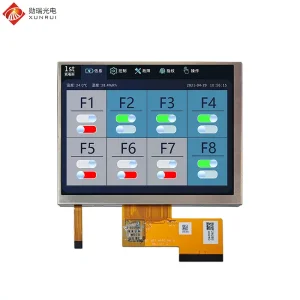
Direct factory production lines offering wide optical view angles, integrated custom driver topologies, and anti-glare capacitive stack configurations.








Evolutionary Trends of the 3.5 Inch Display Ecosystem
From single-pixel legacy matrixes to high-resolution IPS, sunlight-readable optical stacks, and edge-AI enabled smart instrumentation.
Sunlight Readability & Optics
Standard indoor luminances (250–350 nits) fail in high-ambient exterior fields. Tier-one factories now integrate low-die-count, ultra-efficient LED backlights delivering 800 to 1,200 nits, reinforced by index-matched optical bonding (OCA/LOCA) that reduces internal surface reflection from 4.5% to under 0.2%.
Broad-Spectrum Controller Interfaces
System architects face fragmentation across silicon families. Chinese manufacturing hubs address this by delivering 3.5 inch displays customized with pin-compatible FPCs supporting 8/16/18/24-bit RGB, high-speed 4-lane MIPI-DSI, SPI+RGB hybrid serial buses, or embedded MCU-8080 parallel architectures.
Extreme Thermal Survivability
Industrial IoT terminals operate in unconditioned arctic or desert deployment zones. Modern cleanroom manufacturing employs specialized negative-dielectric-anisotropy liquid crystal solutions, maintaining dynamic contrast ratios without pixel lag down to -30°C and thermal clearing stability up to +85°C.
China Factory 4.0: Supply Chain Resilience & Structural Efficiency
How Chinese optoelectronic industrial parks leverage precision automation, integrated upstream sourcing, and ISO-governed gates to de-risk OEM lifecycles.
Automated COG & FOG Micro-Bonding
Manual bonding produces hot spots and premature trace delamination. Advanced factories in Shenzhen and the Pearl River Delta deploy Class 100/1000 cleanroom robotic lines with microscopic visual alignment (CCD) to precisely seat Driver ICs and Flexible Printed Circuits with micron tolerance, maximizing yield across high-volume production cycles.
Vertical BOM Supply Cohesion
Lead times cripple hardware roadmaps. Sourcing from localized Chinese clusters provides immediate geographic proximity to glass foundries, driver silicon houses (e.g., ST7789V, ILI9488, HX8357), ITO touch film slitters, and precision backlight frame injection moulders—collapsing prototype tooling cycles from quarters to weeks.
Multi-Tier Reliability Verification
Rigorous compliance hinges on multi-stage defect screening. Fully vetted facilities implement 5-tiered verification: Incoming raw material QC (IQC), raw glass substrate screening, FOG optical testing with 72-hour thermal burnout aging, finished-module environmental shock chambers, and outgoing automated optical quality control (OQC).
Target Application Landscapes for 3.5 Inch Displays
From handheld medical diagnostic probes to automotive diagnostics and industrial sub-stations.
Portable Medical Monitoring
Handheld vein finders, mobile infusion monitors, and field defibrillators prioritize pixel density and wide IPS viewing cones. Custom 3.5 inch modules feature antibacterial chemically strengthened cover glass (CSG) resistant to harsh chemical sterilizers.
Payment Terminals & Smart POS
Secure handheld payment systems require integrated capacitive touch modules capable of water-drop rejection and palm-rejection logic, fully certified for strict ESD and mechanical drop resistance under standard retail conditions.
Smart Thermostats & Building HMI
Sub-system residential controllers demand long product lifecycles without image retention. Tailored 3.5-inch displays offer deep black levels, sleek rounded bevels, and simple UART/SPI bus connectivity to pair seamlessly with inexpensive microcontrollers.
Direct-From-Factory LCD Modules & Custom Touch Panels
Scalable order profiles engineered for precision compliance across global industrial, automotive, and commercial deployments.







Frequently Asked Questions: Sourcing from Chinese 3.5" Factories
Answers to common supply-chain, technical engineering, and manufacturing questions from global procurement specialists.