
Engineered Display Modules & Integrated Solutions
Explore precision-fabricated TFT LCDs with integrated touch sensors, wide-temperature driver boards, and custom optical enhancements built for extreme field environments.




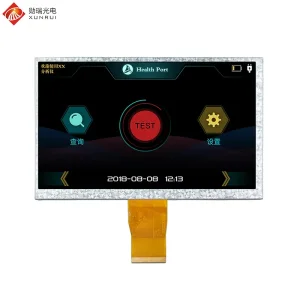



Engineering 4-Inch Touch Screen Displays for Next-Gen Human-Machine Interfaces
In modern industrial automation, IoT smart infrastructure, and portable medical electronics, the 4-inch display tier represents the critical nexus between compact mechanical enclosures and rich graphic interaction.
The Golden Ratio of Embedded Visualization: Why the 4-Inch Form Factor Dominates
The 4.0-inch touch screen footprint occupies a unique position in product design. Unlike smaller micro-displays (0.96" to 2.4") that only convey basic telemetry, or larger panels (7.0" to 15.6") that demand substantial thermal dissipation, high power draw, and expansive chassis cuts, the 4-inch module accommodates complex graphical user interfaces (GUIs), multi-layer menu trees, touch gesture recognition, and variable-angle readability while preserving battery budgets and fitting standardized mechanical envelopes (such as European 86×86 mm wall boxes, handheld scanner grips, and DIN-rail instrument frontages).
Shenzhen Xunrui Optoelectronic Technology Co., Ltd. (XUNRUI) engineers custom 4-inch touch display modules engineered to counter field failure modes: optical reflection washout under direct sun, electromagnetic noise interference (EMI) from variable frequency drives, false triggers from ambient moisture, and thermal stress across -30°C to +85°C operating bands. By bridging chip-on-glass (COG) assembly, flex-on-glass (FOG) hot-bar bonding, optical clear adhesive (OCA/LOCA) lamination, and customized sensor controller firmware, XUNRUI offers tier-one international OEMs an uncompromised hardware platform.
Square 4.0" (480×480 & 720×720)
Engineered for symmetrical architectural HMIs, smart thermostats, luxury HVAC dials, and industrial rotary knobs. Provides consistent aspect ratio graphics and balanced peripheral viewing with ultra-thin symmetric bezel framing.
- Active Area: ~71.8 × 71.8 mm
- Interface: SPI+RGB, MIPI-DSI 2-lane
- Viewing Tech: IPS All-Direction (85/85/85/85)
Vertical 4.0" (480×800 WVGA)
Optimized for rugged mobile data collectors (MDC), handheld RFID scanners, and portable medical telemetry devices. Slim horizontal profile allows single-handed ergonomic operation with dense tactical data rendering.
- Subpixel Density: High-PPI crisp font rendering
- Touch Type: Projected Capacitive (PCAP) multi-touch
- Cover Lens: Chemically strengthened Gorilla / Dragontrail
Rotary & Hybrid Shaped 4.0"
Integrates precision circular cutouts or rotary mechanical encoders directly through the center of the active glass matrix, creating tactical rotary smart knobs with central touch confirmation for smart appliances and automotive switchgear.
- Custom Cover Lens: CNC routed hole & step edges
- Integration: Anti-fingerprint (AF) & anti-glare (AG)
- Bus Protocols: I2C touch + SPI/MCU graphic pipelines
Engineering Architecture: Optical Bonding vs. Air Gap in 4" Form Factors
A granular technical comparison for systems architects balancing optical performance, impact durability, ambient reflections, and procurement expenditure.
| Evaluation Parameter | Full Optical Bonding (OCA / LOCA) | Air Gap Perimeter Tape Lamination | Engineering Design Implication |
|---|---|---|---|
| Internal Reflectance (%) | < 0.5% (Index-matched to glass n=1.52) | ~ 4.5% - 8.5% (Glass-to-air refractive jump) | Optical bonding eliminates washed-out blacks and glare in sunlight. |
| Sunlight Legibility | Requires 600 - 800 nits for complete legibility | Requires 1000 - 1400+ nits to punch through glare | Optical bonding cuts backlight power draw and thermal build-up by 40%. |
| Parallax Error (Touch) | Zero parallax (Touch layer bonded directly to polarizer) | Noticeable parallax (0.3mm to 1.0mm air gap depth) | Vital for fine GUI touch targets, high precision stylus, or angled viewing. |
| Condensation & Dust Ingress | 100% Hermetically sealed; zero condensation risk | Risk of internal fogging during thermal cycling (-20°C to +60°C) | Critical for IP65/IP67 rated outdoor enclosures and medical washdown units. |
| Mechanical Impact (IK Rating) | Resists up to IK08 / IK09 with 2.0mm tempered cover glass | IK05 / IK06 (Air pocket flexes LCD cell under center impact) | Bonded resin layer absorbs kinetic energy across the entire aluminum frame. |
| Tooling & Rework Cost | Moderate tooling for autoclave jigs; higher module cost | Lowest upfront tooling; quick assembly turnaround | Air gap is preferred for cost-sensitive indoor instrumentation with static lighting. |
XUNRUI Engineering Recommendation: Optical Bonding for Harsh Deployment
For any 4-inch touch screen operating in outdoor kiosks, industrial machinery exposed to high ambient luminance, or medical devices undergoing chemical wipe-down, full optical bonding with silicone LOCA or solid optical clear adhesive (OCA) is the industry standard. It eliminates the refractive index boundary between the cover glass (n≈1.51) and the air gap (n≈1.00), preventing the reflection of ambient lumens and ensuring uninterrupted contrast even in direct 10,000+ lux sunlight.
Localized Applications & Mission-Critical Implementations
How XUNRUI’s customized 4-inch touch display modules solve mission-critical interface challenges across diverse industrial and commercial domains.
Smart Building Automation & 86-Box Wall Switches
Architectural control systems demand square 4.0-inch 480×480 IPS displays fitted flush into standard 86×86 mm electrical back boxes. XUNRUI provides custom chamfered black-mask cover glass with 2.5D curved borders, integrated ambient light sensors, and low-power wake-on-touch algorithms that reduce idle power draw to under 15 mW.
- Eliminates color shift with IPS 85/85/85/85 viewing cones
- Customized silk-screen logos and icons on sub-surface ink layers
- Direct SPI or 24-bit RGB interface compatible with ESP32-S3 and STM32 MCUs
Handheld Medical Diagnostics & Infusion Controllers
Medical devices require sterile operability and zero failure tolerance. XUNRUI integrates projected capacitive (PCAP) touch sensors calibrated with proprietary controller firmware (FocalTech / Goodix / ILITEK) supporting medical nitrile glove tracking and water-droplet rejection, allowing error-free operation during fluid sprays.
- Anti-Microbial and Oleophobic (AF) glass coatings
- High ESD tolerance: Air ±15kV, Contact ±8kV compliance
- Medical grade 5-year guaranteed component longevity roadmap
EV Charging Stations & Outdoor Payment Terminals
Subjected to brutal solar exposure and freezing winters, outdoor electric vehicle supply equipment (EVSE) demands displays with 1000+ nits luminance, anti-ultraviolet (UV) polarizing films, and operating ranges from -30°C to +80°C without isotropic liquid crystal blacking (clearing point > 105°C).
- IK08 vandal-resistant 3mm chemically tempered cover glass
- Anti-Glare (AG) chemical etching prevents surface mirror reflection
- Constant-current LED driver boards with PWM dimming feedback
Industrial Robotics & Teach Pendants
Operators in robotic cells handle teach pendants under high electromagnetic vibration, motor noise, and greasy workshop conditions. XUNRUI engineers ruggedized 4-inch vertical and square TFTs backed with copper foil EMI shielding, differential LVDS/MIPI signaling, and thick-glove tracking algorithms.
- Reinforced FPC tail with teardrop stress-relief geometry
- 4-wire resistive touch (RTP) or shielded PCAP touch panel options
- Resistance to heavy hydraulic oil and industrial chemical wipes
Smart Security Access & Biometric Intercoms
Modern access control requires crisp visual feedback for facial recognition scanning and pin entry. XUNRUI’s high-PPI 4-inch IPS displays provide vivid contrast and true color reproduction with high-speed MIPI interfaces capable of rendering 60 fps streaming video without ghosting.
- Narrow borders maximizing active display area within compact frames
- Integrated infrared (IR) ink windows for hidden proximity/light sensors
- Optical bonding preventing condensation behind security glass
Cold-Chain Logistics & Handheld Barcode Scanners
Scanners transition rapidly between freezing -20°C refrigerated warehouses and humid +35°C outdoor loading bays. XUNRUI’s thermal management engineering incorporates fast-response liquid crystals and built-in FPC heaters that maintain snappy 25ms refresh rates under zero sub-zero sluggishness.
- Low power consumption extending mobile battery shift life past 12 hours
- Drop-tested mechanical chassis designs absorbing 1.8-meter drops to concrete
- High-reliability gold-plated connector contacts resisting oxidation
China Supply Chain Resilience: Scale, Speed & Engineering Agility
How XUNRUI leverages the world’s most concentrated optoelectronics manufacturing cluster to deliver unmatched lead times, structural cost benefits, and risk-managed delivery.
Substrate Ecosystem Integration
Located in Shenzhen's Bao'an optoelectronics corridor, XUNRUI maintains direct glass substrate allocation agreements with leading glass foundries (BOE, Innolux, HannStar). This guarantees steady supply, stable cell pricing, and immunity to international market raw material allocations.
10-Day Prototyping Turnaround
While Western suppliers quote 8 to 12 weeks for custom FPC fabrication and glass tooling, XUNRUI’s in-house CAD tooling and dedicated CNC mask cutters churn out engineering verification prototypes (EVT) in as fast as 10 to 14 business days, slashing time-to-market.
5 to 500 PCS Low-Risk Trials
Traditional Tier-1 LCD fabs force rigid minimum order quantities of 50,000 units. XUNRUI eliminates startup risk by providing small-batch pilot validation runs (5 to 500 units) after sample signoff, letting engineering teams test market viability before mass tooling investment.
Fully Automated Cleanrooms
Operates ISO Class 1,000 and Class 10,000 dust-free cleanrooms equipped with high-speed automated COG chip bonders, laser polarizers, auto-dispensing LOCA machines, and temperature-controlled curing tunnels ensuring micron-level accuracy.
Technology Roadmap: Next Horizons in Small-Format Industrial Displays
Anticipating the technological shifts transforming embedded human-machine interfaces over the coming five-year cycle.
Mini-LED Local Dimming Backlights
Transitioning from perimeter edge-lit LED strips to 500+ zone direct-lit Mini-LED arrays in 4-inch modules. This unlocks true HDR rendering, infinite contrast ratios exceeding 100,000:1, and deep blacks for dark industrial cockpits while dropping power consumption by 35% on dark UI palettes.
Edge-AI Driven On-Cell Touch Controllers
Next-gen touch ICs embedded directly on the TFT array (TDDI - Touch and Display Driver Integration) featuring onboard neural hardware inferencing. These controllers recognize hand gestures, intentional hovering, accidental palm strikes, and adjust capacitive sensitivity in real-time to water film interference.
Ultra-Resilient Nano-Coated Cover Materials
Incorporating synthetic sapphire-infused aluminosilicate glasses, vacuum ion-sputtered anti-glare (AG) finishes that maintain diffusion without sparkling, and permanent chemically covalently bonded oleophobic treatments lasting over 100,000 abrasion steel-wool cycles.
Five-Stage Gate Quality System & International Standards
Zero-defect manufacturing certified under ISO 9001 and ISO 14001, providing complete component traceability and test data audits for every production lot.
Stage 1: IQC (Incoming Raw Material Verification)
100% incoming optical inspection on raw TFT cell glass, driver ICs, FPC circuits, and LED dice. Glass thickness checked via optical interferometry to ±0.01mm. Polarizers checked for zero bubbles, scratches, or micro-pinholes.
Stage 2 & 3: COG/FOG Laser Alignment & Thermal Burn-In
Automatic anisotropic conductive film (ACF) bonding with laser-guided sub-micron accuracy. FOG assemblies undergo continuous 72-hour power-on aging under elevated thermal chambers (+50°C) to eliminate infant mortality.
Stage 4 & 5: Final Module Optical Test & OQC Audit
Computerized luminance meter measuring chromaticity coordinates (CIE 1931), white balance uniformity (>85%), contrast ratio, touch linearity calibration, and MIL-STD-105E Level II sampling outgoing quality check (OQC).
Answers to Critical Engineering & Procurement Inquiries
In-depth responses from XUNRUI’s field application engineers (FAE) covering hardware interfaces, touch tuning, optical customization, and supply longevity.
Expanded Display & Driver Module Portfolio
Explore XUNRUI's wider matrix of touch panels, high-resolution portrait screens, circular knobs, and turn-key HDMI driver kits engineered for mission-critical deployments.







Initiate Your 4-Inch Custom Display Project
Speak directly with our senior optoelectronic hardware engineers in Shenzhen. From initial CAD drawing review and FPC schematic routing to sample fabrication and optical bonding, XUNRUI accelerates your production timeline.
Facility Location: 2nd Floor, Building 21, Hualun Science and Technology Park, Fenghuang Xingye 1st Road, Fuyong Sub-district, Bao'an District, Shenzhen, China.