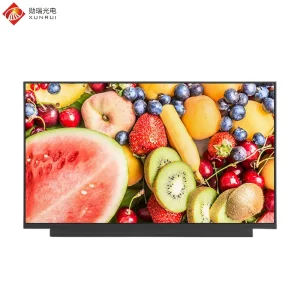
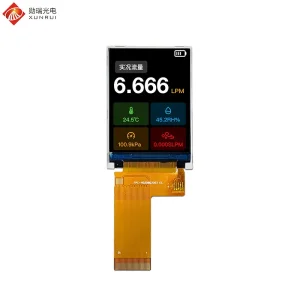
0.96"–27"
Full Display Spectrum Scalability
2,000,000
Monthly Cleanroom Output (PCS)
-30°C~+85°C
Extreme Wide Operational Range
5-Stage QC
IQC, Glass, FOG, Burn-In, OQC
Precision Engineering Portfolio
Featured Industrial Optoelectronic Modules
Explore our foundational standard and high-performance modules engineered for demanding mission-critical deployments across automation, smart cockpits, marine instruments, and mobile terminals.






Technical Architecture
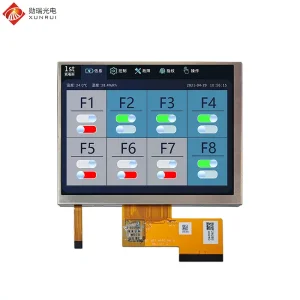
Strategic Anatomy of the 5.7-Inch TFT Matrix
Why the classic 4:3 aspect ratio paired with modern IPS glass remains the gold standard for global industrial automation, instrumentation, and medical diagnostics.
In the rapid evolution of human-machine interfaces (HMI), the 5.7-inch TFT display screen occupies a uniquely resilient architectural position. While consumer electronics have relentlessly trended toward ultrawide aspect ratios (18:9, 20:9) and thin glass substrates prone to mechanical stress, industrial embedded controllers, diagnostic cardiology carts, and harsh marine navigation systems continue to rely on the venerable 4:3 geometry. At standard 640×480 VGA resolution, this panel size strikes an optimal optical balance between computational overhead, tactile operational targets, and electrical efficiency.
Shenzhen Xunrui Optoelectronic Technology Co., Ltd. (XUNRUI) designs and manufactures 5.7-inch modules that bridge legacy electrical architectures with next-generation solid-state materials science. By transitioning traditional twisted nematic (TN) cells into wide-angle In-Plane Switching (IPS) matrices, our engineering teams eliminate the optical inversion phenomena that historically plagued operators viewing instrumentation from oblique angles. An all-direction 85°/85°/85°/85° symmetrical viewing cone ensures that critical diagnostic metrics or high-voltage alarms remain uncompromised, regardless of ambient illumination or operator positioning.
Furthermore, the mechanical footprint of the 5.7-inch form factor directly aligns with established DIN-rail enclosures, NEMA front bezels, and 19-inch rackmount subsystems. Choosing a China-based source with captive tooling and direct cleanroom FOG (Flex-on-Glass) bonding capability mitigates obsolescence risks, providing a secure bridge between twenty-year machine lifecycles and modern optoelectronic component streams.
Optical & Electro-Mechanical Core Specs
Engineered specifically to solve high-vibration, high-EMI, and thermal swing challenges in mission-critical hardware:
- Active Matrix Dimensions: 5.7-inch diagonal, precise 115.20 (H) × 86.40 (V) mm active area.
- Resolution & Density: 640×RGB×480 (VGA), achieving ~140 PPI for razor-sharp vector schematics and clinical waveforms.
- Luminance Scalability: From 400 nits (standard indoor HMI) up to 1,200 nits (sunlight-readable transmissive backlights with constant-current drivers).
- Interface Versatility: Direct native support for 18/24-bit Parallel RGB, single-channel LVDS, SPI bridge architectures, and low-EMI MIPI-DSI.
- Touch Layer Integration: Optically bonded Projected Capacitive (PCAP) with I²C/USB controllers or 4-wire high-durability Resistive (RTP).
Supply Chain Strategy
Global Enterprise Procurement & Lifecycle Governance
Navigating component obsolescence, multi-tiered supplier risks, and localized integration frameworks across European, North American, and Asian markets.
Eradicating Obsolescence
Tier-1 silicon and glass foundries frequently sunset 4:3 production runs in pursuit of hyper-volume smartphone glass. XUNRUI insulates procurement directors by locking long-term supply agreements on raw mother glass and keeping form-fit-function FPC designs consistent for 5 to 7-year continuous production windows.
Direct Factory BOM Control
Bypassing regional display distributors eliminates compounding markup margins and multi-tier logistics delays. Sourcing directly from our Shenzhen production hub grants international procurement heads total bill-of-materials (BOM) transparency down to the driver IC, LED phosphor chemistry, and optical polarizer supplier.
Flexible Production Runs
To mitigate capital expenditure during qualification stages, we provide structured ramp-up pathways: from rapid prototyping, to an agile 5–500 pcs pilot trial batch, followed by scalable mass production (1,000+ pcs MOQ) backed by buffer stock holding agreements for predictable forecasting.
Macro Solutions
Industrial Vertical Solutions Matrix
How our 5.7" display screen integrations solve concrete environmental, electrical, and optical challenges across key global markets.
Industrial HMIs & PLC Terminals
Machinery operating floors generate tremendous electromagnetic interference (EMI) from servo motors and contactors. Our 5.7" modules feature multi-layered ground shielding on custom FPC layouts and high-noise-immunity resistive or capacitive touch sensors that comply with strict IEC 61000-4-2 ESD and IEC 61000-4-3 radiated susceptibility standards.
Medical Diagnostic Devices
Infusion pumps, blood gas analyzers, and portable defibrillators mandate absolute chromatic fidelity and anti-bacterial hygiene. We integrate customized cover glass with antimicrobial and anti-fingerprint (AF) coatings, paired with high-contrast IPS glass to ensure medical staff can read patient vitals instantly without parallax distortion or false touch triggers from latex gloves.
Fleet Management & Heavy Cab Telematics
In agricultural combines, forklifts, and construction excavators, screens face extreme solar loading and severe vibrational acceleration. XUNRUI's 1000+ nit sunlight-readable LED backlights, combined with optical bonding (OCA/LOCA) to eliminate internal reflections, prevent condensation fogging and withstand shock up to 50G.
Optoelectronic Specification
5.7" Industrial Display Comparative Architecture
Direct engineering comparison showing how XUNRUI’s industrial grade IPS modules compare against generic market alternatives.
| Performance Parameter | XUNRUI Industrial Grade 5.7" IPS | Commercial Commodity 5.7" TN | System Architecture Impact |
|---|---|---|---|
| Display Matrix | Normally Black IPS Mode | Normally White TN Mode | Preserves 85° all-around visual angles without grayscale inversion |
| Optical Luminance | 800 to 1,200 cd/m² (Configurable) | 250 to 350 cd/m² | Guarantees direct sunlight readability under high solar ambient lumens |
| Operating Temperature | -30°C to +85°C Extreme Grade | -10°C to +60°C Standard | Eliminates liquid crystal freezing in arctic cold or sluggish switching in desert heat |
| Backlight Half-Life (MTBF) | 50,000 Hours (Nichias LED Dice) | 20,000 Hours | Reduces field replacement costs and extends total machine warranty windows |
| Touch Sensor Technology | Optically Bonded PCAP / Anti-Glare Glass | Air-Gap Resistive Plastic Layer | Prevents internal condensation, enhances impact rating (IK08+), supports multi-touch |
| Signaling Interface | RGB 18/24-bit, LVDS, MIPI-DSI, HDMI Board | Legacy MCU or strict 18-bit RGB | Simplifies routing on modern high-speed MPUs (NXP i.MX, STM32, TI Sitara) |
| Compliance Certification | RoHS, REACH, ISO 9001, ISO 14001 | Uncertified / Non-audited | Passes rigorous EU & North American customs and environmental audits seamlessly |
Future Horizons
Materials Science Roadmap: Evolution to 2030
Pioneering advancements in low-power liquid crystal formulations, high-thermal-conductivity backplanes, and intelligent driver integration.
Low-Power Transflective Stacks
For off-grid IoT sensors and mobile military instrumentation, power budgets are razor-thin. XUNRUI is actively qualifying transflective optical stacks for our 5.7" lines that repurpose incoming solar flux to illuminate the pixel plane, throttling active LED consumption down by as much as 75% during midday operations.
Embedded Micro-Driver Cores
Moving beyond conventional COG (Chip-on-Glass) packaging, our research lab is rolling out Chip-on-Film (COF) designs that integrate hardware graphic acceleration, CAN bus decoders, and SPI serial Flash directly onto the display's flex tail, dramatically reducing motherboard layout complexity for end customers.
Optically Bonded Smart Armour Glass
Modern factory floors demand robust surface protection against accidental tool drops, caustic washdowns, and UV degradation. Our display modules utilize chemical-strengthened Gorilla Glass or Dragontrail substrates up to 4.0mm thick, treated with dual Anti-Reflective (AR) and Anti-Glare (AG) etchings to maintain 94%+ total light transmission.
Quality Assurance
Shenzhen Cleanroom Manufacturing & 5-Gate Testing
How every single 5.7" TFT display screen traverses Class 1000/100 automated cleanrooms to guarantee zero-defect field reliability.
01
Gate 1: Incoming Quality Control (IQC)
Every batch of raw mother glass, ACF conductive film, and driver IC silicon undergoes automated visual inspection and sheet resistance spectroscopy. Polarizers are checked for bubble defects, micro-scratches, and polarization efficiency prior to lamination.
02
Gate 2: Fully Automated Cleanroom COG & FOG Bonding
In Class 100 clean zones, sub-micron precision alignment machines thermo-compress the driver IC directly onto the glass ITO leads (COG), followed by precision alignment of the flexible printed circuit (FOG). Automated optical inspection (AOI) validates conductive particle burst rates on 100% of joints.
03
Gate 3: Post-Bonding Optical & Electrical Inspection
The bonded liquid crystal cell is electrically energized using custom test patterns (red, green, blue, white, black, and grayscale gradations) to instantly identify any open/short traces, pixel gate leakage, or chromatic mura defects.
04
Gate 4: High-Temperature Thermal Aging Chamber Burn-In
Modules are loaded into environmental stress chambers running at +60°C to +80°C under continuous dynamic signal excitation for 24 to 72 hours. This thermal acceleration forces early life failures (infant mortality) to surface on the production line, not in your customer's field installations.
05
Gate 5: Final Outgoing Quality Control (OQC) & Mil-Spec Packaging
Comprehensive final audit inspecting mechanical dimensions, FPC pin pull strength, optical luminance uniformity across nine matrix zones, and ESD resistance. Completed assemblies are vacuum-sealed in anti-static, humidity-controlled, shock-absorbent packaging.
Technical Clarifications
Engineering & Procurement FAQ
In-depth technical answers addressing signaling protocols, custom mechanical tooling, driver matching, and environmental certification.
Why choose a 5.7" 640×480 TFT over widescreen or modern smartphone displays?
Industrial control software, diagnostic medical tools, and automation controllers were natively compiled for 4:3 SVGA/VGA coordinate structures. Upgrading to wide aspect ratios requires complete GUI redesign and software recertification (often impossible in regulated medical or aerospace environments). Furthermore, the 5.7" display provides optimal physical surface area for physical tactile keys or finger touch targets within standard DIN cutouts without occupying unnecessary enclosure volume.
What are the technical tradeoffs between RGB, LVDS, and MIPI on a 5.7" module?
Parallel RGB offers near-zero frame latency and straightforward driving via basic microcontrollers, but generates higher EMI and requires 20+ PCB traces. LVDS (Low-Voltage Differential Signaling) uses differential pairs, minimizing EMI and enabling longer signal cables between the motherboard and front panel display. MIPI-DSI delivers maximum data throughput with the fewest board traces, optimal for compact embedded processors running full Android or Linux stacks. XUNRUI offers custom driver board adapters to convert any of these to standard HDMI or VGA inputs.
How does XUNRUI achieve sunlight readability on outdoor 5.7" displays?
Sunlight readability requires addressing both source brightness and ambient surface reflectance. We engineer high-efficiency LED edge arrays driven by specialized constant-current circuits, pushing luminance past 1,000 cd/m². Concurrently, we utilize optical bonding (refractive index matched silicone or optical clear resin OCA) to eliminate the air gap between the cover glass and TFT polarizer. This eliminates secondary surface reflections, boosting effective contrast under 10,000+ lux direct ambient sunlight.
Can we customize the FPC cable pinout to match our legacy motherboard connector?
Yes. Custom FPC (Flexible Printed Circuit) development is our primary core competency. We can redesign FPC length, bend geometry, pin assignment, internal component filtering (bead inductors, ESD diodes), and ZIF termination pitch (0.5mm, 1.0mm, or board-to-board connectors) to ensure seamless drop-in mechanical and electrical interchangeability with discontinued panels.
Should we select Projected Capacitive (PCAP) or 4-Wire Resistive (RTP) for our project?
Choose PCAP if your application requires smooth multi-touch gestures, a flush edge-to-edge true flat glass aesthetic, easy chemical wipe-down, or high impact resistance (IK07/IK08). Choose Resistive (RTP) if operators will wear thick industrial work gloves, work in environments with heavy water spray/fluids, or operate near extreme electrical noise where capacitive sensing might suffer false positive inputs.
What is the MOQ and development lead time for a customized 5.7-inch display project?
Engineering drawings are typically issued within 3 to 5 business days following formal requirement alignment. Custom tooling samples (including custom FPC and cover glass) are shipped within 3 to 4 weeks. After your team validates and approves samples, we support a flexible 5 to 500 pcs pilot production run. Subsequent mass-production orders are subject to a modest 1,000 pcs MOQ, with long-term buffer stocking arrangements available for volume contracts.
Complete System Catalog
Specialized Compact & Wide-Format Displays
Complementing our 5.7" display modules, explore our full spectrum of specialized panels engineered for IoT instrumentation, handheld diagnostics, and high-ambient cockpits.