
Standard & Custom TFT LCD Display Modules
Directly manufactured at our 5,000m² Shenzhen cleanroom facility. Fully customizable pin-outs, sunlight-readable backlights, and precision-matched touch sensors.

China 3.5 inch TFT LCD display 320×240 RGB 54pin interface 350nit TN Screen
View Product Specs
China 5 inch 480×272 TN TFT LCD Module with capacitive touch panel
View Product Specs
China 1.8 inch 360×360 MIPI 30pin 400nit IPS Circular TFT LCD Module
View Product Specs
Custom 2.8 inch 240×320 SPI 10pin 250nit TN TFT LCD Display
View Product Specs
Custom 4.3 inch 480×272 MCU/SPI 40pin 350nit TN TFT LCD Display
View Product Specs
China 8 inch 1024×600 1300nit TN TFT LCD with capacitive touch panel
View Product Specs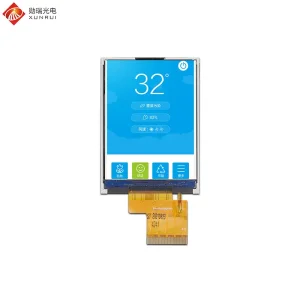
China 2.8 inch TN TFT LCD module 240×320 RGB 40pin interface 250nit
View Product Specs
Custom 4.3 inch TFT LCD 800×480 RGB 40pin interface 300nit IPS module
View Product SpecsThe 6.2-Inch Resistive LCD Module: Micro-Architecture & Physics
Why mission-critical embedded systems continue to mandate specialized 6.2" resistive TFT panels over capacitive architectures in demanding electrical and tactile environments.
Pressure-Actuated Contact Mechanics
Unlike projected capacitive (PCAP) panels that rely on dielectric coupling, our 6.2-inch resistive screens employ a high-purity dual-layer Indium Tin Oxide (ITO) structure. Actuation occurs mechanically when the flexible upper polyester (PET) film contacts the rigid bottom glass substrate across a 0.035mm spacer dot matrix. This physics model yields 100% deterministic touch inputs regardless of non-conductive heavy welder's gloves, rubber surgical gloves, or bare plastic/metallic styluses.
Uncompromising EMI / RFI Immunity
Capacitive screens frequently suffer from "ghost touches" or total lockup in heavy industrial spaces populated by variable-frequency drives (VFDs), welding arc equipment, high-voltage transformers, and unshielded switching power supplies. The 6.2" analog 4-wire/5-wire resistive touch interface is purely resistive and galvanic; it does not measure micro-volt electrostatic fluctuations, making it inherently impervious to conducted and radiated electromagnetic interference up to 30 V/m.
Complete Fluid & Environmental Resilience
In chemical processing plants, outdoor agritech consoles, and marine bridge systems, screens are routinely doused with saltwater, hydraulic lubricants, motor oil, and heavy rain. Where PCAP controllers misinterpret liquid puddles as finger touches, our 6.2-inch resistive touch surface remains completely neutral to standing pools of liquid, only recording input when intentional localized physical pressure is applied.
| Optoelectronic Parameter | Standard Industrial Grade | High-Brightness Sunlight Readable | Extreme Rugged / Automotive Spec |
|---|---|---|---|
| Active Screen Diagonal | 6.20 inches (157.48 mm) | 6.20 inches (157.48 mm) | 6.20 inches (157.48 mm) |
| Native Resolution | 800 × 480 (WVGA) / 1024 × 600 | 800 × 480 (WVGA) | 800 × 480 / Wide-Aspect Custom |
| Luminance (Backlight Output) | 350 – 450 cd/m² (Nits) | 800 – 1,200 cd/m² (Nits) | 1,000+ cd/m² with Auto-Dimming |
| Contrast Ratio | 500:1 to 800:1 | 800:1 typ. | 1000:1 IPS Enhanced Matrix |
| Viewing Angle (CR ≥ 10) | 70/70/50/70 (TN) or 85/85/85/85 (IPS) | Full Viewing IPS (85/85/85/85) | Full Viewing IPS (Super-TFT) |
| Touch Technology | 4-Wire Analog Resistive (RTP) | 5-Wire Precision Industrial Resistive | Armored Glass-Film-Glass (GFG) RTP |
| Surface Hardness & Coating | 3H Hard Coating (Anti-Glare) | 3H/4H Anti-Glare + Anti-Reflection | 7H Chemical Toughened Outer Layer |
| Touch Durability / Actuations | > 1.0 Million touches per point | > 10.0 Million touches (5-Wire) | > 35.0 Million touches (5-Wire GFG) |
| Operating Temperature | -20°C to +70°C | -30°C to +80°C | -40°C to +85°C (AEC-Q200 Qualified) |
| Signaling Interface | RGB 24-bit / TTL / MCU 8/16-bit | RGB 24-bit / 1-ch LVDS | Automotive LVDS / OpenLDI |
Technology Roadmap & Engineering Horizons
Continuous innovation within our Shenzhen R&D labs ensures that resistive touch technology evolves in harmony with next-generation display drivers and optomechanical demands.
Armored Glass-Film-Glass (GFG) Architecture
Traditional resistive screens utilize an exterior polyester (PET) film layer vulnerable to deep gouging from sharp metallic tools. Xunrui's latest 6.2-inch GFG (Glass-Film-Glass) roadmap integrates an ultra-thin (0.1mm) flexible chemically strengthened aluminosilicate glass cover on the touch surface. This achieves a scratch resistance rating of Mohs 7H while retaining 100% of the pressure-sensitive, glove-compatible resistive actuation benefits.
Index-Matched Direct Optical Bonding
Conventional air-gap bonding creates two internal reflective boundaries (PET-to-air, air-to-polarizer), wasting up to 13.5% of light transmission and washing out contrast in direct sun. Xunrui introduces cleanroom LOCA (Liquid Optical Clear Adhesive) bonding specifically calibrated to match the refractive indices (n=1.51) of the 6.2" TFT glass and touch sensor. This yields vivid sunlight viewability with a 30% reduction in LED backlight power consumption.
Multi-Touch Dual-Resistive Digitizers (AMR)
Addressing the historical limitation of single-point resistive tracking, our technical trajectory includes Analog Matrix Resistive (AMR) layouts for 6.2" displays. By partitioning the ITO layer into micro-matrix sensing intersections, the panel delivers pinch-to-zoom, dual-handed confirmation gestures, and rotation mapping—all while retaining full immunity to heavy grease, seawater, and conductive industrial solvents.
Macro Industry Applications & Field Deployments
Over 2,000,000 displays manufactured monthly across hundreds of mission-critical global OEM platforms. Here is how leading industries engineer around our 6.2-inch resistive screens.
1. Factory Automation, CNC & PLC Human-Machine Interfaces
Industrial production lines cannot tolerate downtime triggered by accidental touch triggers or controller crashes. Our 6.2" resistive TFT panels serve as the standard interface for European and American PLC controllers and robotic arm teach pendants. Line operators wearing heavy polyurethane-coated protective gloves can execute emergency shutdowns, adjust spindle speeds, and input numerical sequences without taking off safety gear. Tested for over 1 million actuations at any single coordinate without line drift.
2. Commercial Fleet Telematics & Off-Highway Vehicles
Agricultural harvesters, mining haulers, and long-haul refrigerated freight cabins undergo relentless mechanical vibration, wide cabin thermal swings (-30°C winter to +75°C solar loading), and direct sunlight exposure. We supply 6.2-inch wide-temperature panels configured with 1000-nit high-brightness backlights, constant-current LED drivers, and anti-glare polarizers. Even with thick dust layers or mud splatters on the display surface, navigation and hydraulic controls remain totally responsive.
3. Medical Diagnostic, Infusion & Sterilization Units
In operating theaters, intensive care units (ICUs), and field laboratories, touchscreens are aggressively sprayed and wiped with isopropyl alcohol, chlorine bleaches, and quaternary ammonium disinfectants. Our 6.2-inch resistive touch displays are constructed with specialized chemically inert exterior barrier films that resist chemical etching and delamination. Furthermore, medical personnel wearing double-layered sterile latex or nitrile gloves experience zero actuation delay.
4. Oil & Gas, Mining Exploration & Explosion-Proof Terminals
Deployments certified for ATEX / IECEx Zone 1 and Zone 2 hazardous explosive environments mandate hardware that cannot generate thermal hotspots or high-voltage capacitive sparks. Our 6.2" resistive low-voltage signal architecture complies effortlessly with intrinsic safety circuit requirements. The panels are ruggedized to withstand mechanical impact drops according to IK07/IK08 standards when paired with our reinforced laminated carrier glass.
China Factory 4.0: Shenzhen Xunrui Optoelectronics
Established in 2016, our 5,000m² manufacturing facility integrates automated FOG bonding, high-precision laser trimming, and rigorous 5-stage quality gating to deliver exceptional yield rates.
1. Gate 1: IQC Incoming Inspection
100% incoming optical and electrical inspection of raw glass substrates, ITO polyester rolls, driver ICs, and LED light bars. Spectrophotometer spectral verification guarantees color temperature consistency.
2. Gate 2: Cleanroom FOG Bonding
Class 1,000 / Class 100 cleanroom environment for automated ACF (Anisotropic Conductive Film) pre-attachment and precision hot-bar thermocompression FPC-to-glass bonding with sub-micron alignment accuracy.
3. Gate 3 & 4: Dual Thermal Aging
Both FOG sub-assemblies and fully packaged 6.2" LCD modules undergo a mandatory 72-hour burn-in stress test at 60°C and 90% relative humidity to eliminate premature component mortality and identify pixel anomalies.
4. Gate 5: OQC Outgoing Final Gate
Automated Optical Inspection (AOI) cross-examines 100% of panels for linearity, edge insulation resistance (≥ 20MΩ @ 25V DC), touch activation force (≤ 50g), optical transmission, and cosmetic integrity before vacuum sealing.
Global Enterprise Procurement Requirements
We engineer risk out of overseas sourcing. Tier-1 multinational procurement teams rely on our disciplined sample approval, trial run scaling, and transparent component lifecycle management.
Application & Enclosure Scoping
Our senior optoelectronics team evaluates your 3D enclosure CAD files, thermal dissipation envelopes, microcontroller timing constraints, and pin-out configurations before tooling capital is allocated.
Engineering Drawings & Approval
Detailed mechanical 2D/3D drawings, FPC schematic bend-radii specifications, touch tail pin assignments, and optical stack-up sheets are issued within 3 working days for customer review and formal sign-off.
Rapid Prototyping & Iteration
Custom tooling samples are fabricated in our Shenzhen rapid-prototyping lab and delivered via expedited air courier. Iterations continue without friction until your team verifies complete functional approval.
5–500 Pcs Pilot Trial Run
To eliminate production ramp risk, we support a one-time pilot batch of 5 to 500 units. This allows validation of surface-mount assembly, housing ultrasonic welding, and factory firmware compatibility.
Volume Mass Production (MOQ 1,000+)
Upon trial verification, high-volume automated manufacturing commences with consistent batch tracking, scheduled buffer stocking programs, and guaranteed raw material pre-allocation.
5–7 Year Product Longevity Assurance
We guarantee long-term availability for our 6.2-inch resistive LCD assemblies. A minimum 6-month Product Change Notification (PCN) and End-of-Life (EOL) last-time-buy window protects your regulatory lifecycle.
Compliance, Environmental Standards & Global Certifications
Shenzhen Xunrui Optoelectronic Technology operates under certified ISO systems, satisfying all import mandates for North American, European, and Asia-Pacific industrial corridors.
ISO 9001 & ISO 14001 Certified
Our complete operational apparatus—from supply-tier raw silicon qualification to wastewater management and electrostatic discharge (ESD) flooring—complies with independently audited ISO 9001 Quality and ISO 14001 Environmental management certifications.
RoHS & REACH Substance Compliance
Every component in our 6.2-inch resistive LCD modules—including optical adhesives, polarization sheets, flex circuits, and solder pastes—is strictly verified lead-free and free of hazardous substances in full alignment with EU RoHS Directive 2011/65/EU and REACH SVHC.
EMC & ESD Immunity Verification
Our modules undergo third-party laboratory verification for electromagnetic compliance according to EN 55032 / EN 55035 guidelines, sustaining electrostatic discharges of ±8kV contact and ±15kV air discharge without controller reset or latch-up.
Frequently Asked Questions: 6.2" Resistive Displays
Direct technical answers to questions commonly raised by system architects, procurement leads, and embedded hardware engineers.
Why choose a 6.2-inch resistive screen over a capacitive (PCAP) touch display for industrial equipment?
What is the difference between 4-wire and 5-wire resistive touch on the 6.2" display?
Can the backlight brightness of the 6.2" LCD be boosted for outdoor sunlight visibility?
What signaling interfaces are supported for driving the 6.2-inch TFT LCD?
What are the Minimum Order Quantities (MOQ) and sample lead times for custom projects?
How does Shenzhen Xunrui guarantee long-term supply stability and prevent sudden obsolescence?
What customized physical and optical treatments can be applied to the 6.2" screen?
Specialty High-Bright, Wide-Aspect & Touch Assemblies
Explore our complementary range of industrial TFT panels, from compact 2.4" handhelds to large 21.5" HMI displays, fully integrated with resistive or capacitive touch sensors.

Custom 5 inch 800×480 RGB 50pin interface 500nit TN TFT LCD Display
View Product Specs
Custom 21.5 inch 1080×1920 LVDS 30pin 250nits IPS TFT LCD Display
View Product Specs
China 4.3 inch 800×480 IPS TFT LCD Module with capacitive touch panel
View Product Specs
Custom 5 inch TFT LCD module 800×480 RGB 40pin interface 350nit IPS screen
View Product Specs
Custom 4.3 inch 480×272 TN TFT LCD display with resistive touch panel
View Product Specs
China 3.5 inch 320×480 RGB 50pin 300nit IPS TFT LCD Display
View Product Specs
Custom 2.4 inch 240×320 MCU 40pin interface 250nit TN TFT LCD module
View Product Specs
China 10.1 inch TFT LCD module 1280×800 LVDS 40pin interface 350nit IPS screen
View Product SpecsConsult directly with our Shenzhen Display Engineering Team
Whether you are evaluating a retrofit for an existing 6.2" resistive enclosure or initiating a clean-sheet industrial terminal design, our engineering staff provides detailed optical simulations, 2D/3D mechanical drawings, and rapid sample prototyping.