
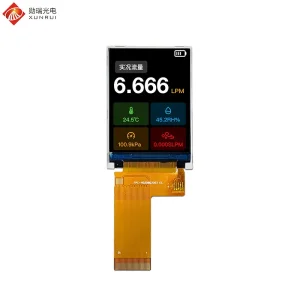
High-Precision Micro Displays
Featured Product Portfolios (Batch A)
Explore standard, circular, and custom configuration displays verified for mission-critical industrial, medical, and smart-edge ecosystems.






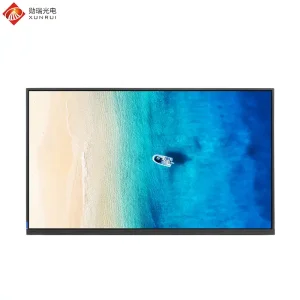
Engineering Whitepaper
240x320 (QVGA) Display Architecture & Customization Vectors
A technical examination into why the 240x320 matrix remains the absolute benchmark standard for high-reliability embedded interfaces and how custom factory integration solves space-constrained engineering hurdles.
2,000,000+
Monthly Manufacturing Capacity
5000 m²
Cleanroom Production Space
5 Checkpoints
IQC, Glass, FOG, In-line, OQC
5-500 pcs
Rapid Pilot Verification Batches
Wide-Angle IPS vs. Value TN Tooling
Depending on unit economics and operational constraints, OEM clients select between all-direction (80/80/80/80) IPS symmetric optical viewing fields or cost-effective TN cells optimized for 6 o'clock or 12 o'clock fixed views. Custom optical polarizers eliminate gray-scale inversion entirely in critical instrument clusters.
Interface Routing: MCU, SPI & RGB
Direct low-pin-count serial peripheral interface (4-wire/3-wire SPI) simplifies circuit boards on resource-limited MCUs (e.g., STM32, ESP32), while 8/16-bit 8080/6800 parallel bus or high-speed RGB interfaces guarantee silky 60 FPS refresh rates on interactive medical instrumentation and portable diagnostics.
Sunlight Readability & Thermals
Standard displays exhibit wash-out in exterior settings. Factory-customized LED light bars boost nit performance from baseline 250 nits up to daylight-readable thresholds of 1,000+ nits. Combined with wide-temperature liquid crystal fluid (-30°C to +85°C), zero phase-transition blackening occurs under extreme solar radiation.
Global Supply Chain Intelligence
Why Sourcing 240x320 Displays Direct from China Factories Wins
The strategic confluence of component clustering, automated COG/FOG bonding infrastructure, and engineering cost amortization provides unmatched production agility.
Aggregated Upstream Supply Ecosystem
Direct adjacency to world-leading glass foundries, driver IC packagers (e.g., Sitronix ST7789V, Ilitek ILI9341V), and specialized backlight diode fabricators in Shenzhen and the Pearl River Delta guarantees zero-friction component logistics and swift procurement turnover.
High-Yield Automated COG & FOG Lines
By removing manual labor from sensitive micro-bonding steps, high-speed automated Chip-On-Glass (COG) and Film-On-Glass (FOG) machines deliver micron-accurate alignment for anisotropic conductive film (ACF), radically lowering failure and circuit fracture risks.
Amortized Non-Recurring Engineering (NRE)
Custom tooling (FPC geometry redesign, metal bezel stamping, custom light guide plate tooling) incurs a fraction of the cost found in Western or Japanese fabrication pipelines. Prototyping iterations move from blueprint approval to functional sample testing in days.
Factory Engineering Specifications
Standard vs. Fully Customized 240x320 Module Matrix
A reference architecture mapping factory customization options across electrical, optical, and physical mechanical planes.
| Engineering Parameter | Catalog Standard Specifications | Custom Factory Engineering Capabilities |
|---|---|---|
| Panel Diagonal & Formats | 1.77", 2.0", 2.2", 2.4", 2.8", 3.2" | Custom active area sizing, circular cuts, bar stretched dimensions |
| Luminance / Brightness | 250 – 350 nits (Indoor / Handheld) | 500 – 1200+ nits with high-efficacy constant-current backlights |
| Viewing Angle Technology | TN (6:00 or 12:00 clock view) | All-Viewing-Angle IPS (80/80/80/80 deg) with zero color shift |
| FPC Circuit Topology | Standard pitch bottom/top exit (30/40/50 Pin) | Custom layout, length, bend radii, EMI gold foil/silver shielding |
| Driver IC Integration | ST7789V, ILI9341V, GC9307 (COG mounted) | Specific customer-dictated driver IC, built-in GRAM management |
| Touch Interaction Layer | None (Bare panel) | Air bonding / Optical OCA bonding of RTP (Resistive) or PCAP (Capacitive) |
| Cover Lens & Surface Treatment | Standard polarizer | Chemically strengthened AGC/Gorilla glass, AG, AR, AF nano coatings |
Global Applications
System-Level 240x320 Industrial Deployment Scenarios
From smart energy infrastructures to certified healthcare equipment, discover how tailored QVGA displays solve harsh deployment challenges.
Medical Diagnostics & Patient Infusion
Handheld blood analyzers, spirometers, and ambulatory infusion monitors require high pixel density for legible physiological wave charting. Optical OCA bonding with anti-bacterial cover glass protects screens from hospital disinfectant wiping without delamination.
Smart Grid Metering & Substation Panels
Outdoor electricity meters and DIN-rail circuit breakers endure 10-to-15-year deployments under severe electrostatic stress. We engineer integrated ESD/EMI suppression diodes directly into the display FPC flat cable to pass rigorous IEC 61000-4-2 Level 4 immunity testing.
Rugged Telematics, Marine & Two-Way Radios
Vehicle fleet monitoring units and UHF/VHF mission-critical radios operate under blistering heat, freezing chills, and constant direct sunlight. Semi-transmissive (transflective) cells or 1000-nit high-brightness backlights ensure crisp legibility without draining battery banks.
High-Precision Industrial Displays
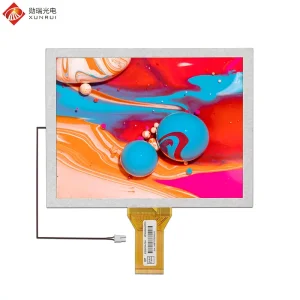
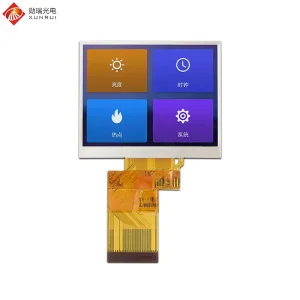
Featured Product Portfolios (Batch B)
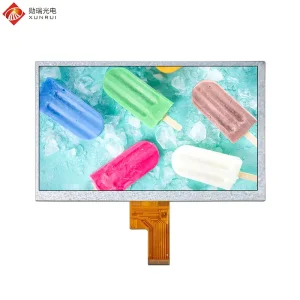
Touch-integrated, wide-temperature, and ultra-high-brightness TFT panels manufactured to tight tolerances for heavy-duty OEM integrations.





Knowledge Base & FAQ
Frequently Asked Questions on Custom 240x320 Manufacturing
Detailed technical, commercial, and operational guidance for component engineers and procurement directors sourcing from China.
What specific parameters can be customized for a 240x320 TFT LCD module?
Customization covers the mechanical, optical, and electrical design:
- FPC Design: Total length, shape, thickness, pinout remapping, component integration (resistors, step-up backlight ICs, ESD protection), and gold-finger contacts.
- Optical Performance: Choice of IPS (full-perspective view) or TN (6:00/12:00 view), high-output LED backlights (from standard 250 nits up to 1200+ nits), transflective sunlight polarizers, and optical filters.
- Touch Assembly: 4-wire analog resistive touch panels (operated via gloved stylus) or custom projected capacitive (PCAP) sensors with I2C/USB interfaces.
- Cover Glass: Chemically strengthened glass thicknesses (0.55mm, 0.7mm, 1.1mm, 2.0mm+), silkscreen ceramic borders, cutouts, chamfered edges, and surface coatings (Anti-Glare, Anti-Reflective, Anti-Fingerprint).
What are the minimum order quantities (MOQ) and sample lead times for custom tooling?
Sample phase prototypes typically require 15 to 20 working days for customized FPC and backlight tooling. Following customer drawing verification and sample testing approval, we support pilot trial runs from 5 to 500 units to qualify SMT and injection-molding fitment. Standard customized mass production batches maintain an MOQ threshold of 1,000 units to guarantee raw material procurement cost-efficiency.
How do China LCD manufacturers guarantee long-term longevity and product lifecycle availability?
Industrial and medical equipment programs demand stable component lifecycles spanning 5 to 7+ years. We combat supply discontinuations through:
- Locking supply agreements with primary tier-1 glass foundries and long-lifecycle driver IC series (such as Sitronix ST7789V / Ilitek ILI9341).
- Issuing Last-Time-Buy (LTB) and End-of-Life (EOL) notices at least 6 to 12 months in advance.
- Providing drop-in pin-compatible FPC revisions and driver code bridge solutions if an underlying component undergoes silicon die shrink.
What quality assurance checkpoints are conducted before export delivery?
Under our ISO 9001 and ISO 14001 quality systems, display modules pass five rigorous verification gates:
- IQC (Incoming Quality Control): Microscopic inspection of raw mother glass, LEDs, flex cables, and ICs.
- Glass Visual Inspection: Laser array scanning for pixel defects, scratches, or polarizer contamination.
- FOG In-Line Aging: High-temperature burn-in checking anisotropic conductive film (ACF) conductivity and contact impedance.
- Final Finished Assembly Thermal Chamber Testing: Operating thermal stress (-20°C to +70°C or -30°C to +85°C) and 90% RH humidity aging.
- OQC (Outgoing Quality Control): Optical color coordinates (CIE), chromaticity, luminous uniformity tests, and drop/vibration drop-pack qualification.
What is the difference between Air Bonding and Optical (OCA) Bonding for 240x320 displays?
Air bonding joins the touch panel or cover glass to the TFT bezel using perimeter double-sided adhesive tape, leaving an air gap. This is cost-effective but allows internal reflections under bright sun. Optical Bonding fills the entire interstitial gap with Optically Clear Adhesive (OCA) or liquid OCR. This eliminates internal reflections, boosts impact resistance, prevents condensation fogging, and delivers superior optical clarity in outdoors applications.
Accelerate Your Custom 240x320 Display Project
Submit your mechanical step files, electrical timing requirements, and target environment specs. Our Shenzhen display engineering team will deliver a comprehensive DFM review and tooling quotation within 24 business hours.
Request an Engineering Consultation