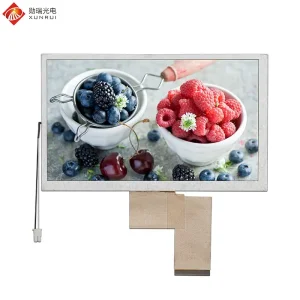
Custom 3.5 inch IPS TFT LCD 320×480 MCU 40pin interface 300nit Manufacturer, Factories
Explore Product
Explore our proven high-yield standard and customized TFT panels matching diverse MCU, RGB, LVDS, and MIPI protocols across medical, automation, and vehicle domains.

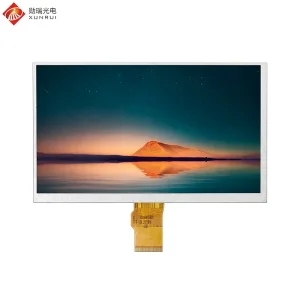


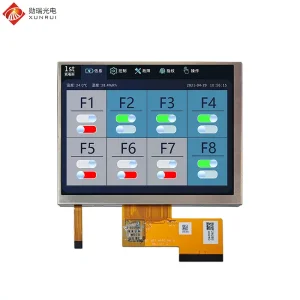


Navigating technical tradeoffs between ultra-compact sub-5" panels and larger 7"-10" displays: why custom 6.2 TFT LCD displays are dominating the latest generation of automotive consoles and smart terminals.
The 6.2-inch format bridges the ergonomic gap between 5.0" handheld devices and bulkier 7.0" panels. Engineered with widescreen aspect ratios (such as 16:9, 18:9, and customized ultra-wide bar geometries), it accommodates complex graphical interfaces and split-screen telemetry while fitting directly into space-constrained 1-DIN dashboards and ergonomic hand-grips.
Outdoor and high-ambient lighting challenges are eliminated through full optical bonding (LOCA/OCA), which eliminates the air gap between the TFT polarizer and the protective cover lens. This cuts internal reflection below 1.2%, maximizes contrast ratios, and prevents internal condensation and dust buildup over decades of continuous exposure.
Operating standard LEDs at elevated drive currents yields catastrophic heat traps. Our custom 6.2" display layouts implement constant-current dual-rail LED strings paired with high-thermal-conductivity aluminum PCB substrates, shedding thermal mass efficiently and maintaining 80% luminous flux past 50,000 hours of continuous operation.
From silicon controller matching to cover lens chemical strengthening, Xunrui delivers end-to-end electro-optical tailoring tailored to your BOM requirements.
| Module Subsystem | Standard Parameters | Custom Factory Options | Design & Testing Methodology |
|---|---|---|---|
| Display Panel / Liquid Crystal | IPS All-Viewing-Angle / a-Si TN | Transflective polarizers, fast-response automotive fluid, custom cut-glass aspect ratios | Electro-optical birefringence mapping, viewing angle contrast polar verification |
| Luminance & Backlight Unit | 300 - 500 nits (Typical indoor) | 800 to 1,600 nits sunlight readable, high-CRI white LED arrays, PWM dimming down to 1% | Integrating sphere spectrum analysis, thermal imaging run-in testing |
| Signaling Interface & FPC | RGB 24-bit / MCU 8/16-bit | 4-Lane MIPI DSI, LVDS with differential impedance control, custom pin mapping, EMI shielding | Time-Domain Reflectometry (TDR), eye-diagram signal integrity validation |
| Touch Panel (PCAP / RTP) | G+F structure, I2C single-touch | G+G structure, Corning Gorilla Glass up to 6mm, glove/water rejection, Cypress/Ilitek ICs | CS/RS IEC 61000-4-6 immunity testing, ball-drop IK08/IK10 mechanical impact |
| Cover Glass Surface Finish | Clear polished soda-lime glass | AG (Anti-Glare chemical etch), AR (Anti-Reflection), AF (Anti-Fingerprint oleophobic) | Spectrophotometer reflectance check, water contact angle measurement (>110°) |
How Tier-1 system architects integrate our custom 6.2-inch TFT display modules into demanding operating environments.
Motorcycle digital dashboards, electric commercial vehicles, and marine telematics rely on 6.2" IPS screens running up to 1,200 nits. Featuring optical bonding with automotive UV-filtering resins, these screens withstand direct solar baking and freezing thermal shocks (-30°C to +85°C) without delamination or black spots.
Bedside patient monitors, portable defibrillators, and laboratory analyzers require accurate color rendering, broad 85/85/85/85 viewing cones, and cover lenses sealed against hospital-grade disinfectant sprays. Our customized PCAP touch panels support accurate gloved input and saline splash rejection.
Factory floor HMIs, robotic teach pendants, and warehousing barcode scanners require robust protection against shock, vibration, and electro-static discharge (ESD). Our custom 6.2 TFT modules provide air-discharge protection up to 15kV, contact protection to 8kV, and reinforced chemically tempered cover glass up to 4mm.
Shenzhen Xunrui Optoelectronics eliminates procurement and manufacturing risk through a verified 6-stage NPI (New Product Introduction) workflow.
Our R&D team reviews your 3D CAD files, power consumption budget, backlight driving constraints, and target host processor (Rockchip, NXP, STM32, Allwinner) to recommend an optimized design stack.
Complete mechanical layout, FPC routing schematics, and backlight thermal dissipation models are delivered within 3-5 business days for your engineering sign-off prior to custom tooling fabrication.
First-article samples (5–20 units) are manufactured on our pilot line, undergoing 100% optical chromaticity verification, high/low temperature operational aging, and FOG bonding pull tests.
We run a flexible pre-production batch of 5 to 500 units to ensure seamless assembly at your SMT/box-build factory, establishing statistical process control (SPC) benchmarks.
Mass manufacturing kicks off with custom orders exceeding 1,000 units on Class 1,000 cleanroom automated COG, FOG, and optical lamination lines with a monthly output exceeding 2,000,000 units.
Every export lot leaves with detailed IQC/OQC test logs. We guarantee long-term life cycle support with a minimum 5- to 7-year continuous availability policy, preventing disruptive re-designs.
Compliant with worldwide environmental, quality, and industry-specific certifications to streamline your regulatory submissions.
Standardized quality management systems overseeing incoming glass, IC packaging, anisotropic conductive film (ACF) lamination, and final visual inspection.
Eco-friendly manufacturing processes ensuring sustainable waste management, energy-efficient cleanrooms, and minimal environmental footprint.
All polarizers, glass substrates, bonding adhesives, and driver IC components are 100% compliant with EU RoHS and REACH hazardous substance limits.
Integrated shielding tape, grounded copper foil, and ferrite filtering maintain complete electromagnetic compatibility under stringent CE/FCC industrial testing.
How our advanced R&D pipeline ensures your next-generation hardware designs remain at the competitive edge of display technology.
We are transitioning select high-end 6.2-inch industrial variants to local-dimming Mini-LED backplanes. Delivering over 1,000 localized dimming zones, this enables OLED-grade 100,000:1 contrast ratios without the risk of burn-in or accelerated blue diode degradation in high-temperature environments.
Our roadmap incorporates Touch and Display Driver Integration (TDDI), unifying display driver logic and capacitive touch processing onto a single silicon die. This reduces total module thickness by 25%, simplifies FPC routing down to a single connector, and significantly lowers system BOM cost.
Integrating piezoelectric actuators directly behind the 6.2" cover lens provides distinct localized mechanical click sensations when users adjust critical knobs or emergency triggers. This delivers tactical physical confidence without mechanical switch degradation in dusty industrial settings.
Clear, direct answers regarding custom tooling costs, lead times, driver electronics, and environmental durability.
Custom FPC and backlight tooling generally ranges from $800 to $2,500 depending on complexity, with prototypes delivered in 15–20 working days. Customized capacitive touch cover glass tooling ranges from $1,500 to $3,500 depending on chemical tempering thickness and silkscreen layers, completing within 20–25 working days.
Yes. In addition to bare glass and COG modules, Xunrui supplies turnkey display assemblies paired with our proprietary HDMI, VGA, AV, or Type-C controller driver boards. We also provide integrated LED backlight boost converters on the same PCBA for direct plug-and-play prototyping.
We maintain close strategic alliances with glass manufacturers (BOE, HannStar, IVO) and IC fab houses to guarantee a 5-to-7-year minimum availability horizon. In the event of a raw glass or IC discontinuance, we provide at least 6 months advance Last-Time-Buy (LTB) notice and seamless pin-to-pin drop-in replacement solutions.
To support hardware engineers through the clinical/field validation phase, we offer a one-time trial production run of 5 to 500 units upon sample sign-off. Subsequent full-scale customized production requires an MOQ of 1,000 units, while off-the-shelf standard catalog displays carry zero MOQ constraints.
We utilize high-end multi-channel projected capacitive (PCAP) controller ICs from Ilitek and Goodix configured with custom self-capacitance and mutual-capacitance hybrid algorithms. This allows the sensor to detect finger inputs accurately while ignoring continuous moisture films, water droplets, and conductive saline solutions.
Yes. We operate class 1,000 automated vacuum optical bonding machinery utilizing high-durability optical clear silicone (LOCA) or dry film (OCA). This creates a solid mechanical monolithic stack between the cover glass, touch sensor, and TFT panel that absorbs vibration and eliminates air gaps.
Explore our broader display range engineered for compact instrument panels, round dials, handheld diagnostics, and widescreen HMIs.