
Featured Industrial & High-Brightness LCD Modules (Batch A)
From compact wearable telemetry displays to heavy-duty sunlight-readable vehicle HMIs, explore certified industrial TFT solutions engineered in Shenzhen.





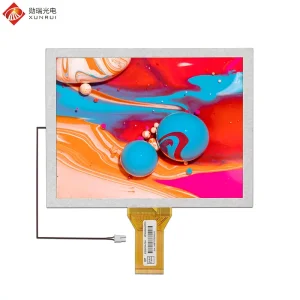


The Strategic Role of 5.7" High-Brightness Displays in Global Automation
Why the 5.7-inch form factor remains the undisputed golden ratio for legacy replacement, rugged telematics, and mission-critical outdoor Human-Machine Interfaces (HMIs).
The Enduring Dominance of the 5.7-Inch Industrial Standard
In the evolving landscape of electronic display engineering, form factors come and go with consumer electronics cycles. However, the 5.7 inch LCD display module—particularly in its classic 4:3 aspect ratio and 640×480 (VGA) or 320×240 (QVGA) configurations—holds a permanent foundation in mission-critical hardware architecture. Global engineering conglomerates across North America, Europe, Japan, and Australasia maintain tens of thousands of active field assets built around the physical envelope of 5.7" chassis dimensions.
Historically deployed with monochrome STN, passive matrix, or low-brightness CCFL backlights, these critical assets now require drop-in modernization. Contemporary high-brightness 5.7" TFT LCD modules manufactured by specialized Chinese facilities provide this crucial bridge: offering modern LED light engines exceeding 800 to 1,500 nits, high-contrast active-matrix IPS liquid crystal fluid, and modern electrical signal drivers (RGB 18/24-bit, LVDS, MCU parallel, and even HDMI/eDP bridging) while remaining mechanically retrofittable within legacy front panels and NEMA/IP-rated enclosures.
Solar Load Dissipation
Outdoor high-brightness displays absorb immense radiative energy. High-efficiency phosphor LEDs and solid-aluminum heat-spreader chassis prevent thermal isotropic blacking-out (liquid crystal phase transition) up to +85°C.
Direct Sunlight Legibility
Standard 250-nit indoor screens wash out when ambient illuminance exceeds 10,000 lux. Our 5.7" modules deploy high-output Nichia/Osram LED arrays with circular polarizers and anti-reflective (AR) surface treatments yielding crisp 1,200:1 contrast ratios in 100,000 lux daylight.
Drop-in Form Fit Function
Eliminate multimillion-dollar tooling reinvestments. Custom flexible printed circuits (FPCs), dedicated pin-matching daughterboards, and exact outer frame tolerances enable drop-in replacements for discontinued legacy Japanese or European panels.
Industrial Supply Chain Architecture: The Chinese Manufacturing Moat
How vertical integration across the Greater Bay Area allows Shenzhen Xunrui Optoelectronics to deliver Tier-1 quality at lean unit economics.
Ultra-Clustered Ecosystem
Located in Bao'an District, Shenzhen, Xunrui operates at the epicenter of the global optoelectronics supply network. Raw glass mother-sheets (G5/G6 Gen fabs), polarizers, driver ICs, LED dies, and custom beryllium copper FPCs are sourced within a 2-hour trucking perimeter, slashing component lead times by up to 65% compared to overseas competitors.
Flexible Engineering & Low MOQs
Western and Japanese display conglomerates routinely mandate minimum order quantities (MOQs) of 10,000 to 50,000 units for customized backlights. Xunrui fundamentally de-risks customer engineering cycles by offering prototype tooling, 5 to 500-unit trial production batches, and a standard mass-production threshold of just 1,000 units.
Automated Cleanroom Quality
Operating Class 1,000 and Class 100 dust-free cleanrooms, Xunrui enforces comprehensive ISO 9001 and ISO 14001 automated manufacturing. High-precision COG (Chip-on-Glass) and FOG (Flex-on-Glass) bonding equipment ensures sub-micron alignment accuracy, eliminating contact resistance and signal jitter under extreme vibration.
Engineering Credential Assurance: Xunrui Optoelectronic Technology Co., Ltd. (established in 2016, 5,000 m² modern facility, 2,000,000 pcs monthly capacity) deploys a rigorous 5-stage quality gate protocol: IQC raw material inspection, glass substrate defect screening, in-line FOG bonding thermal cycling, 100% finished-module 72-hour burn-in aging, and OQC optical chromaticity spectrophotometer sign-off.
Parametric Benchmarks: Standard vs. Industrial Sunlight-Readable 5.7" LCD
A detailed optical and environmental comparison between standard commercial panels and Xunrui’s ruggedized 5.7" high-luminance industrial display stack.
| Performance Parameter | Standard Commercial 5.7" TFT | Xunrui Ruggedized High-Brightness 5.7" | Operational Engineering Benefit |
|---|---|---|---|
| Typical Luminance | 250 – 350 Nits (cd/m²) | 1,000 – 1,500 Nits | Zero visual washout under direct 100k Lux overhead sunlight |
| Optical Bonding | Air Gap (Perimeter Tape) | Full OCA / OCR Vacuum Optical Bonding | Eliminates internal air-glass reflections, cuts reflectance by 400% |
| Operating Temperature | -10°C to +60°C | -30°C to +85°C | Flawless sub-zero startup without auxiliary heaters; no blacking-out |
| Viewing Angle (CR ≥ 10) | 6 o'clock or 12 o'clock TN (60/60/50/55) | IPS All-View 85/85/85/85 (>170°) | Zero grayscale inversion; perfect color fidelity off-axis |
| Backlight Half-Life (MTBF) | 20,000 – 30,000 Hours | 50,000 – 70,000 Hours | Continuous 24/7/365 uninterrupted operation for 7+ years |
| Touch Sensor Technology | Basic Resistive or Consumer PCAP | Industrial PCAP (G+G, 3mm Glass) / Heavy-duty RTP | Support for heavy welding gloves, wet surfaces, salt spray, and styluses |
| Surface Hardness & Coating | 3H Hard Coating (Plastic lens) | 7H Tempered Glass + AR / AG / AF Coatings | IK08/IK10 impact survivability; anti-smudge and anti-glare clarity |
| Available Interfaces | Single RGB 18-bit | RGB, MCU 8080, LVDS, eDP, HDMI via Driver | Plug-and-play adaptability to legacy controllers and ARM/x86 SBCs |
Field Applications: Where Failure is Not an Option
From maritime bridges to agricultural autonomous tractors, discover how high-brightness 5.7" panels perform in unforgiving operational environments.
Marine Nav & Fishfinders
Vessels exposed to open water endure massive salt spray, broad daylight glare, and temperature fluctuations. Our 5.7" panels with optical bonding, anti-reflective coating, and 1,200-nit backlights give captains instant, uncompromised sonar, radar, and GPS chart readings through polarized sunglasses.
EV Ultra-Fast Chargers
Public EV charging infrastructure is installed outdoors with zero thermal protection. Operating 24/7 in direct sunlight, the 5.7-inch display unit serves as the payment and telemetry terminal, requiring IK09 impact resistance, wide -30°C to +85°C endurance, and auto-dimming sensor integration.
Heavy Industrial Machinery HMIs
CNC machining centers, automated injection molders, and chemical processing consoles demand high noise tolerance (EMC/EMI shielding). Paired with 4-wire or 5-wire resistive touch panels, our 5.7" screens ensure seamless operator interaction even when technicians wear thick, oil-covered safety gloves.
Heavy Telematics & Harvesters
Farming tractors, excavators, and mining equipment face grueling vibration profiles and dusty environments. Our customized potting compounds, rugged FPC strain reliefs, and high-shock LED backlights guarantee continuous telemetry under harsh ISO 16750 agricultural vibration standards.
Portable Medical Defibrillators
Emergency medical technicians operate in uncontrollable outdoor ambient lighting. First-responder AEDs and vital-sign monitors demand immediate 1,000-nit readability, anti-bacterial cover glass, and rapid cold-boot response times to deliver real-time ECG curves without latency or distortion.
Ruggedized Field Terminals
Aerospace ground control, military communication gear, and pipeline inspection rovers require MIL-STD-810 compliance. We integrate custom electromagnetic interference (EMI) mesh coatings, NVIS (Night Vision Imaging System) dual-mode backlights, and conformal-coated driver circuit assemblies.
Next-Generation Technologies Transforming 5.7" Industrial Displays
How optical bonding innovations, quantum efficiency improvements, and thermal packaging breakthroughs are redefining the performance ceiling.
Mini-LED & Local Dimming
By replacing edge-lit LED bars with matrix-addressable Mini-LED arrays, next-generation 5.7" panels achieve peak luminance up to 2,000 nits while slashing power consumption by 35%. Dark areas dim completely, yielding 100,000:1 contrast ratios and cutting thermal emission inside tightly sealed enclosures.
Advanced Optical Bonding (OCA/OCR)
Traditional air gaps generate two reflective boundaries (index of refraction ~1.0 vs ~1.5 for glass/polarizer), reflecting up to 8.5% of incident sunlight. Xunrui's optical bonding under high vacuum fills this boundary with optically clear resin (n=1.49), boosting mechanical shatter resistance by 300% and stopping moisture condensation entirely.
Transflective Hybrid Micro-Optics
For ultra-low power handheld devices, hybrid transflective TFT technology integrates internal micro-reflectors behind each subpixel. When direct sunlight enters the display, it reflects outward through the color filters, using the sun as a natural backlight and reducing battery draw to near zero in bright daylight.
OEM Buyer's Guide: How to Qualify an Industrial LCD Manufacturer in China
Essential engineering verification checkpoints to protect your project from premature obsolescence, batch variance, and field failure.
Lifecycle Longevity
Verify the manufacturer's Product Change Notification (PCN) and End-of-Life (EOL) roadmap. Xunrui guarantees a minimum 5 to 7-year continuous availability cycle on industrial 5.7" display panels with pin-compatible replacement commitments.
LED Driver Thermal Derating
High brightness generates significant heat. Inspect whether the display integrates a constant-current LED driver board with active pulse-width modulation (PWM) dimming and internal thermal shut-off protection.
ESD & EMC Shielding
Industrial environments generate severe electrostatic discharge. Ensure the module includes grounded FPC EMI shields and complies with IEC 61000-4-2 Level 4 (±8kV contact, ±15kV air discharge) standards.
Optical Traceability
Demand CIE 1931 chromaticity coordinates and luminance uniformity records (≥80% 9-point calibration) with every production batch. Xunrui provides full lot-numbered spectrophotometer test reports.
Frequently Asked Technical Questions: 5.7" High-Brightness LCDs
Direct technical clarifications from Xunrui’s senior display integration engineering team.
What distinguishes true sunlight-readability from mere high brightness?
True sunlight readability is an optical equation: Contrast Ratio = (Display Lumens + Reflected Ambient Light) / (Reflected Ambient Light). Merely stacking high-power LEDs to hit 1,000 nits without addressing surface reflections causes intense glare and internal heat buildup. True sunlight readability combines high luminous output (≥1,000 nits) with optical bonding, circular polarizers, and anti-reflective/anti-glare (AR/AG) glass coatings to minimize surface reflection below 1.5%.
Can you customize the pinout and mechanical bezel to match obsolete panels?
Yes. A primary capability at Xunrui is reverse engineering legacy EOL panels from brands like Kyocera, Sharp, Hitachi, and NEC. We redesign custom FPC cables, manufacture matching metal brackets, and build custom driver boards (converting RGB or MCU to legacy CCFL-era pinouts) so your system drops in without modifying the host chassis or enclosure tooling.
What is the typical lead time and MOQ for customized 5.7" display modules?
Custom drawings and optical simulations take 3 to 5 business days. Rapid prototypes are delivered within 2 to 3 weeks. Following sample qualification, we offer a small pilot run of 5 to 500 units to validate mechanical and thermal assembly. The standard minimum order quantity (MOQ) for full volume production is 1,000 units, significantly lower than international competitors.
How do you address solar clearing (blackout) when the screen is exposed to summer sun?
Solar clearing occurs when incoming radiation pushes the liquid crystal fluid past its clearing point (Tni), causing isotropic black spots. Xunrui integrates specialized High-Tni liquid crystal materials with transition thresholds up to +105°C or +110°C, combined with UV-blocking polarizers and thermally conductive graphite heat spreaders, preventing screen clearing even in direct desert sun.
Featured Industrial & High-Brightness LCD Modules (Batch B)
Explore our specialized broad-spectrum modules from 1.3" circular smart-controls up to 15.6" Full HD industrial operator terminals.



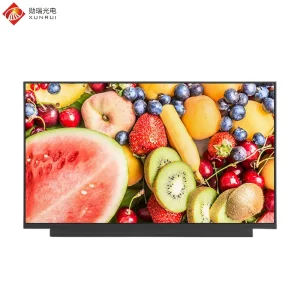

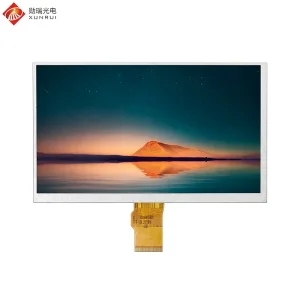


Initiate Your 5.7" High-Brightness Prototype Project
Connect directly with our Shenzhen optoelectronic engineering division. We evaluate mechanical CAD drawings, optical requirements, thermal budgets, and interface timings within 24 hours.