
Featured Industrial TFT LCD Modules & Assemblies
OEM-grade display hardware engineered for mission-critical instruments, factory automation terminals, and rugged outdoor interfaces.




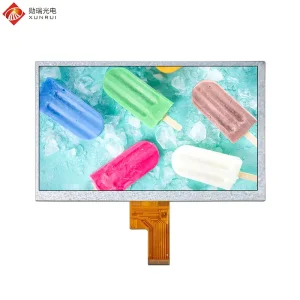


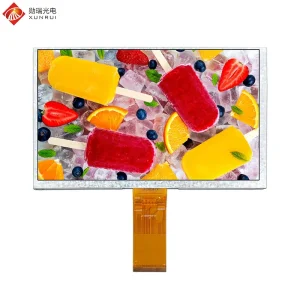
The Strategic Value of 5.7-Inch TFT Form Factors in Industrial Design
Understanding legacy compatibility, ergonomic UI efficiency, and why the 5.7" display remains the golden ratio for programmable logic controllers and precision field analyzers.
Classic 4:3 Golden Ratio Retention
While mobile consumer tech has shifted to ultra-wide ratios, industrial graphical user interfaces (GUIs), SCADA dashboards, and embedded control cabinets remain deeply optimized for 4:3 and 640×480 (VGA) or 320×240 (QVGA) architecture. A 5.7-inch display preserves spatial density without forcing complex software refactoring.
Thermal Envelope & Low-Power Balance
With an active area that matches standard 1/4 DIN and compact sub-racks, a 5.7" module provides substantial visual output while limiting backlight LED power dissipation to under 1.8W–2.5W. This thermal margin is crucial for sealed IP65/IP67 enclosures lacking active fan ventilation.
Drop-in Legacy Panel Replacement
Global factories maintain thousands of legacy machine tools reliant on discontinued passive STN/CSTN screens. Chinese manufacturing clusters provide plug-compatible 5.7-inch TFT replacements featuring built-in timing controllers, converting outdated CCFL backlights to high-efficiency LED arrays.
Why Global OEMs Rely on Chinese Display Manufacturing Clusters
Beyond assembly: how supply chain density, automated cleanrooms, and vertical integration reduce cycle times and guarantee long-term operational viability.
Sub-Tier Supply Chain Hyper-Localization
In regions such as Shenzhen and the broader Pearl River Delta, raw glass substrates (BOE, IVO, Innolux), optical-clear adhesives (OCA), polarizing films, driver ICs, and flexible printed circuits (FPC) sit within a 50-kilometer radius. This proximity compresses rapid prototyping turns from months to under 14 days.
Flexible Tooling & 5–7 Year Long-Tail Roadmaps
Medical and industrial products cannot tolerate unexpected end-of-life (EOL) redesigns. Tier-1 Chinese specialist manufacturers structure cell-cutting contracts and stock long-term glass reserves, offering guaranteed 5-to-7-year product stability with controlled engineering change notifications (PCN).
High-Yield Optical Bonding Capabilities
China's manufacturing scale has democratized full optical bonding (wet bonding using liquid OCR or silicone OCA). Air-gap elimination dramatically suppresses internal surface reflection, elevates sunlight legibility up to 1000+ nits, and prevents internal condensation in high-humidity climates.
| Evaluation Metric | Standard Consumer-Grade Display | Xunrui Industrial 5.7" TFT Touch Solution | Procurement Advantage |
|---|---|---|---|
| Operating Temperature | 0°C to +50°C | -30°C to +85°C (Wide Range) | Zero crystallization or blackouts in extreme field deployments |
| Touch Sensor Technology | Standard Consumer PCAP (0.7mm cover) | Ruggedized 4/5-Wire RTP or 3.0mm Expl-Proof PCAP | Operable with work gloves, saline drops, or thick industrial glass |
| Luminance (Backlight) | 200 – 350 cd/m² (Nits) | 500 – 1200 cd/m² (High-Reliability Nichia LED) | Clear visibility under direct zenith sun exposure |
| Lifecycle Commitment | 12 – 18 Months (Rapid EOL) | 5 – 7 Years Guaranteed Form/Fit/Function | Avoids regulatory re-certification for FDA/CE/UL systems |
Field-Proven Deployment Solutions for 5.7-Inch Assemblies
Engineered touch screen and display systems tested across high EMI, intense mechanical vibration, and volatile environments.
Factory Automation & CNC
Integrated with high-durability 4-wire resistive touch layers resistant to cutting oils, lubricants, and iron dust. High-EMI shielded FPCs avoid signal false triggers from nearby 380V variable-frequency drives (VFD).
Medical Diagnostic Hardware
Ventilators, hemodialysis monitors, and precision infusion pumps. Customized with anti-microbial cover glass, anti-reflective (AR) treatments, and multi-touch firmware tuned for nitrile glove input.
Heavy Machinery & Fleet Telematics
Tractors, mining loaders, and construction cranes. Backlights powered up to 1000+ nits with wide operating temperatures (-30°C to +85°C) to withstand sub-zero winters and scorching summer engine bays.
Marine & Port Infrastructure
Moisture-sealed optical bonding stops sea spray salt-fog erosion. Optical coatings deliver IP67 front-panel resilience and match marine regulatory standards for shock and vibration.
Zero-Defect Quality Assurance Architecture
Shenzhen Xunrui Optoelectronic enforces a 5-tier ISO-audited testing discipline, verifying every module before batch dispatch.
IQC & Substrate Verification
Every batch of raw glass, driver ICs, and polarizers passes rigorous incoming quality checks. Cleanrooms (Class 1,000 to Class 100) minimize micro-particle inclusions before the automated bonding process begins.
FOG (Film-on-Glass) & Automated COG
Automated Chip-On-Glass (COG) and FPC-on-Glass (FOG) machines guarantee micron-precise pitch alignment. High-magnification optical inspection ensures ACF (Anisotropic Conductive Film) particle distribution meets zero-short specifications.
Chamber Aging & Environmental Stress
Modules face 72-hour burn-in cycles inside elevated temperature and humidity chambers (+60°C / 90% RH). Thermal-shock testing (-40°C to +85°C) ensures zero delamination across touch panels and optical stacks.
OEM Customization Spectrum for 5.7" Modules
Adapt mechanical, optical, and electrical properties to match existing chassis tooling and proprietary embedded boards.
Cover Glass & Surface Treatments
Select tempered soda-lime or chemically strengthened aluminosilicate cover glass from 0.7mm to 6.0mm. Surface upgrades include Anti-Reflective (AR), Anti-Glare (AG, gloss reduction down to 60±10), and Anti-Fingerprint (AF) oleophobic nanocoatings.
Interface & Bridging Boards
We customize FPC pinouts to replicate vintage legacy interfaces or match modern system architectures. Supported controller protocols include 24-bit Parallel RGB, LVDS, MCU 8080/6800, MIPI DSI, and direct HDMI/VGA driver carrier assemblies.
LED Backlight Tuning
From standard 350-nit indoor operation up to 1200-nit high-brightness arrays for open-sky marine equipment. Constant-current drivers feature PWM linear dimming across 1% to 100% ranges without high-frequency flicker.
Frequently Asked Technical & Sourcing Questions (FAQ)
Answers to critical questions regarding 5.7" display integration, touch sensitivity, lead times, and factory verification.
What are the primary differences between 5.7" Resistive and PCAP Touch options?
Can a modern 5.7" TFT directly replace obsolete passive STN/CSTN displays?
What is your typical lead time for custom tooling and trial production?
How does Xunrui protect projects against unexpected component obsolescence?
How are 5.7-inch screens packaged to prevent transit damage during international shipping?
Explore Complementary Displays & Smart Screen Assemblies
Compare alternative resolutions, broad-view IPS panels, and ultra-high-luminance display assemblies across our manufacturing line.








Accelerate Your Display Design Cycle
Direct communication with Shenzhen Xunrui's optoelectronic application engineers. Send your mechanical drawings, pinout requirements, or display specifications for an immediate feasibility review.
Consult an Application Engineer →