
Precision Small-to-Mid Form Factor Display Matrices
Explore high-yield standard and semi-custom TFT LCD display assemblies manufactured under strict Class 1000 cleanroom environments in Shenzhen.





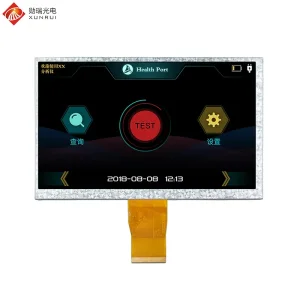


Why the 6.2-Inch LCD Module is Dominating Smart Edge Hardware
Strategic shift from legacy 4:3 configurations to ergonomic, wide-format 18:9 and 16:9 6.2-inch display form factors across industrial control and automotive clusters.
Ergonomic Aspect Ratio Transition
Global original equipment manufacturers (OEMs) are transitioning handheld diagnostics, rugged mobile terminals, and EV instrumentation from square formats to elongated 6.2-inch IPS screens. The 6.2-inch geometry provides an optimal 152mm diagonal workspace, delivering superior thumb-reach ergonomics without sacrificing high pixel density (up to 720×1520 or 1080×2400 resolutions).
Direct Sunlight & Ambient Resilience
Outdoor procurement requirements mandate luminance values exceeding 850 to 1,200 nits (cd/m²). Standard consumer-grade panels wash out beneath 10,000 lux illumination. Custom industrial 6.2 LCD modules deploy specialized ultra-efficient LED arrays coupled with anti-reflective (AR) and anti-glare (AG) surface etching to preserve critical contrast ratios above 1000:1 in high direct sun.
Environmental Ruggedization (-30°C to +85°C)
Unlike commercial mobile screens that freeze or suffer image sticking below 0°C, industrial 6.2 TFT LCD modules engineered in China incorporate wide-temperature liquid crystal fluid and ITO glass heaters. This ensures continuous 60 Hz frame refreshing under Arctic environments (-40°C cold boot) and high-heat automotive cockpits without clearing-point degradation.
"In enterprise hardware procurement, specifying a 6.2 LCD module is rarely just about diagonal size—it centers around ensuring long-term glass substrate availability, reducing total cost of ownership (TCO) through 5-to-7-year design lock-ins, and mitigating parasitic optical reflections through automated vacuum optical bonding."
Standard vs. Industrial 6.2" LCD Module Architectures
A granular side-by-side technical evaluation illustrating the difference between generic consumer displays and Shenzhen Xunrui's high-reliability optoelectronic solutions.
| Performance Parameter | Commercial Grade 6.2" Screen | XUNRUI Industrial 6.2" IPS Module | Automotive / Marine 6.2" Spec |
|---|---|---|---|
| Optical Topology | Standard TN / Commercial IPS | Super-IPS (All-Viewing 85/85/85/85) | Ultra-IPS with Retardation Film |
| Luminance Capability | 250 – 350 nits (Air bonded) | 600 – 1,000 nits (Configurable) | 1,200 – 1,600 nits (Direct Sunlight) |
| Touch Sensing Method | Consumer Capacitive (0.55mm Glass) | Industrial PCAP (G+G, 1.8mm+ Tempered) | G+G IK08 Impact, Glove & Saltwater Mode |
| Bonding Technology | Edge Tape Frame Bonding | OCA / LOCA Optical Bonding | Automated Vacuum Polyurethane Optical Bonding |
| Signaling Interface | MIPI-DSI (Consumer Flex) | 4-lane MIPI / LVDS / Custom RGB | FPD-Link III / GMSL2 / Automotive LVDS |
| Operating Temperature | -10°C to +50°C | -20°C to +70°C | -40°C to +85°C (AEC-Q100 ICs) |
| ESD / EMI Shielding | Standard Plastic Frame | Internal ITO Shield + Ferrite FPC | Class B Radiated EMI Protection |
Customization Capabilities for 6.2 LCD Modules
Shenzhen Xunrui Optoelectronic Technology Co., Ltd. provides end-to-end hardware adaptations from CAD rendering to complete display-touch-driver assemblies.
Custom Cover Glass (CG) Architecture
We tailor cover lenses from 0.7mm chemically strengthened soda-lime up to 6.0mm Corning Gorilla Glass. Surface enhancements include Anti-Fingerprint (AF) oleophobic coatings, Anti-Reflective (AR) sputtering, and custom ceramic silk-screen perimeter printing matching pantone branding specifications.
FPC Geometry & EMI Hardening
Flexible Printed Circuits (FPC) can be reshaped to navigate complex chassis enclosures. We integrate multi-grounded shielding, EMI silver foil wraps, and custom pinouts supporting ST7703, ILI9881C, or custom driver ICs, eliminating costly client-side PCB redesigns.
Driver Board & Firmware Tuning
Beyond raw panel glass, our engineers supply pre-flashed converter boards accepting direct HDMI, Type-C DisplayPort, or analog VGA input. Touch controller ICs (Goodix, FocalTech, Ilitek) are custom-tuned to prevent false touches from water droplets or heavy leather gloves.
Full Optical Bonding (LOCA / OCA)
By filling the internal air gap between the TFT polarizer and the touch panel with high-refractive-index optical adhesive, we eliminate internal reflection loss, improve mechanical shock absorption up to IK10, and eliminate moisture condensation issues completely.
Macro Industry Deployment of 6.2-Inch Modules
Engineered to satisfy specific regulatory and mechanical standards across demanding commercial and rugged sectors.
Automotive & Micro-Mobility Clusters
Integrated into digital dashboards for electric motorcycles, telematics units, and DIN-format center consoles. Wide viewing angles ensure prompt driver comprehension without color shifting under peripheral sightlines. High thermal stability prevents screen blackouts in vehicles left parked under direct summer sunlight.
Medical Diagnostic & Vital Sign Devices
Infusion pumps, handheld blood gas analyzers, and portable ventilators require exceptional chromatic consistency and sharp rendering of vital telemetry data. Our 6.2-inch modules support anti-microbial chemical wash-downs and optical bonding that withstands harsh hospital-grade disinfectant wipe downs.
Rugged Industrial Handhelds & POS
For warehouse mobile barcode scanners, payment terminals (POS), and field-service tablets, the 6.2-inch format delivers modern smartphone aesthetics with industrial longevity. Drop-tested to withstand repeated 1.5-meter concrete impacts when laminated with chemically strengthened cover glass.
Technology Roadmap: The Future of Mid-Format Displays
Shenzhen Xunrui's R&D engineering direction aligning with next-generation display architectures through 2030.
Ultra-High Nit In-Cell IPS
- • Seamless In-Cell touch sensor integration reducing overall thickness to <2.2mm.
- • Backlight power consumption reductions via high-efficiency LED dies.
- • Standardized 4-lane MIPI-DSI with native high-DPI scaling.
Mini-LED Local Dimming
- • Implementation of 512+ zone local dimming arrays in 6.2" form factors.
- • Dynamic contrast ratios exceeding 100,000:1 for nighttime avionics.
- • Drastic reduction of black-level haloing under night-vision goggles.
Transflective Sunlight Hybrids
- • Ultra-low power transflective LCDs leveraging ambient sun for illumination.
- • Sub-10mW static image display for zero-emission smart utility meters.
- • Circular polarization layers canceling reflected glare from sunglass lenses.
Micro-LED & Haptic Convergence
- • Transition from TFT liquid crystal to inorganic Micro-LED emitter matrices.
- • Micro-fluidic localized surface haptic feedback beneath cover glass.
- • Complete operational lifetime exceeding 100,000 hours at 2,000+ nits.
5-Stage Manufacturing QC Verification Matrix
Shenzhen Xunrui enforces stringent optoelectronic inspection regimes certified to ISO 9001 and ISO 14001 international standards.
Gate 01: Raw Glass & Wafer IQC
Incoming quality control conducts 100% microscopic surface inspection of raw mother-glass, polarizers, and driver IC silicon wafers under Class 1000 laminar flow hoods to eliminate particle inclusion.
Gate 02: High-Precision FOG Bonding
Automated Flex-on-Glass (FOG) thermocompression hot-bar bonding ensures micron-level pitch alignment between ITO conductive tracks and flexible circuits, validated via shear-strength push tests.
Gate 03: 72-Hour Thermal Stress Burn-in
Every customized display batch passes continuous aging cycles inside environmental chambers (-30°C to +80°C at 90% RH) to eliminate early mortality defects and trace polarization delamination.
Gate 04: Optical Spectrometry Calibration
Automated optical test fixtures measure chromaticity coordinates (CIE 1931), white balance uniformity (>85% 9-point check), and contrast ratios to ensure batch-to-batch visual parity.
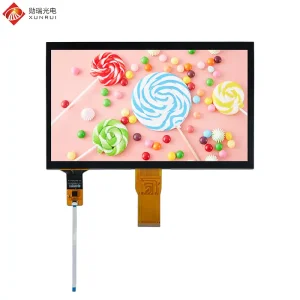
High-Brightness, Large Format & Smart Touch Modules
Engineered for global OEM drop-in integration with pre-certified CE, RoHS, and FCC compliance pathways.






Frequently Asked Questions on 6.2 LCD Modules
In-depth answers addressing design risks, optical specifications, and MOQ terms directly from our engineering leadership.
What is the standard lead time for customized 6.2 LCD samples?
Initial engineering CAD validation and pinout matching take 3 to 5 business days. Once tooling drawings are formally approved, working functional prototypes—including custom FPC design and precision laser-cut cover glass—are fabricated and shipped within 18 to 22 business days. Small-batch pilot runs of 5 to 500 units proceed directly after client evaluation.
Can you provide sunlight readability without excessive heat buildup?
Yes. Simply overdriving LEDs creates unacceptable thermal dissipation inside compact enclosures. We achieve 1,200+ nits luminance by pairing ultra-efficient flip-chip LED packages with high-transmittance polarizer stacks and OCA optical bonding. This configuration delivers sunlight clarity while slashing backlight drive power consumption by up to 35%.
How do you guarantee long-term availability against panel obsolescence?
Shenzhen Xunrui partners with tier-1 glass foundries under multi-year substrate roadmap agreements. For critical industrial, military, and medical devices, we guarantee panel supply continuity for 5 to 7 years. In the event of upstream fab silicon migrations, our engineering team manages backward-compatible FPC and driver firmware updates with advance EOL notices of at least 12 months.
What interface protocol is recommended: MIPI-DSI, RGB, or LVDS?
For modern 6.2-inch modules with resolutions of 720×1520 or above, a 4-lane MIPI-DSI interface is strongly recommended because it reduces EMI radiation, lowers pin counts, and conserves PCB real estate. For long-distance transmission across industrial cabinets (greater than 20cm), we recommend low-voltage differential signaling (LVDS) or conversion to HDMI via our driver boards.
Can the touch panel operate under rain and heavy industrial gloves?
Yes. Our projected capacitive (PCAP) touch sensors utilize multi-channel industrial controller ICs (such as Ilitek or Goodix). We program firmware algorithms specifically with self-capacitance sensing modes, enabling reliable multi-touch tracking through 5mm tempered glass cover plates, continuous water droplet exposure, and thick industrial work gloves.
What minimum order quantities (MOQ) apply for custom 6.2" tooling?
To reduce evaluation friction for global hardware developers, we support prototyping batches of 5 to 500 units after drawing sign-off. For customized mass production requiring custom FPC tooling or tailored cover glass silk screens, standard batch MOQs begin at 1,000 units, structured with flexible scheduled-release purchase orders.
Accelerate Your 6.2-Inch Display Design Today
Send your mechanical DXF/STP enclosure files, interface requirements, and target optical specifications. Our Shenzhen optoelectronic engineering team responds within 24 hours with a comprehensive DFM review.