
Precision Modular Displays & Custom QVGA Solutions
Explore standard, wide-temperature, and ultra-high brightness display assemblies engineered in our Shenzhen optoelectronic manufacturing base for immediate OEM sampling.

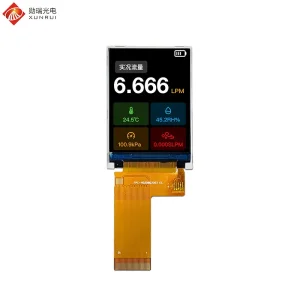






The Engineering Foundation of 320x240 (QVGA) Displays
Why Quarter-VGA resolution remains the definitive standard for industrial reliability, thermal stability, and microcontroller bandwidth efficiency across harsh physical environments.
Deterministic MCU Rendering
Unlike 1080p or 4K consumer screens that demand multi-gigahertz processors and external high-speed DDR memory, a 320x240 display requires exactly 153.6 Kilobytes of frame buffer memory in 16-bit RGB565 format (320 × 240 × 2 bytes).
- Fits inside embedded SRAM on STM32, ESP32, NXP i.MX RT
- Eliminates external SDRAM bus noise and routing complexity
- Zero dropped frames in safety-critical alert interfaces
Thermal & Power Budget Efficiency
By operating with fewer active thin-film transistors, a 3.5" or 2.4" 320x240 TFT display generates drastically less parasitic heat, achieving backlight efficiencies impossible in dense FHD micro-pixel grids.
- Sub-0.5W total power consumption for battery field gear
- Low junction temperatures avoid thermal color shifting
- Proven operation in explosion-proof ATEX enclosures
Guaranteed Long-Term Availability
While consumer displays face rapid obsolescence every 12 to 18 months, our industrial 320x240 manufacturing lines guarantee a 7 to 10+ year availability horizon with proactive PCN/EOL roadmaps.
- Long-term wafer supply from Tier-1 glass foundries
- Compatible pin-for-pin drop-in replacement designs
- Eliminates recurring medical/industrial recertification costs
Search Intent & Engineering Reality: 320x240 vs High-Density Panels
Engineers searching for "Custom 320x240 TFT Display Manufacturers" are rarely looking for consumer tablet resolutions. Their primary requirement is deterministic reliability: displays that wake up instantly from cold storage at -30°C, maintain legibility under full direct desert sunlight (1000 nits), tolerate high electromagnetic interference (EMI) from industrial variable-frequency drives (VFDs), and maintain mechanical pinout compatibility over a decade-long product lifecycle.
Multi-Tier Customization Capabilities for 320x240 Modules
From glass chemistry to interface timings, XUNRUI adapts every layer of the optoelectronic stack to meet your physical enclosure constraints and operational parameters.
| Subsystem | Standard Specification | Custom OEM Engineered Options | Validation / Target Environment |
|---|---|---|---|
| Optical Liquid Crystal | TN (Twisted Nematic), 6:00 or 12:00 viewing direction | IPS (In-Plane Switching), All-O'Clock 80/80/80/80 viewing symmetry, Transflective sunlight layers | Medical / Diagnostic Handheld |
| Backlight Brightness | 250 – 350 cd/m² (Nits), standard white LED array | High-Nit 800 – 1200+ cd/m² with custom constant-current driver boards & thermal heat spreading | Direct Outdoor Sunlight |
| Touch Interaction | Non-touch or standard 4-wire Resistive (RTP) | Projected Capacitive (PCAP) with I2C/USB, glove touch, water-rejection tuning, 3mm-6mm tempered glass | Industrial HMI / Kiosk |
| Signaling Interface | 8/16-bit 8080/6800 Parallel MCU or 3/4-wire SPI | RGB 18/24-bit, MIPI DSI, LVDS, or customized UART/RS485/CAN intelligent driver boards | Embedded IoT / Automotive |
| FPC Cabling & Pinout | Standard pitch bottom entry (e.g., 30-pin, 40-pin, 50-pin) | Custom length, EMI gold-plated/silver-foil shielding, multi-bend radius, exact legacy pin matching | Drop-In Retrofit Systems |
| Cover Lens (CG) | 0.7mm standard soda-lime bare glass | Corning Gorilla / Chemically Strengthened Glass, IK07/IK08/IK10, Anti-Glare (AG), Anti-Reflective (AR), Anti-Fingerprint (AF) | Vandal-Resistant & Marine |
Optical Bonding (OCA / OCR)
Air-gap displays suffer from 3 internal optical reflections, degrading contrast under direct sunlight. We engineer both Optical Clear Adhesive (OCA tape) and Optical Clear Resin (OCR liquid bonding) to eliminate index mismatch between the polarizer and cover glass.
- Sunlight contrast ratio boost by up to 400%
- Prevents internal condensation and dust entry
- Enhances shock absorption to withstand IK08 impacts
Ruggedized Cover Glass Chemistry
For chemical plants, medical sterilizing environments, and outdoor kiosks, our custom cover lenses incorporate advanced surface treatments tailored to harsh cleaning protocols.
- Anti-Glare (AG) chemical etching kills specular reflections
- Anti-Reflective (AR) vacuum sputtering boosts transmission to 97%
- Hydrophobic AF coating resists bleach, isopropyl, and grease
Wide Temperature LC Formulations
Standard liquid crystal fluids experience sluggish molecular relaxation below -10°C and isotropic phase transition above +70°C. We formulate wide-temp liquid crystal fluid stacks with fast response times.
- Operating range: -30°C to +85°C
- Storage endurance: -40°C to +90°C
- Sub-35ms refresh time preserved even at sub-zero temperatures
Real-World Application Scenarios for 320x240 Displays
Across North America, Europe, East Asia, and the Global South, our custom 320x240 TFT modules serve as the visual backbone for mission-critical instruments.
Industrial Automation & Process Control HMIs
Programmable Logic Controllers (PLCs), explosion-proof gas detectors, vibration analyzers, and field calibrators deployed inside refineries and stamping plants require resilient 3.5" or 2.8" QVGA screens.
- Challenge: Heavy motor EMI, operator gloves, coolant overspray.
- XUNRUI Custom Architecture: 4-wire analog resistive touch or industrial Cypress/Microchip PCAP with water-rejection firmware; thick FPC shielding foil.
Medical Handheld Diagnostics & Patient Care
Syringe infusion pumps, automated external defibrillators (AEDs), handheld point-of-care blood gas monitors, and portable spirometers rely on 320x240 IPS displays for high visual clarity.
- Challenge: Medical disinfection wiping (glutaraldehyde, alcohol), strict IEC 60601-1-2 EMC compliance.
- XUNRUI Custom Architecture: Flush chemically hardened cover lens with sealed bezel gasket, high-contrast IPS wide-viewing crystal matrices.
Smart Grid Telemetry & Energy Metering
Three-phase commercial power meters, photovoltaic inverter displays, high-voltage substation switchgear monitors, and remote terminal units (RTUs) operating 24/7/365 without shutdown.
- Challenge: 15-year continuous operation without backlight failure; temperature fluctuations from harsh winters to scorching summers.
- XUNRUI Custom Architecture: Long-life Nichia LED backlights (50,000+ hrs MTBF to half-life), wide-temp liquid crystal formulation (-30°C to +80°C).
Maritime, Aviation & Heavy Vehicle Auxiliaries
Marine bilge monitors, auxiliary cockpit gauges, engine diagnostic pods in agricultural tractors, and mining truck telematics require crisp QVGA readability in open-cab direct sunlight.
- Challenge: Blinding sunlight glare up to 100,000 Lux; heavy mechanical vibration and saline humidity.
- XUNRUI Custom Architecture: 1000–1200 nit customized backlights, Optical Bonding (OCA) to prevent fogging, anti-reflective front coatings.
Commercial Security, Intercoms & Access Nodes
Biometric door access controllers, commercial video intercom door panels, secure payment terminals (POS), and smart locker authentication screens requiring high reliability.
- Challenge: Vandalism exposure, UV exposure degradation, yellowing of front polarizers.
- XUNRUI Custom Architecture: IK08/IK09 impact-certified front cover plates, UV-blocking polarizing films, custom silk-screen logos with hidden IR sensors.
Legacy Drop-in Retrofit Engineering
Industrial machinery across North America and Western Europe designed around obsolete monochrome STN/FSTN or discontinued Japanese TFTs (e.g., Kyocera, NEC, Sharp).
- Challenge: Non-negotiable enclosure cutouts, legacy 8-bit parallel buses, discontinued driving voltages.
- XUNRUI Custom Architecture: Custom FPC with active step-up charge pumps, tailored bezel brackets, firmware-matched initialization strings.
Shenzhen Factory Resilience: Upstream Access & Rapid Ramping
Operating from Shenzhen's Bao'an optoelectronic technology cluster since 2016, XUNRUI leverages integrated supply chains to offer unbeatable engineering speed, lower tooling overhead, and production continuity.
5,000m² Certified Manufacturing Hub
Our Bao'an facility operates ISO 9001:2015 and ISO 14001:2015 certified cleanrooms with fully automated COG (Chip-on-Glass) and FOG (Flex-on-Glass) bonding lines.
- 2,000,000 units monthly total module capacity
- Automated optical inspection (AOI) with sub-micron alignment
- Class 1,000 laminar flow bonding environments
Rapid Prototyping: 5 to 500 Pcs Pilot Runs
Unlike legacy mega-fabs that demand 50,000-unit minimum orders just to open a tooling conversation, XUNRUI embraces mid-market engineering velocity.
- Initial engineering drawings issued in 3–5 working days
- Fast tooling turnarounds: working samples in 2–3 weeks
- Low-risk trial batches (5–500 pcs) before mass ramp-up (1000+ pcs)
Rigorous 5-Gate Quality Protocol
Zero-defect assurance backed by multi-stage aging and rigorous optical and electrical screening before global export packaging.
- Gate 1: IQC incoming optical & wafer inspection
- Gate 2: High-temperature FOG bonding shear & conductivity test
- Gate 3: 24–72 hr dynamic thermal chamber aging at 60°C
- Gate 4 & 5: 100% full electrical touch/optical sweep and OQC out-gate
Technology Roadmap: The Next Era of 320x240 Displays
Continuous innovation in liquid crystal chemistry, smart driving firmware, and optical bonding materials ensures QVGA modules continue leading edge-computing displays.
Full IPS Transition
Phasing out legacy TN panels prone to 6:00/12:00 grayscale inversion. Modernizing standard production to true 80/80/80/80 IPS panels with zero color distortion from any viewing angle.
Ultra-Efficient Light Guides
Next-generation prism film sheets and localized low-power LED matrices yielding 1,000 cd/m² sunlight luminance at 35% reduced thermal dissipation and battery consumption.
Smart UART/CAN Modules
Integrating on-module flash memory, GUI engines, and direct serial protocols (RS485/CAN-Bus/Modbus). Offload UI rendering completely from the host motherboard.
Extreme Wide-Temp & Haptic PCAP
Liquid crystal formulations operating from -40°C to +95°C coupled with tactile haptic-feedback capacitive sensors for automotive cockpits and extreme arctic outdoor telemetry.
Regulatory Compliance & Engineering Assurance
Global original equipment manufacturers require auditable proof of material safety, chemical compliance, and electrical reliability before design sign-off.
Environmental & Safety Compliance
Every module manufactured in our facility complies with strict international environmental directives for chemical toxicity and recyclability.
- RoHS 3 (EU 2015/863): Zero lead, mercury, cadmium, hexavalent chromium, PBBs, PBDEs, or phthalates.
- REACH (EC 1907/2006): Fully documented SVHC substance disclosures.
- UL94V-0: Flame-retardant FPC polyimide substrates and plastic bezels.
Electromagnetic & ESD Robustness
Industrial displays must endure high static electricity discharge and severe electrical transients without reset or image freeze.
- ESD Immunity (IEC 61000-4-2): Air discharge ±15kV, contact discharge ±8kV with grounded perimeter rings.
- EMI Mitigation: Tuned rise times and integrated grounding foils suppress CISPR 32 Class B electromagnetic radiation.
Strict PCN & EOL Discipline
Protecting our customers from surprise redesign costs is our core industrial commitment.
- Advance Notification: Minimum 6 to 12 months advance Product Change Notification (PCN) before any component revision.
- Last-Time Buy (LTB): Guaranteed buffer stock allocations during end-of-life phases.
- Pin-Compatible Successors: Form, fit, and functional drop-in replacements designed before phase-outs.
Engineering FAQ: Custom 320x240 TFT Sourcing & Integration
Comprehensive technical answers directly from XUNRUI’s optoelectronic engineering desk to accelerate your design cycle and de-risk procurement.
What are the primary differences between TN and IPS technologies in 320x240 TFT modules?
How do you achieve true sunlight readability on a 320x240 display without thermal runaway?
- Using high-efficacy Nichia LED dies that deliver more lumens per milliampere.
- Custom thick-copper FPC backplanes that act as integrated heat-spreaders, funneling thermal energy to the device's chassis.
- Applying Optical Bonding (OCA/OCR) with anti-reflective (AR) front coatings to cut surface reflectance from ~14% down to under 0.8%. This dramatically reduces the backlight power needed to achieve clear sunlight legibility.
Can XUNRUI customize the FPC pinout and length to drop into an existing obsolete display footprint?
What is the minimum order quantity (MOQ) and timeline for custom tooling?
Should our project select a Resistive (RTP) or Projected Capacitive (PCAP) touch sensor?
- Select Resistive (RTP): Ideal for extreme industrial environments where operators wear heavy leather/insulated gloves, where heavy fluid splattering or oil droplets are common, or where zero risk of false EMI touch triggers is required. RTP operates strictly by mechanical pressure, making it electrically bulletproof in high-voltage environments.
- Select Projected Capacitive (PCAP): Essential for modern smartphone-like multi-touch gestures, smooth scrolling, and designs requiring a sleek, flush glass front. Our PCAP assemblies can be customized with 3mm to 6mm chemically strengthened cover glass (IK08/IK10 rated) and tuned with custom firmware algorithms to support thin latex/nitrile gloves and water droplet rejection.
What controllers (Driver ICs) are standard in your 320x240 and 240x320 product lines?
Integrated Driver Modules, Bar Displays & Custom Panels
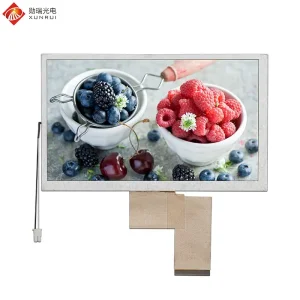
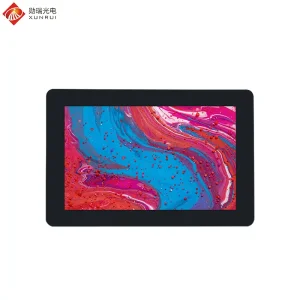
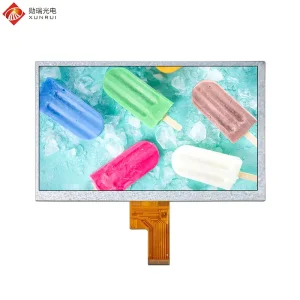
In addition to 320x240 QVGA platforms, XUNRUI engineers standard, bar-type, square, and large-format touch displays up to 27 inches for industrial automation ecosystems.





Initiate Your Custom 320x240 Display Specification
Connect directly with XUNRUI’s optoelectronic engineering desk. Send us your target dimensions, interface pinout requirements, backlight target nits, and operating environment parameters for a rapid feasibility review and quotation.