
Precision Display Modules & Integrated Touch Subsystems
Explore our core industrial and embedded display portfolio manufactured in our Shenzhen cleanrooms. Each unit is available with customized FPC pinouts, enhanced cover glass, and high-lumen optical stacks.






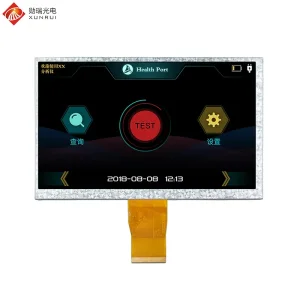

The Strategic Landscape of 5.7" Industrial LCD & Touch Systems
Why the 5.7-inch 4:3 aspect ratio remains the cornerstone of mission-critical human-machine interfaces, and how custom optoelectronic manufacturing resolves legacy obsolescence while delivering next-generation optical performance.
The Irreplaceable 4:3 Form Factor
For more than two decades, the 5.7-inch display (typically 640×480 VGA or 320×240 QVGA) has served as the universal standard for industrial DIN-rail controllers, test and measurement oscilloscopes, and surgical consoles. While consumer markets migrated toward ultra-wide 16:9 and 20:9 geometries, heavy equipment chassis, CNC retrofits, and maritime monitoring systems are mechanically restricted to square-profile 4:3 openings. Re-tooling structural steel cabinets costs tens of thousands of dollars; sourcing modernized, high-performance 5.7" panels eliminates chassis redesign while upgrading technical capability.
- Strict mechanical drop-in compatibility
- Active area: ~115.2 × 86.4 mm matching legacy cuts
- Zero structural metalwork overhaul required
From CCFL to Solid-State High-Nit LED
Legacy 5.7-inch displays suffered from cold cathode fluorescent lamp (CCFL) backlight failure, exhibiting color shifting, high-voltage inverter hazards, and severe brightness degradation below 250 nits. Shenzhen Xunrui Optoelectronics re-engineers the 5.7" architecture utilizing ultra-efficient surface-mount Nichia/Osram LED matrices coupled with micro-prismatic light guide plates (LGPs). We achieve optical outputs exceeding 1,200 nits while slashing power consumption by 45%, enabling continuous daylight readability in open-cockpit agriculture and marine navigation.
- Backlight half-life extended to 50,000+ hours
- Integrated constant-current LED driver options
- Elimination of fragile, failure-prone high-voltage inverters
IPS All-Perspective Transformation
Traditional twisted nematic (TN) panels in the 5.7" space suffered from severe grayscale inversion and chromatic washouts when viewed off-axis, creating hazardous reading angles in overhead factory racks or multi-operator medical theaters. Xunrui introduces advanced In-Plane Switching (IPS) and Super-IPS glass structures to the custom 5.7" domain. This guarantees a symmetrical 85°/85°/85°/85° viewing hemisphere, uniform 800:1 to 1000:1 contrast ratios, and stable color saturation regardless of the user's viewing trajectory.
- True 178°/178° viewing cone with zero inversion
- 16.7M / 262K color fidelity with wide NTSC gamut
- Chemically strengthened substrate glass options
Touchscreen Integration: PCAP vs. Resistive Physics
A comprehensive engineering comparison of touch sensory layers matched to the 5.7" footprint, detailing substrate bonding, optical index matching, and electromagnetic interference (EMI) containment.
| Engineering Parameter | Industrial 5-Wire Resistive (RTP) | Projected Capacitive (PCAP / CTP) | Xunrui Custom Enhanced Hybrid |
|---|---|---|---|
| Primary Actuation Method | Mechanical Pressure (Stylus, Gloved, Bare) | Electrostatic Capacitance Coupling | Tuned Firmware Multi-Touch (Glove + Water Rejection) |
| Optical Transmittance | 78% – 82% (Dual ITO films + air spacer) | 88% – 92% (Optical Glass Substrate) | >93% via LOCA/OCA Direct Optical Lamination |
| Surface Hardness & Durability | 3H (PET film susceptible to scratches) | 6H – 7H (Standard Soda-Lime Glass) | 9H Mohs (Chemically Toughened Gorilla / Dragontrail) |
| Multi-Touch Capability | Single-touch only | 5 to 10 Simultaneous Finger Points | Multi-finger Gestures + Palm Rejection Calibration |
| EMI / RF Susceptibility | Inherently Immune to RF Emissions | Requires tuned digital noise filtering | Integrated Hardware Shielding Mesh + ILITEK/EETI IC |
| Harsh Media Resilience | Vulnerable to organic solvent punctures | Hermetically sealed glass front face | Resistant to hospital grade bleach, saline, hydrocarbons |
| Operating Temperature | -20°C to +70°C | -20°C to +70°C | -30°C to +85°C (Automotive / Military Grade) |
Optical Bonding (OCA/LOCA) Science
Traditional air-gap bonding leaves an internal boundary of air (refractive index n=1.0) between the TFT glass (n=1.52) and the touch layer. This generates two extra reflective boundaries, causing internal bounce that wastes 8.5% to 10% of light and washes out display contrast under solar incidence. Xunrui operates automated vacuum optical bonding cells utilizing optically clear resin (OCR/LOCA) or dry film adhesive (OCA) matched precisely to n=1.49. This eradicates internal reflection, prevents internal condensation in tropical climates, and elevates module impact resistance to IK08/IK10 standards.
Advanced Cover Glass Metrology
We provide full bespoke machining of the external protective glass lens. Cover plates can range from 0.7 mm for space-constrained handheld terminals up to 6.0 mm laminated bulletproof blast glass for explosion-proof mining stations (ATEX / IECEx). Our internal processes provide customized ceramic silkscreen printing with custom brand logos, dead-front capacitive buttons, bevel routing, stepped edges, and precision cutouts for physical emergency stop switches or optical sensors.
Specialized Surface Coatings
Raw cover glass is susceptible to ambient glare, smudge accumulation, and abrasive scratching. We incorporate tri-layer sputtering: Anti-Glare (AG) chemical etching to diffuse direct reflections without introducing pixel sparkle; Anti-Reflective (AR) physical vapor deposition to boost total transmission above 95%; and Anti-Fingerprint (AF) oleophobic fluoropolymer coatings providing water contact angles >115°, ensuring easy wiping of organic fluids, lubricants, and blood in surgical applications.
Enterprise Sourcing: Overcoming Component Obsolescence
Procurement directors and embedded engineering teams face constant challenges with sudden end-of-life (EOL) notices from consumer display fabs. Xunrui’s dedicated industrial roadmap guarantees product longevity, component equivalence, and rigorous cost stability.
5-to-10 Year Roadmap Continuity
Consumer tablet and smartphone display assemblies are retired every 12 to 18 months, which is intolerable for medical or industrial capital equipment that takes 3 years to gain FDA 510(k) or CE safety certification. Xunrui guarantees 5 to 7+ years of form-fit-function (FFF) production consistency. If raw glass fab revisions occur upstream, our engineering group executes drop-in FPC pin remapping and driver board matching to keep your enclosure and firmware unaltered.
De-risked Trial Batch Framework
Moving from CAD verification directly to a 5,000-unit production order presents substantial risk. Xunrui provides a phased introduction model: following engineering sign-off on 3 to 5 custom prototypes, we supply a one-time trial batch of 5 to 500 units. This enables our clients to carry out field EMC testing, software UI trials, and environmental stress validation before triggering high-volume mass production (custom MOQ >1,000 units).
Interface Adaptability & Bridge Boards
System designers frequently need to connect modern processing architectures with legacy protocols. We manufacture custom printed circuit board assemblies (PCBAs) integrating 24-bit TTL RGB, 18-bit LVDS, 4-wire SPI, 8/16-bit 8080 MCU, and MIPI-DSI interfaces directly on the rear of the 5.7" module, complete with onboard AV, HDMI, or VGA converters for straightforward integration into existing PC/104 or ARM host architectures.
Engineered Blueprints for Extreme Operating Environments
How our custom 5.7" display and touch sub-assemblies are integrated across demanding industries, delivering sustained reliability and regulatory compliance.
1. Medical Diagnostic & Infusion Systems
Modern medical devices demand uncompromised reliability, wide viewing perspectives, and zero false touch triggers caused by saline or disinfectant drips. We engineer 5.7" IPS modules equipped with customized PCAP sensors running tuned firmware that ignores free-floating fluids while registering touches from double-layered surgical nitrile gloves. Modules comply with IEC 60601-1-2 4th Edition EMC limits, shielding against nearby electrosurgical arc interference.
- Antibacterial cover glass coatings
- Seamless IP65 flush bezel mount design
- Zero optical color shifting under steep angles
2. Industrial Automation, Robotics & CNC
Factory environments expose human-machine interfaces to heavy motor vibrations, line noise spikes, airborne oil aerosols, and rough operation by gloved personnel. Xunrui offers heavy-duty 5-wire resistive and 3.0 mm tempered glass capacitive 5.7" displays rated for MIL-STD-810H vibration resistance. Advanced conductive copper back-shielding and differential LVDS signaling preserve data integrity in high-voltage variable-frequency drive (VFD) cabinets.
- Heavy glove actuation (leather, Kevlar, rubber)
- Operating temperature: -30°C to +80°C
- High noise immunity controller ICs (EETI / FocalTech)
3. Marine Navigation & Heavy Fleet Telematics
Operating an open-cockpit boat or agriculture tractor under direct 100,000-lux midday sunlight makes standard screens unreadable. Our outdoor 5.7" LCD displays combine 1,200–1,500 nit edge-lit backlights with circular polarizing films, enabling clarity even when operators wear polarized sunglasses. Salt-fog resistant silicon edge sealing prevents trace electrolytic corrosion along internal silver bus lines, passing ASTM B117 salt spray tests.
- Full sunlight legibility up to 1,500 nits
- Optical bonding prevents internal fogging
- UV-resistant cover glass prevents yellowing
Engineering Workflow: From Blueprint to Volume Supply
Our ISO 9001 and ISO 14001 certified engineering lifecycle guarantees comprehensive design review, rapid physical sampling, and strict gate inspections before final dispatch.
Mechanical & Optical Audit
Our engineers evaluate your 3D CAD models, bezel clearances, ambient lux profiles, pin-in requirements, and operating thermal envelopes to lock in your custom specification.
CAD/FPC Schematic Sign-Off
We generate 2D/3D structural drawings, circuit schematics, touch sensor layout files, and customized FPC flex tail geometries within 3 to 5 business days for customer sign-off.
Rapid Tooling & Prototyping
Precision tooling for cover glass silk masks, injection backlight frames, and laser FPC etching produces working engineering prototypes within 15 to 20 working days.
Small-Batch Pilot (5–500 pcs)
Following customer approval of initial samples, an optional trial run of 5 to 500 units validates yield stability, optical uniformity, and assembly consistency on our SMT/FOG lines.
Volume Mass Production
Custom orders transition into scalable volume manufacturing (MOQ 1,000+ units) utilizing automated high-speed COG/FOG bonding and automated optical inspection (AOI).
5-Checkpoint Quality Gate
100% of panels pass through IQC incoming inspection, glass laser geometry verification, FOG thermal burn-in aging (72 hrs at 50°C), functional display aging, and final OQC outgoing verification.
Technology Roadmap: Next-Gen 5.7" Innovations
Preview Xunrui's ongoing optoelectronic developments designed to keep classic industrial formats aligned with cutting-edge display capabilities.
Quantum Dot & Mini-LED Backlights
By migrating from traditional edge-lit LED strips to localized full-array local dimming (FALD) Mini-LED architectures with >576 individual zones, upcoming 5.7" revisions achieve true 100,000:1 dynamic contrast ratios. This enables deep black levels essential for dark-room medical endoscopy and night-vision cockpit operation (NVIS MIL-STD-3009 compliant).
In-Cell & On-Cell Touch Miniaturization
To reduce total module thickness and shave system weight in portable inspection tools, Xunrui is testing In-Cell touch arrays integrated directly within the liquid crystal cell itself. This removes the secondary glass substrate entirely, reducing overall z-height by up to 35% while boosting optical transmittance to 94% without requiring separate external bonding.
Piezoelectric Haptic Feedback Integration
Addressing the major limitation of flat glass capacitive interfaces—the lack of physical button response—our R&D team is embedding microscopic piezoelectric actuator disks along the outer bezel. This provides targeted haptic confirmation pulses to operators' fingertips, confirming button actuation through heavy protective gloves without requiring visual confirmation.
Custom 5.7" LCD Touch Screen Engineering FAQ
Detailed technical answers addressing common queries raised by hardware R&D teams, procurement managers, and embedded systems developers.
Can Xunrui replace discontinued 5.7" displays from Kyocera, Sharp, or Ampire without requiring mechanical redesign?
What is the typical Minimum Order Quantity (MOQ) and lead time for custom 5.7" tooling?
How do you ensure projected capacitive touch reliability when operated with thick gloves or exposed to moisture?
What is the difference between air-gap bonding and optical bonding (OCA/LOCA) for outdoor equipment?
Which electrical interfaces are available for custom 5.7" LCD screen designs?
What certifications and quality control procedures govern production at your Shenzhen factory?
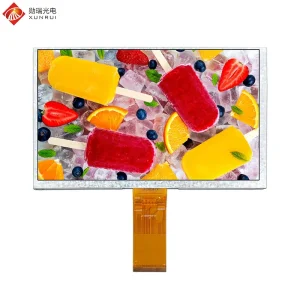
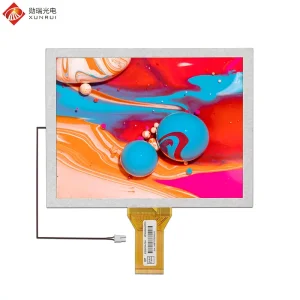
Specialty Display Panels & High-Brightness Assemblies
Complementary display configurations engineered across custom form factors, high-ambient outdoor nit ratings, and specialized automotive interfaces.






Initiate Your Custom 5.7" Engineering Build Today
Whether you require a drop-in replacement for a legacy system or a ground-up ruggedized display stack for next-generation hardware, our Shenzhen engineering team is ready to review your mechanical drawings and application specs.