
Standard & Custom Industrial TFT LCD Modules (Part I)
Explore our foundational range of ultra-reliable small-to-mid display solutions, fully customizable from FPC routing to bonded cover glass.

China 1.44 inch 128×128 SPI 15pin 250nit TN TFT LCD Module Supplier, Factories
Configure Specs
Custom 5 inch 800×480 TN TFT LCD display with capacitive touch panel Manufacturers, Suppliers
Configure Specs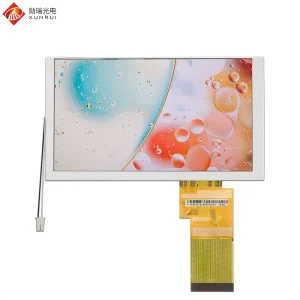
China 6.2 inch 800×480 RGB 60pin 500nit TN TFT LCD Module Manufacturer, Manufacturers
Configure Specs
Custom 5 inch 720×1280 MIPI 40pin 1000nit IPS TFT LCD Display Manufacturer, Supplier
Configure Specs
Custom 5 inch 480×272 TN TFT LCD Module with resistive touch panel Manufacturers, Factory
Configure Specs
Custom 10.1 inch 1280×800 IPS TFT LCD display with capacitive touch panel Supplier, Factory
Configure Specs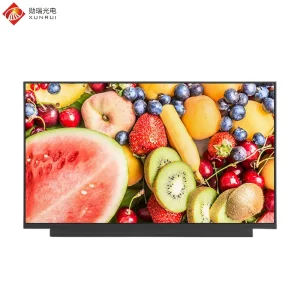
China 15.6 inch 1920×1080 EDP 30PIN 400nit IPS TFT LCD Module Supplier, Factories
Configure Specs
Custom 10.1 inch 1024×600 RGB 50pin interface 350nit TN TFT LCD module Manufacturer, Manufacturers
Configure SpecsThe Global 4-Inch TFT LCD Market: The Ergonomic Anchor of Edge HMI
A rigorous examination of optical form-factors, semiconductor integration, and why the 4-inch display envelope is redefining modern embedded human-machine interfaces.
The 86-Box Smart Wall Standard
Globally, building automation, HVAC controllers, and smart architectural lighting standardize on the universal 86mm × 86mm wall switch back-box. A 4.0-inch square TFT LCD (typically 480×480 or 720×720 resolution) fits within this physical frame, maximizing active touch area without altering existing structural junction boxes.
- 1:1 Aspect ratio perfect for rotary navigation
- Symmetrical viewing angles (85/85/85/85 IPS)
- Eliminates mechanical bezel overhangs
Circular 4-Inch Dial Interfaces
Automotive center consoles, industrial high-torque rotary encoders, and premium smart kitchen appliances have driven explosive demand for 4.0-inch circular TFT LCD panels (720×720 native MIPI). Circular displays require specialized laser scribing and precision circular seal dispensation to avoid micro-crack propagation under thermal cycling.
- True-round active display area (AA: Ø 101.6mm)
- Custom circular capacitive touch overlays
- MIPI DSI 2-lane / 4-lane high frame rate
Total Cost of Ownership (TCO)
Compared to 7.0-inch or larger panels, a custom 4-inch display minimizes bill-of-materials (BOM) load on the host processor. Systems can be driven by cost-effective ARM Cortex-M4/M7 or dual-core microcontrollers without demanding expensive high-density DDR RAM, drastically slashing hardware unit cost and power consumption.
- Low power consumption (< 1.2W backlight)
- SPI + RGB hybrid interfaces for low-pin MCUs
- Compact single-cell Li-ion battery compatibility
Custom 4-Inch TFT LCD Architecture: From Substrate to Cover Glass
Precision-tailored optoelectronic layers built to withstand extreme thermal shock, solar degradation, mechanical vibration, and electromagnetic interference.
Optical Stacks & Sunlight Readability
Standard indoor displays (250–350 nits) wash out under direct sunlight. Our customized 4-inch modules can be engineered with custom high-efficiency LED strings outputting 800 to 1,500 nits. By coupling high-brightness edge-lit backlights with dual-brightness enhancement films (DBEF), we achieve direct sunlight legibility without thermal runaway.
- Luminance: 250 nits to 1,500+ nits adjustable
- Half-life LED MTBF exceeding 50,000 hours
- Transflective polarizers for ultra-low power
FPC Geometry & EMI Hardening
Enclosure constraints often force display connection ribbons through complex bends. We engineer custom Flexible Printed Circuits (FPC) with gold-plated contact fingers, integrated EMI shielding layers (silver paste or copper foil), and embedded ESD suppressors. Pin assignments can be routed directly to match legacy carrier motherboards.
- Custom pinouts: SPI, 8/16-bit MCU, RGB, MIPI
- Multi-bend polyimide flex with stiffeners
- Class B conducted and radiated emission pass
Optical Bonding: OCA vs. LOCA
To eliminate internal boundary reflections and air gap condensation, we provide full optical bonding utilizing Optically Clear Adhesive (OCA) dry sheets or Liquid Optically Clear Adhesive (LOCA/OCR). Optical bonding eliminates the 4% surface reflection from the back of the cover glass, boosting contrast by up to 400% in bright ambient conditions.
- Zero moisture ingress or fogging in harsh environments
- Dramatically enhanced drop-test shatter resistance
- Refractive index matched adhesive (n ≈ 1.49)
Rugged Cover Lens Surface Treatments
Industrial displays encounter corrosive chemicals, heavy impacts, and dirty operating hands. We laminate custom CNC-machined tempered chemically strengthened cover lenses (Corning Gorilla, AGC Dragontrail, or soda-lime) with Anti-Glare (AG), Anti-Reflective (AR), and Anti-Fingerprint (AF/Oleophobic) nanocoatings.
- IK07 to IK10 mechanical impact survivability
- Surface hardness up to 7H - 9H pencil scratch rating
- Custom ceramic silk screen printing (any RAL/Pantone)
Touch Controller Tuning (Glove & Water)
Industrial applications cannot tolerate false touch triggers or unresponsive inputs. Our touch engineering team configures high-SNR capacitive touch controllers (such as FocalTech FT5436, Goodix GT911, or Ilitek ILI2130) with custom firmware parameter maps that support operation with 5mm thick industrial work gloves and water rejection.
- False-trigger immunity against saline and water spray
- Reliable multi-touch with thick safety leather gloves
- Resistive 4-wire options for mission-critical EM environments
Automotive & Ultra-Wide Temperature Cells
Outdoor instruments deployed in Arctic or desert zones face severe liquid crystal viscosity changes. Standard displays freeze below -10°C, causing sluggish frame transitions. Our wide-temperature TFT cells maintain continuous 60Hz switching performance from -30°C to +85°C, eliminating image sticking and slow response.
- Operating Temp: -30°C to +85°C (Storage: -40°C to +90°C)
- High-clearing point liquid crystal (Tni > 110°C)
- Avoids blackening under direct solar radiation
4-Inch TFT LCD Hardware Interface Selection Matrix
Selecting the optimal embedded display bus requires balancing bandwidth, MCU GPIO pin counts, frame rate requirements, and PCB layer costs.
| Interface Type | Common Pin Count | Max Bandwidth | Frame Rate (480x480) | Host Processor Requirement | Recommended Industrial Application |
|---|---|---|---|---|---|
| SPI (3-Wire / 4-Wire) | 8 – 15 Pins | Up to 50 Mbps | 15 – 30 FPS | Low-cost MCU (STM32F4, ESP32) | Static HMIs & Thermostats |
| QSPI (Quad-SPI) | 10 – 16 Pins | Up to 133 Mbps | 35 – 50 FPS | Mid-tier MCU (STM32H7, i.MX RT) | Smart Home Switches |
| RGB 18/24-Bit Parallel | 40 – 50 Pins | Up to 500 Mbps | 60 FPS (Zero Lag) | MPU with LCD Controller (Allwinner, NXP) | Industrial Machinery UI |
| MIPI DSI (2 / 4-Lane) | 20 – 30 Pins | Up to 1.5 Gbps/lane | 60 – 120 FPS | Application Processor (Rockchip, Qualcomm) | Medical Monitors & Automotive |
| MCU 8080 / 6800 Parallel | 30 – 40 Pins | Up to 20 MB/s | 20 – 40 FPS | Legacy 8-bit / 16-bit Microcontrollers | Field Test Instrumentation |
The Chinese Factory Advantage: Agile Prototyping & Supply Chain Resilience
Shenzhen Xunrui Optoelectronic Technology Co., Ltd. leverages the world’s most concentrated optoelectronics ecosystem to turn engineering concepts into verified mass-production units.
7–14 Day Rapid Prototyping Cycle
Where legacy Western manufacturers require 12 to 20 weeks for customized tooling, our localized cluster in Shenzhen allows us to deliver customized FPC layouts, revised backlight light-guides, and custom touch-panel cover lenses in as little as 10 to 14 business days. This compresses your overall product design cycle by up to 60%.
Fully Integrated In-House Assembly
We do not outsource critical assembly steps. Glass cutting, polariser lamination, automated COG (Chip-on-Glass) and FOG (Flex-on-Glass) ACF bonding, optical bonding, and cleanroom encapsulation take place under our direct quality management system, certified to ISO 9001 and ISO 14001 standards.
BOM Stability & 5–7 Year Longevity
Consumer display glass faces constant obsolescence. For industrial and medical OEM customers, XUNRUI guarantees 5 to 7 years of pin-compatible display availability. When raw glass generations eventually transition, our firmware engineers provide drop-in driver board or bridge IC solutions to keep your device in continuous production.
Our 5-Stage Zero-Defect Manufacturing Protocol
IQC Raw Material Verification
Microscopic inspection of raw glass substrates, chromaticity binning of LED backlights, and peel-strength testing of FPC adhesives.
Automated Optical Inspection
High-speed AOI systems verify precision alignment of ACF conductive particles during Chip-On-Glass and Flex-On-Glass thermo-compression bonding.
High-Temp Thermal Burn-In
100% of bonded display modules undergo continuous operational aging inside climate chambers for 48 to 72 hours at 50°C - 60°C.
Optical & Touch Calibration
Spectroradiometric evaluation of white balance, luminance uniformity (>85%), contrast ratios, and touch coordinate linearization.
OQC & Vacuum ESD Packaging
Final drop-shock, vibration, and thermal cycling checks before nitrogen-purged vacuum packaging in anti-static ESD shielding bags.
High-Reliability Industrial Deployments for 4-Inch Displays
Real-world integration scenarios where custom 4.0-inch TFT LCD technology delivers exceptional resilience, usability, and visual performance.
Smart Thermostats & Building Control
A European smart home brand integrated our custom 4.0-inch 480×480 square IPS module into their flagship connected thermostat. Featuring chemically strengthened 1.8mm cover glass with an oleophobic coating, the display delivers 500 nits of vivid color, full 85-degree symmetrical viewing angles, and ultra-low standby dissipation.
Industrial Handheld Gas Analyzers
For chemical and mining field instruments, explosive gas environments prevent standard capacitive touch due to thick rubber gloves and spark hazards. We supplied a custom 4.0-inch sunlight-readable 1000-nit panel equipped with an ultra-durable 4-wire resistive touch overlay and -30°C to +80°C operating window for petrochemical field inspection.
Medical Diagnostic Infusion Pumps
Medical intensive care equipment demands cleanability with isopropyl alcohol and bleach solutions without fogging or delamination. Our LOCA optically bonded 4-inch display provides continuous water/disinfectant rejection, antimicrobial cover glass, and high EMI immunity passing IEC 60601-1-2 medical EMC standards.
Frequently Asked Questions: Custom 4-Inch TFT LCD Manufacturing
Direct technical answers to common queries submitted by display hardware engineers, procurement specialists, and product managers.
What is the typical tooling cost (NRE) and lead time for custom 4-inch TFT LCDs?
Non-Recurring Engineering (NRE) costs vary based on customization scope. FPC redesign generally costs between $500 and $1,200 with a 10–14 day sample lead time. Custom capacitive touch cover glass (custom silk printing, dimensions, and AG/AR coatings) runs $1,500 to $3,500 depending on glass thickness and CNC complexity. Complete optical stack development takes approximately 2 to 3 weeks from approved CAD drawings.
Can you provide high-brightness 4-inch displays readable in direct sunlight?
Yes. Standard displays average 250–350 nits, which wash out under direct outdoor sunlight. We custom-build 4-inch backlights utilizing high-efficiency Nichia or Epistar LED arrays outputting 800 to 1,500+ nits. We pair this with enhanced optical films (DBEF) and optical bonding to ensure direct solar contrast ratios exceeding 10:1 in 10,000+ lux ambient daylight.
What is the difference between TN and IPS technology for a 4-inch panel?
Twisted Nematic (TN) panels are cost-effective but suffer from severe color inversion and contrast decay when viewed off-axis (typically 45–65 degree viewing cone). For premium industrial and medical devices, we recommend In-Plane Switching (IPS) panels, which provide true 80/80/80/80 or 85/85/85/85 all-angle viewing cones with consistent color fidelity and zero grayscale inversion.
How does XUNRUI support small-batch trial production before mass manufacturing?
We recognize the financial and engineering risk in ramping new hardware. After initial prototype sign-off, we provide small-batch trial runs of 5 to 500 units. This allows your firmware, mechanical, and QA engineering teams to validate production yields, automated test fixtures, and field behavior before committing to volume MOQs (typically 1,000+ units).
Can the touch panel operate under wet conditions or with industrial work gloves?
Yes. By tuning touch controller firmware (FocalTech, Goodix, or Ilitek), we adjust self-capacitance and mutual-capacitance algorithms to reject uniform water film interference while tracking intentional finger gestures. Glove mode sensitivity maps allow smooth tracking through 2mm to 5mm thick nitrile, leather, or synthetic industrial gloves.
What interface should I choose for an STM32 or ESP32-S3 host processor?
For resource-constrained MCUs like STM32F4 or ESP32, an SPI or QSPI (Quad-SPI) interface is ideal, keeping pin count low (6–12 pins) while supporting 25–40 FPS UI frame rates for 480×480 panels. For high-end MCUs with integrated RGB controllers (like STM32H7, NXP i.MX RT), a 16-bit or 24-bit RGB interface delivers full 60 FPS performance without CPU overhead.
Specialized Form Factors & Extended Modules (Part II)
Review our specialized round, square, HDMI-interfaced, and large-format TFT displays designed for extreme industrial applications.

China 7 inch HDMI 1024×600 IPS TFT LCD Module With driver board and CTP Supplier, Factory
Configure Specs
Custom 2 inch 176×220 MCU 45pin interface 220nit TN TFT LCD Module Supplier, Suppliers
Configure Specs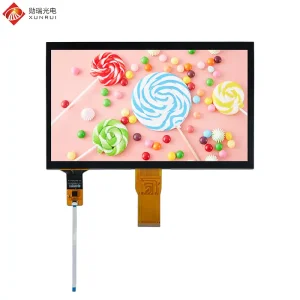
China 10.1 inch 1024×600 RGB IPS TFT LCD Module with capacitive touch Manufacturers, Factories
Configure Specs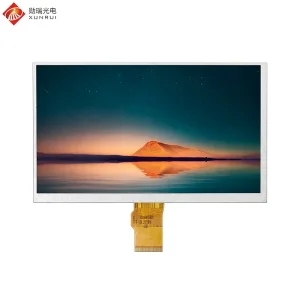
Custom 9 inch 800×480 RGB 50pin interface 500nit TN TFT LCD module Manufacturer, Suppliers
Configure Specs
China 4 inch 480×480 RGB Square IPS TFT LCD Module with capacitive touch Manufacturer, Supplier
Configure Specs
China 10.1 inch TFT LCD module 1280×800 LVDS 40pin interface 350nit IPS screen Manufacturer, Manufacturers
Configure Specs
China 2.8 inch 240×320 MCU 30pin interface 250nit TN TFT LCD display Manufacturers, Factories
Configure Specs
Custom 4 inch IPS 720×720 MIPI 30pin interface Circular TFT LCD module Manufacturer, Factories
Configure Specs