
Featured Small-to-Medium TFT LCD Modules
Factory-direct customized displays featuring wide thermal tolerance, IPS all-angle viewing, and flexible electrical bus protocols for mission-critical embedded hardware.


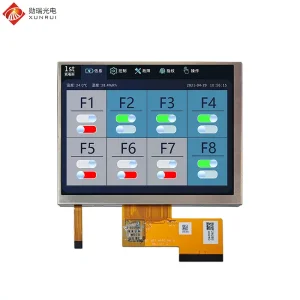
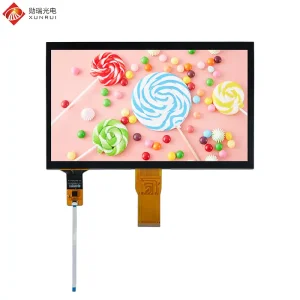




The Paradigm Shift in 4-Inch TFT Screen Engineering
Small-format displays are no longer passive readout panels; they have transformed into interactive, high-definition graphical nerve centers for smart physical infrastructure.
Square & Rotary 1:1 Aspect Formats
While legacy 4.3" modules (480×272) continue to serve industrial retrofits, modern edge-device architectures have rapidly shifted toward square 4.0-inch (480×480, 720×720) and 3.95-inch displays. These symmetric form factors are engineered specifically for intelligent rotary knob encoders, home automation thermostats, and compact wall switches, maximizing UI canvas while minimizing enclosure footprint.
Universal IPS Dominance Over TN
Twisted Nematic (TN) panels are being systematically phased out in high-reliability applications due to grayscale inversion when viewed from off-axis perspectives. Modern 4" TFT screens utilize In-Plane Switching (IPS) liquid crystal alignment, delivering true 80°/80°/80°/80° or 85°/85°/85°/85° viewing cones without chromatic distortion, crucial for medical infusion pumps and vehicle sub-consoles.
High-Efficiency Optical Backlighting
Legacy 250–350 nit panels become illegible washed-out surfaces under direct 10,000+ lux daylight. Sourcing trends show that over 65% of enterprise inquiries now mandate 800 to 1,500 nits of luminance. Advanced 4" modules achieve this through optical matrix enhancement, low-forward-voltage (Vf) Nichia/Osram LED dies, and custom light guide plates (LGP) that avoid thermal runaway within sealed enclosures.
Engineering Parameters: Sourcing Custom 4" TFT Screens
Procurement teams and hardware architects must balance optical fidelity, signaling protocols, and physical durability. Here is how technical leads evaluate 4" panel integration.
| Evaluation Parameter | Legacy / Consumer-Grade Spec | Xunrui Industrial Custom Grade | Impact on Hardware Engineering |
|---|---|---|---|
| Panel Topology | TN (Twisted Nematic) 6 o'clock | IPS (In-Plane Switching) / ADS All-Viewing | Eliminates color inversion when users view the HMI from steep vertical or lateral angles. |
| Backlight Luminance | 250 – 350 cd/m² (Nits) | 800 – 1,500 cd/m² (Custom Array) | Guarantees readability in direct outdoor sunlight (>10,000 lux) and marine deck equipment. |
| Operating Temperature | -10°C to +60°C | -30°C to +85°C (Ultra-Wide Option) | Prevents liquid crystal freeze, sluggish refresh, or black-screen polarization failure in cold/heat. |
| Electrical Interface | Parallel RGB (40-Pin / 50-Pin) | MIPI-DSI (2/4-Lane) / QSPI / 8/16-Bit MCU | Drastically lowers EMI radiation, reduces PCB trace counts, and saves MCU GPIO overhead. |
| Touch Sensor Bonding | Air Gap (Perimeter Tape Bonding) | Full Optical Bonding (OCA / LOCA) | Removes internal refractive reflections, halts condensation/fogging, boosts IK impact rating. |
| Cover Lens Hardness | Standard Soda Lime Glass (3H–5H) | Chemically Strengthened Gorilla/Asahi (7H+) | Survives tool drops, IK08 steel ball impacts, and harsh chemical cleaning wipe-downs. |
Signaling Architecture
Small 4-inch screens are frequently paired with low-cost, resource-constrained microcontrollers (e.g., STM32, ESP32-S3, NXP i.MX RT). Customizing the FPC pinout for 4-wire SPI + RGB or Dual/Quad-SPI allows high refresh GUI animation without burning out 40 GPIO lines on the mainboard. For Linux/Android-driven edge units, we route differential MIPI DSI lines with controlled 100Ω differential impedance.
Electro-Static & EMC Hardening
Industrial and automotive enclosures face continuous conducted and radiated RF noise. Xunrui integrates custom multi-layer FPCs with ground shield meshes, conductive copper foil backings, and ESD TVS protection diodes directly on the flex cable, enabling end-products to pass strict IEC 61000-4-2 (±8kV Contact, ±15kV Air Discharge) testing without external redesigns.
Thermally Tuned Backlights
Driving LEDs to 1,200 nits produces concentrated thermal flux within a 4-inch footprint. Our engineering team utilizes aluminum or copper-alloy back bezels combined with thermal interface phase-change pads. This draws heat away from the liquid crystal layer, extending the LED MTBF past 50,000 hours and avoiding clearing point degradation (Tni).
Turnkey 4" Display Solutions Engineered for Enterprise Hardware
Every industry subjects optoelectronics to unique stress vectors. Here is how our custom 4-inch display modules are tailored across major sectors.
Industrial HMIs & PLCs
Factory automation demands immunity to high vibration, heavy motor noise, and operator glove usage. We manufacture 4.0" square and 4.3" landscape modules equipped with ILITEK industrial touch ICs supporting water rejection, thick 3mm chemically tempered cover glass, and high EMI immunity (CS 10V).
Medical & Life Sciences
Patient monitors, automated pipette stations, and aesthetic lasers require optical clarity and chemical resistance. Our medical 4" IPS displays feature custom anti-bacterial and anti-fingerprint (AF) coatings capable of withstanding daily hospital wipe-downs with isopropyl alcohol and bleach, fully meeting IEC 60601-1-2 standards.
EV Charging (EVSE) & Energy
Public Level 2 and DC Fast Chargers are exposed to relentless UV exposure, sub-zero winters, and desert heat. We deploy wide-temperature (-30°C to +85°C) 4-inch TFT cells with anti-UV polarizers that resist yellowing and solar bubbling, paired with optical bonding to stop internal condensation.
Smart Building & Rotary Knobs
Premium luxury thermostats and high-end audio hardware require bespoke circular or rounded-corner 4-inch screens. Xunrui supplies customized circular cover lenses with integrated optical encoders, ceramic silk-screen perimeter bezels, and plug-and-play HDMI or USB driver bridge boards for rapid GUI deployment.
Total Customization Architecture for 4-Inch Displays
From initial Gerber mechanical drawings to certified mass production, our Shenzhen engineering facility provides surgical customization at every layer of the display stack.
1. Custom Flexible Printed Circuit (FPC)
Enclosure space constraints frequently mandate unique cable routings. We re-engineer FPC trace lengths, bend radii, connector pinouts (ZIF, BTB), and gold-finger plating thicknesses. We can integrate custom boost back-light driver ICs, capacitive touch controllers (Goodix, FocalTech), and EMI shielding layers right onto the flex.
2. Optical Assembly & Touch Stacks
Choose between Projected Capacitive (PCAP multi-touch) or 4-wire analog resistive touch panels. We provide in-house cleanroom Optical Bonding using Optical Clear Adhesive (OCA) or liquid LOCA resin. This eliminates the air gap between the cover lens and TFT panel, maximizing daylight contrast while preventing internal ingress of moisture and fine dust.
3. Bespoke Cover Lens & Bezel Surface
Customize glass thickness from 0.55mm up to 6.0mm for vandal-resistant applications. We apply ceramic screen printing with corporate logos, provide CNC cutouts for mechanical push-buttons, sliders, or camera lenses, and deposit vacuum surface treatments: Anti-Glare (AG) etching, Anti-Reflective (AR) coatings, and oleophobic Anti-Fingerprint (AF).
Zero-Defect Quality Assurance & Long-Term Supply Guarantees
Shenzhen Xunrui Optoelectronic Technology operates under certified ISO 9001 and ISO 14001 quality architectures. We eliminate supply chain volatility and production variance through rigid gate inspections.
The 5-Gate Quality Funnel
Every production batch must pass five strict milestones:
- Gate 1 (IQC): 100% incoming inspection of raw glass substrates, driver ICs, and LED arrays.
- Gate 2 (Array Inspection): Microscopic automated optical inspection for subpixel defects.
- Gate 3 (FOG + Thermal Aging): Flex-on-Glass bonding verification followed by thermal burn-in.
- Gate 4 (Final Functionality): Touch linearity, multi-point calibration, and optical color balance testing.
- Gate 5 (OQC): Outgoing quality check, vibration drop test, and vacuum ESD export packing.
Global Regulatory Compliance
International export readiness is engineered into every SKU. All Xunrui 4" TFT modules are fully compliant with RoHS 3 (EU 2015/863), REACH (SVHC high-concern substances), CE, and FCC electromagnetic directives. We maintain strict non-conflict mineral sourcing chains for gold, tantalum, tin, and tungsten, protecting your corporate ESG compliance.
5 to 7+ Year Lifecycle Commitment
The worst nightmare for an industrial OEM is sudden panel end-of-life (EOL). Xunrui works directly with major glass foundries (BOE, Innolux, HannStar) to secure silicon supply agreements. We guarantee active production longevity of 5 to 7+ years. If an upstream wafer must transition, we issue a formal 6-month Last Time Buy (LTB) notice and engineer a pin-compatible drop-in alternative.
The Future of 4-Inch Display Architectures
Discover the disruptive optoelectronic innovations entering small-format industrial and embedded display production.
Quantum Dot (QD-TFT) Backlights
By integrating cadmium-free quantum dot optical films between the blue LED array and TFT substrate, next-generation 4" screens achieve over 100% DCI-P3 color gamut coverage without increasing power draw. This delivers OLED-level color richness with the lifetime durability and burn-in immunity of industrial liquid crystal.
Touch and Driver Integration (TDDI)
Historically, a touch-enabled 4" module required two independent ICs: a display driver (e.g., ST7701S) and a capacitive touch controller (e.g., GT911), demanding separate FPC routings. TDDI merges both controllers into a single silicon die, drastically thinning the module stack, lowering BOM cost, and removing capacitive noise interference.
Memory-in-Pixel (MIP) & Transflective Hybrids
For remote IoT sensors, agricultural telemetry, and battery-powered handhelds, backlights account for over 85% of total system power. Emerging transflective 4" architectures utilize ambient sunlight as their primary illumination source, dropping static image holding power consumption down to milliwatts while maintaining crystal clarity outdoors.
Frequently Asked Engineering & Sourcing Questions
Authoritative answers to critical inquiries encountered during project evaluation, prototyping, and volume manufacturing phases.
High-Performance Bar, Touch & Sunlight-Readable Displays
Discover specialized form factors including ultra-wide stretched bar panels, high-nit outdoor displays, and integrated capacitive touch modules.








Initiate Your Custom 4" TFT Display Build
Engage directly with our optoelectronic hardware engineers in Shenzhen. From mechanical CAD integration and pinout remapping to high-brightness optical bonding samples, we take your display project from prototype to certified volume delivery.